Early humans living in Europe some 40,000 years ago developed a conventional system of geometric signs — deliberate, repeatable markings that went beyond decoration and hint at an early form of structured communication, according to a study published this week in the Proceedings of the National Academy of Sciences.
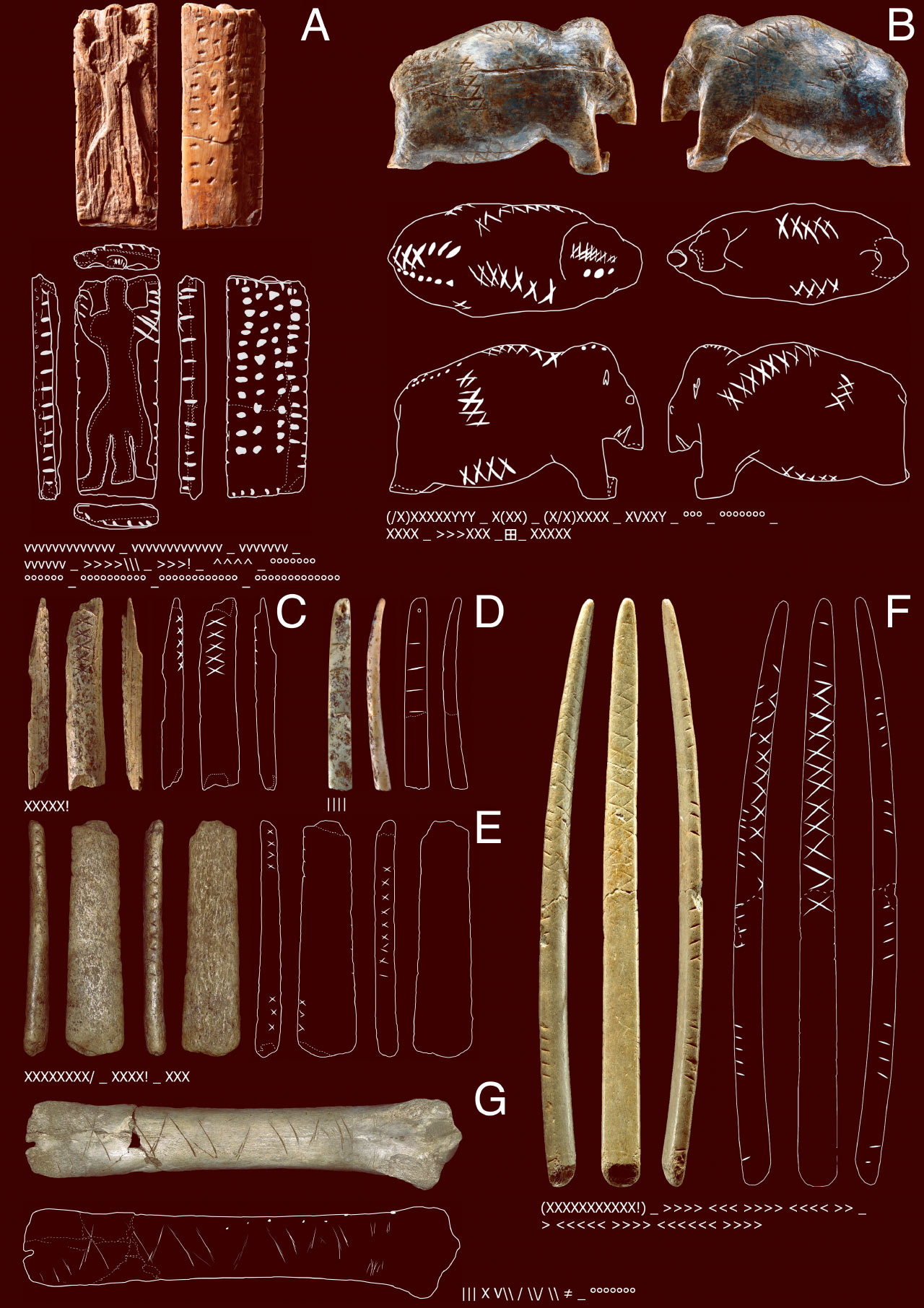
Mobile artifacts with geometric signs from the Swabian Aurignacian. Image credit: Christian Bentz & Ewa Dutkiewicz, doi: 10.1073/pnas.2520385123.
“At the beginning of the Upper Paleolithic around 45,000 years before present, modern humans arrived in Eastern and Central Europe,” said Dr. Christian Bentz, a researcher at Saarland University and the University of Passau, and Dr. Ewa Dutkiewicz from the Staatliche Museen zu Berlin.
“On their journey they encountered their distant relatives — Neanderthals.”
“In this time of migrations and population turn-overs, modern humans produced a panoply of so-called mobile objects, such as tools and figurines made of ivory, bone, or antler.”
“These are present right from the earliest period of the Upper Paleolithic, the so-called Aurignacian technocomplex.”
“Especially the Dordogne region in southwestern France, the cave systems of the Swabian Jura in southwestern Germany, and a cluster of sites in Belgium have yielded hundreds of objects adorned with sequences of geometric signs.”
In the study, the researchers analyzed a corpus of 260 mobile Aurignacian artifacts from a cluster of cave sites in the Swabian Jura.
The objects were carved from mammoth ivory, bone and antler between 43,000 and 34,000 years ago.
They include tools, beads, musical instruments and figurines of animals and humans.
Many are engraved with sequences of dots, lines, crosses and other geometric shapes.
“The people inhabiting these caves between 43,000 and 34,000 years ago have produced a specialized range of tools to cut meat, work animal hides, and create clothes and ropes,” the scientists said.
“They have developed the first musical instruments — flutes — made of bones and ivory.”
Using tools from information theory and quantitative linguistics, the authors analyzed more than 3,000 geometric signs found on the objects.
They measured features such as repetition, diversity of signs and overall information density in the engraved sequences.
“There are plenty of theories, but until now there has been very little empirical work carried out on the basic, measurable characteristics of the signs,” Dr. Bentz said.
The results were striking: statistically, the Paleolithic signs looked nothing like modern writing, which tends to avoid repetition and packs information densely.
But they closely resembled the earliest known accounting marks — protocuneiform — used in Mesopotamia around 5,500 years ago.
That similarity does not mean Ice Age Europeans were writing. Writing, in the strict sense, encodes spoken language. The Aurignacian signs do not.
Instead, the engravings represent a stable, conventional system of signs — a way to store and transmit information visually, without words.
Where the signs appeared mattered. Figurines, especially those carved from ivory, carried denser and more complex sequences than everyday tools.
Certain symbols were reserved for particular subjects: dots were commonly engraved on human and feline figures, while crosses appeared on animals like mammoths and horses, but never on human forms.
Such patterned choices suggest shared rules passed down across generations.
Over roughly 10,000 years, the researchers found, the structure of the sign system remained remarkably stable — unlike protocuneiform, which rapidly evolved into full writing as ancient economies grew more complex.
“Our analyses demonstrate that these sign sequences have nothing to do with the writing systems of today, which represent spoken languages and are characterized by high information density,” Dr. Bentz said.
“In contrast, the signs on the archaeological objects are frequently repeated — cross, cross, cross, line, line, line. This type of repetition is not a feature found in spoken language.”
“However, our findings also show that Paleolithic hunter-gatherers developed a system of symbols that has an information density that is statistically comparable to the earliest protocuneiform tablets from ancient Mesopotamia, which came 40,000 years later.”
“Sign sequences in protocuneiform script are also repetitive and the individual signs are repeated at a similar rate. In terms of complexity, the sign sequences are comparable.”
The findings add weight to a growing view among archaeologists that symbolic communication did not suddenly appear with writing, but emerged gradually, through systems designed to record numbers, events or social knowledge.
Some markings may have tracked seasonal cycles, hunting information or ritual concepts, though their exact meanings remain out of reach.
“While modern humans can access thousands of years of information and knowledge transfer that the humans of then could not, anatomically speaking, Stone Age humans had already reached a similar stage of development as modern humans,” Dr. Dutkiewicz said.
“This means they likely had similar cognitive abilities as we do. The ability to record and convey information to others was extremely important for Paleolithic humans. It may have allowed them to coordinate groups or even helped them survive.”
“They were highly skilled craftspeople. You are able to see that they carried the objects with them. A lot of the objects fit right in the palm of your hand. That is another way in which the objects are similar to protocuneiform tablets.”
_____
Christian Bentz & Ewa Dutkiewicz. 2026. Humans 40,000 y ago developed a system of conventional signs. PNAS 123 (9): e2520385123; doi: 10.1073/pnas.2520385123