An incomplete fossilized skull that has sat in the collections of the Natural History Museum of Denmark since the 19th century has turned out to represent a previously unrecognized species of glyptodont (genus Glyptotherium) that once roamed South America.
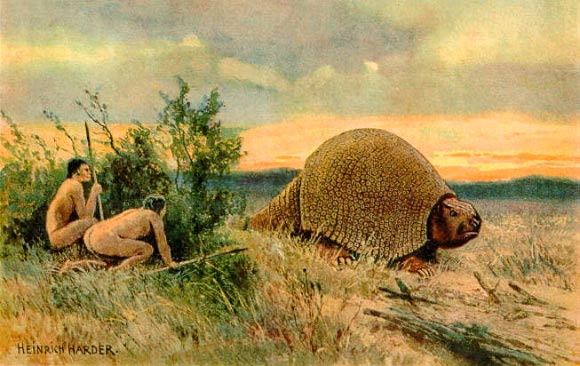
Paleo-Indians hunting a glyptodont, a relative of the armadillo that lived during the Pleistocene epoch. By Heinrich Harder, 1920.
The newly named species, Glyptotherium deuterophractum, lived between 60,000 and 17,000 years ago in a swath of South America stretching from Brazil to Venezuela.
The animal was a type of glyptodont, the extinct clade of giant, heavily armored relatives of modern armadillos, some of which grew to the size of a small car.
“Among the mammals of the Xenarthra clade known from the Brazilian Pleistocene, giant sloths and glyptodonts stand out in the fossil record,” said Universidade Federal de Pernambuco paleontologist Édison Vicente Oliveira and colleagues.
“The latter included armored herbivores characterized by a non-banded dermal bone carapace, fusion within the lumbar vertebral column, trilobed teeth, among others.”
The holotype skull of Glyptotherium deuterophractum was collected in the 19th century by Danish naturalist Peter Wilhelm Lund at the famous Lagoa Santa caves in Brazil.
Catalogued as NHMD 2045557, the specimen was later examined by another Danish scientist, Johannes Reinhardt, who in 1875 classified it as ‘Schistopleurum euphractum.’
In a new study, Dr. Vicente Oliveira and his co-authors compared the skull’s cranial features as well as glyptodont teeth, ankle bones and armor plates called osteoderms from Brazil and Venezuela with those of known glyptodont species from North and Central America.
They concluded the Brazilian animal was distinct enough to warrant its own name, Glyptotherium deuterophractum.
The species occurred in northeastern, southeastern, and northern Brazil, and its range extended into northern South America.
“Glyptotherium deuterophractum is recorded in southeastern Brazil, in the states of Minas Gerais and São Paulo; in northeastern Brazil, in the states of Rio Grande do Norte, Pernambuco, Piauí, and Alagoas; and in northern Brazil, in the states of Tocantins and Amazonas,” they said.
“The species is also recorded from northwestern Venezuela, in the state of Falcón.”
The discovery underscores how much remains to be learned from museum collections gathered generations ago, and how outdated taxonomic assumptions can obscure biodiversity that was, in effect, hiding in plain sight.
“The description of this new Brazilian glyptodontine species highlights the need for a more detailed comparison of the Venezuelan and Brazilian materials with the Glyptotherium cylindricum hypodigm,” the paleontologists said.
Their paper was published August 15 in the Journal of Mammalian Evolution.
_____
É.V. Oliveira et al. 2026. The neglected Reinhardt’s glyptodontine from Lagoa Santa, Brazil: a reassessment of taxonomic status and description of a new species of Glyptotherium. J. Mamm. Evol 33, 41; doi: 10.1007/s10914-026-09836-0