The oldest undisputed animal fossils, from the Ediacaran biota, are about 574 million years old, but chemical traces left by sponges, known as lipid biomarkers, hint that animals were around before 635 million years ago. Virginia Tech paleontologist Orin Lole Durbin and colleagues have turned to molecular clocks, which use genetic differences between living species to estimate when lineages split, to try to settle the matter.
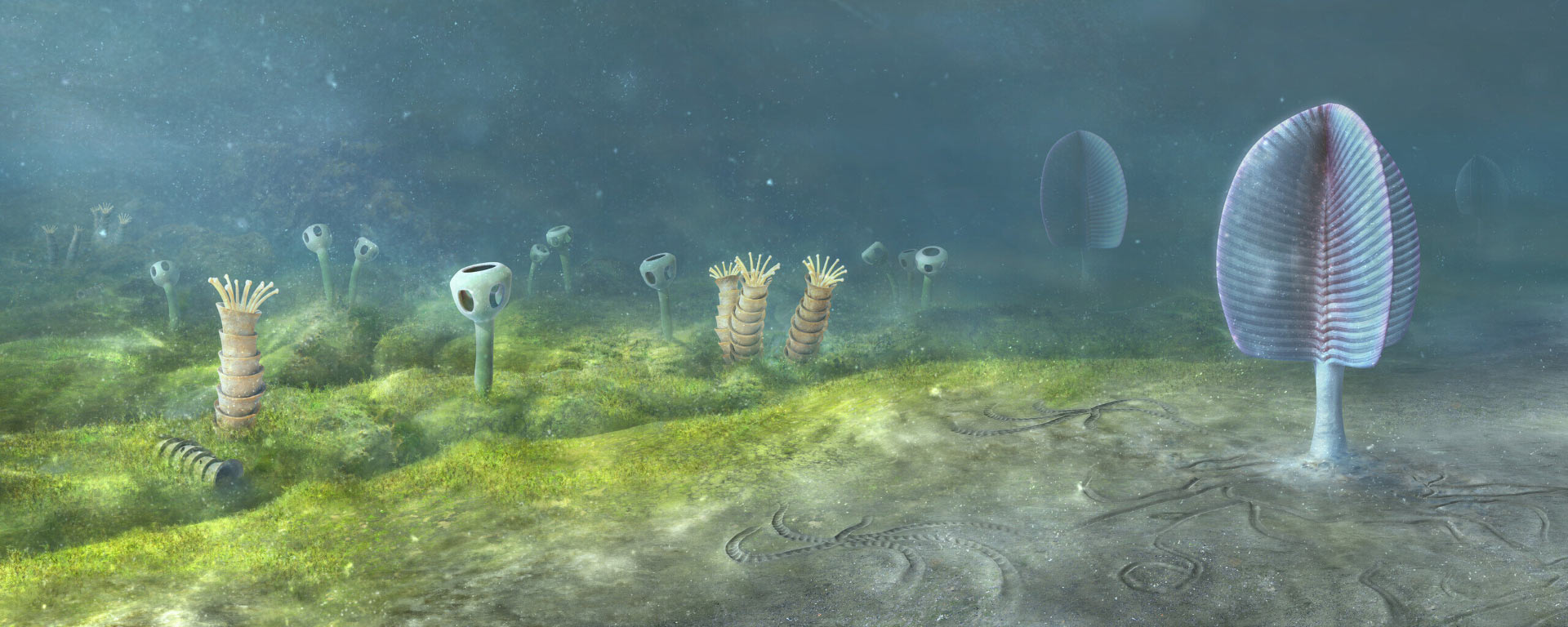
Sea floor in the Ediacaran of Namibia, 543 million years ago. Image credit: Museum of Natural History, University of Oxford / Mighty Fossils.
“The timing of the origin of animals on Earth has puzzled scientists for centuries,” Lole Durbin and co-authors said.
“Unambiguous macrofossil evidence of animals extends only to the earliest examples of the Ediacara Macrobiota, dated to 574 million years ago, and the microfossil record likewise does not record definitive animals until the Ediacaran.”
“Lipid biomarkers, however, suggest animals were present during the terminal 10 to 20 million years of the Cryogenian (717 to 635 million years ago).”
“Recent analyses indicate that signatures specific to sponges are preserved in sufficient abundance in Neoproterozoic rocks to support their presence. This represents a stark dichotomy.”
In a new study, the authors aimed to reexamine geological deposits used to establish the maximum possible age of animals.
They argue that some relatively young deposits previously used for this purpose may be unreliable because the absence of animal fossils does not necessarily mean animals had not yet evolved.
The oldest unambiguous animal body fossils date to about 574 million years ago, near the beginning of the Ediacaran period.
But chemical traces preserved in ancient rocks have been interpreted as evidence that animals, including sponges, existed considerably earlier, during the Cryogenian period, more than 635 million years ago.
To test the reliability of one commonly used molecular-clock calibration, the researchers examined the Kheseen Biota, a collection of phosphatized microfossils from Mongolia.
The assemblage dates to roughly 550-526 million years ago, a time when animals were already present elsewhere, yet it contains no fossils that can confidently be identified as animals.
The Kheseen fossils are preserved in a manner comparable to those of the Weng’an Biota of China, which has been used as a maximum calibration for the origin of animals.
“The Kheseen Biota breaks the argument that the exceptional microfossils of Weng’an mean we would have seen animal fossils in the assemblage had they existed at the time,” said Dr. Ross Anderson, a researcher at the Oxford University’s Museum of Natural History.
“The Kheseen microfossils are just as well-preserved, yet animals continue to be absent — despite the fact we know at that point they existed.”
The scientists found that the two assemblages share several fossil species and have similarly detailed preservation.
Because animals were already evolving when the Kheseen sediments accumulated, their absence from the assemblage cannot simply be taken as evidence that animals did not yet exist.
This finding calls into question the use of the Weng’an Biota as a maximum calibration for the origin of animals.
Lole Durbin, Dr. Anderson and their colleagues argue that ecological or fossilization conditions could explain why animals are absent from both assemblages.
When they substituted older, Tonian-age deposits for the younger Ediacaran calibrations, molecular-clock analyses produced much older estimates for the emergence of animals.
Depending on the calibration, estimates for the origin of crown-group animals extended into the range of roughly 800 to 700 million years ago.
“Pre-Ediacaran animal body fossils still elude us, and this analysis does not prove that animals existed 800 million years ago,” Lole Durbin said.
“However, our new fossil evidence from Mongolia undermines one of the main arguments for restricting animal origins to the Ediacaran interval.”
“Meanwhile, our molecular-clock analyses show how much further back their evolutionary history could extend.”
“Future work should explore fossil deposits from different parts of the world, representing different environments and modes of fossilization, in the search for animals.”
“This should also consider all available evidence for animals, including body fossils, traces of their activity and chemical biomarkers.”
“Until that evidence becomes available, the precise birth date of the animal kingdom remains uncertain,” Dr. Anderson.
The study was published today in the journal Science Advances.
_____
Orin M. Lole Durbin et al. 2026. Re-evaluating molecular clock maximum age calibrations revives pre-Ediacaran divergence estimates for animals. Science Advances 12 (40); doi: 10.1126/sciadv.aeg6289