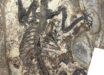
Fossils from southeastern France reveal a previously unknown, roughly 2.5-m (8-foot) long tethysaurine mosasaur that appears to have lived in a freshwater lake, not the sea.
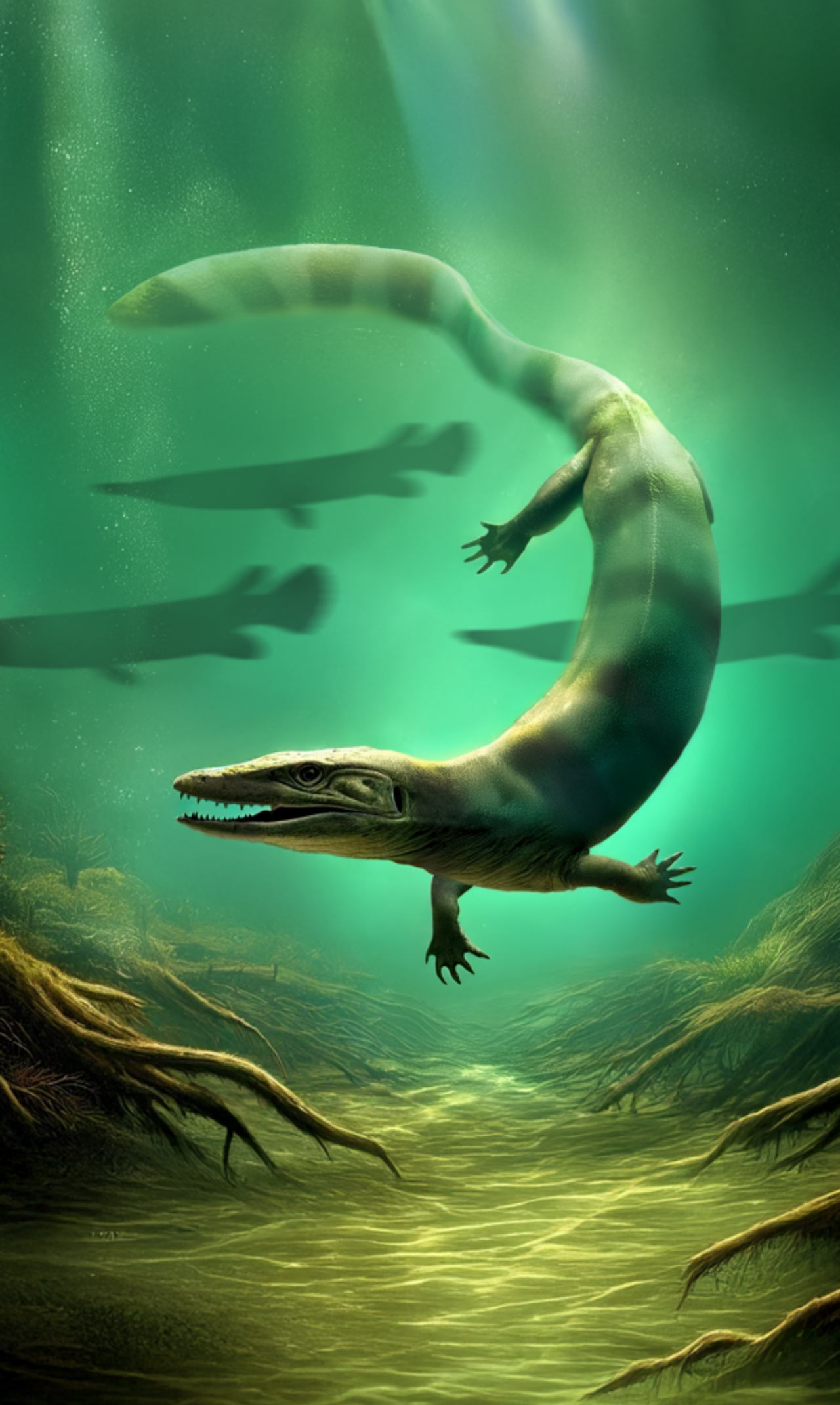
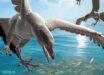
An artist’s impression of Garamaudo bauciensis. Image credit: Bardet et al., doi: 10.24072/pcjournal.804.
Garamaudo bauciensis lived in what is now Europe during the Santonian age of the Late Cretaceous, roughly 84 million years ago.
The species was a type of the tethysaurine, a group of early mosasaurs within the superfamily Mosasauroidea.
“Mosasauroidea is an extinct group of aquatic squamates that invaded and diversified in the aquatic environment at the beginning of the Cenomanian, spreading worldwide from the Santonian to the end of the Maastrichtian, and becoming extinct during the biological crisis of the end-Cretaceous mass extinction,” said lead author Dr. Nathalie Bardet and Dr. Alexandra Houssaye from France’s National Museum of Natural History and their colleagues.
“They possess elongated skulls and bodies, and long, laterally compressed tails. They encompass a high diversity of sizes, from 1 to 15 m (3.3-50 feet) in length, in ecology, from freshwater, shallow marine to open waters, and in diet, from mollusks and arthropods to large fish and reptiles.”
“Most mosasauroids possess a morphology strongly modified for an aquatic lifestyle, with paddles and the loss of connection between the vertebral column and the pelvis — that is, the absence of a true sacrum.”
“More primitive forms display limbs looking adapted for a terrestrial locomotion and a sacrum, illustrating a plesiopedal and plesiopelvic condition.”
“Most mosasauroid remains are from marine deposits,” they added.
“However, a few species and undetermined mosasauroid remains have been encountered in freshwater environments, such as shallow estuarine and fluvial deposits.”
“Particularly common are freshwater occurrences in the Santonian-Campanian continental deposits of Europe, from Portugal to Hungary and Austria, passing through southern France.”
Garamaudo bauciensis’ fossilized remains were found in 1997 at the Bouc-Bel-Air – Sousquières locality in the city of Bouc-Bel-Air, Provence, southeastern France.
The fossils include part of a lower jaw, vertebrae, ribs, a pelvis and a humerus. They comes from at least four individuals, though most of it appears to belong to one.
“The Bouc-Bel-Air – Sousquières locality represents a freshwater ecosystem, probably a moderately eutrophic, carbonate-producing lake periodically influenced by flooding and shallowing events, within the continental deposits of the Aix-en-Provence Basin,” the paleontologists said.
“Such rapid flooding episodes could explain the state of preservation of the holotype specimen of Garamaudo bauciensis, which includes broken bones having however well-preserved surfaces.”
Garamaudo bauciensis was about 2.5 m long and, unlike the better-known mosasaurs, kept limbs that look suited to walking on land, along with a pelvis firmly attached to the spine.
Its ribs were long and straight, suggesting a deep but narrow, side-to-side flattened body.
The researchers suggest the animal swam by undulating like an eel.
CT scans showed thick, compact bone in the vertebrae, ribs and humerus, a trait they link to buoyancy control.
They propose that Garamaudo bauciensis could dive to shallow depths and may have been an ambush predator, but the density of its bones seems incompatible with life on land.
The animal was probably among the top predators in its ecosystem, possibly feeding on small fish, reptiles or amphibians, though its diet remains unknown.
“The assignment of this new freshwater mosasaurid to the tethysaurines highlights an additional occurrence of a freshwater species in this clade and the fact that, based on current knowledge, it is only within the Tethysaurinae that freshwater forms evolved among mosasaurids,” the scientists said.
“During the same period, hydropedal and hydropelvic mosasaurs with a higher growth rate and spongious bones, indicating an active carangiform swimming mode, evolved and radiated in open marine environments, spreading throughout the world.”
“This new discovery therefore contributes to a better understanding of a more diverse and complex evolution and history of post-Turonian mosasaurids, including more extensive niche partitioning than previously realized.”
The study was published on September 28, 2026 in the Peer Community Journal.
_____
N. Bardet et al. 2026. Garamaudo bauciensis, a new freshwater mosasaurid (Reptilia, Squamata) from the Santonian (Late Cretaceous) of Provence, southeastern France. Peer Community Journal 6: e99; doi: 10.24072/pcjournal.804