New observations of 21 extreme debris disks suggest the dust comes from violent impacts between planet-building bodies, and could even flag star systems in the midst of a planetary shake-up.
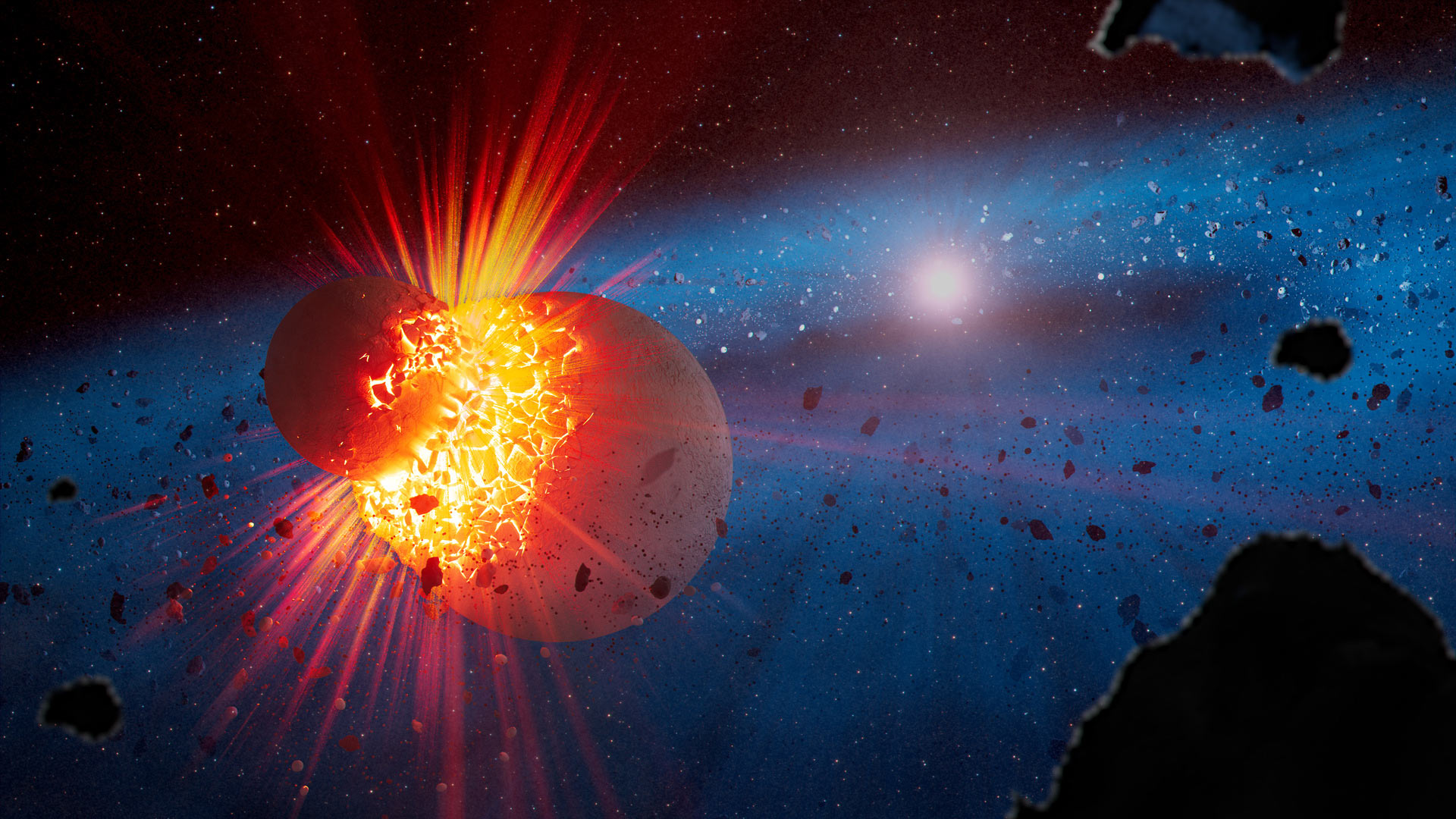
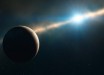
The types of collisions within young stellar systems known as extreme debris disks are relevant to scientists’ understanding of our own Solar System, which is thought to have undergone similar impact events that created our Moon and shaped Earth’s initial state. Image credit: NASA / ESA / CSA / Joseph Olmsted, STScI.
“This is the first time we have gathered enough systems to truly understand this subclass that we call extreme debris disks,” said lead author Dr. Kate Su, an astronomer at the Space Science Institute.
“Before Webb, we had limited information. We knew that they are weird and very different from the typical cold debris disks that we know, like Vega and Fomalhaut.”
“Now that we have more data, we can pin down what these disks represent for planet formation and evolution.”
The astronomers analyzed mid-infrared spectra of 21 extreme debris disks (EDDs): 16 from the Mid-Infrared Instrument aboard the NASA/ESA/CSA James Webb Space Telescope and five from NASA’s Spitzer Space Telescope.
For 12 of the systems, complete mid-infrared spectra were obtained for the first time.
The dust is unlike that in typical planet-forming or older debris disks. EDD grains are mostly submicron in size, smaller than the few-micron grains that dominate protoplanetary disks, and there is far more of it in optically thin form.
The grains also show signs of having been heated and altered, including high levels of crystalline silicates and, in some systems, silica.
Eight of the 21 systems, about 38%, were classified as silica-rich. Fewer than 10% of protoplanetary disks fall into this category.
The researchers propose that the silica forms when impacts vaporize rock and the vapor quickly condenses, a process similar to how glassy spherules form in impact debris on Earth and the Moon.
Crystalline silicates such as forsterite can form through condensation or through annealing, where existing dust is heated and restructured.
According to the authors, silica-rich disks arise from collisions between large planetary embryos comparable to Mars.
Silica-poor disks, rich in crystalline silicates, would come from less energetic impacts, likely between smaller, Moon-sized bodies or from low-velocity grazing hits.
“To just see their mid-infrared emission and beautiful spectral features with Webb, which allowed us to identify their compositions, was the most exciting thing for me,” said Dr. Agnes Kospal, an astronomer at Konkoly Observatory.
“We have no other way to study these planetary embryos directly because they are too small.”
Silica-rich EDDs appear only around stars younger than about 300 million years, consistent with simulations in which the giant-impact phase of terrestrial planet formation fades after a few hundred million years.
Three EDDs in the sample are older than 300 million years, and all three are silica-poor with very strong 10-micron features.
The team suggests such systems, as well as other silica-poor disks with very large amounts of small grains, may be signposts of late dynamical instability, when planets or other bodies rearrange their orbits and stir up smaller objects.
“How rocky planets formed and giant planets evolved are part of the broader story of the Solar System’s formation. It’s all one story,” Dr. Su said.
“Our work on extreme debris disks helps us bring together the big picture of what we currently understand.”
The findings appear in the Astrophysical Journal.
_____
Kate Y. L. Su et al. 2026. Extreme Debris Disks: Insights into Violent Collisions in Planet Formation and Destruction. ApJ 1010, 1; doi: 10.3847/1538-4357/ae88fe