In ferromagnets, like a refrigerator magnet, atomic spins line up in the same direction. In antiferromagnets, neighboring spins point in opposite directions and cancel each other out. Now physicists reports experimental evidence for a material that blends features of both: a cobalt-intercalated tantalum diselenide (Co1/4TaSe2) that appears to be an altermagnet.
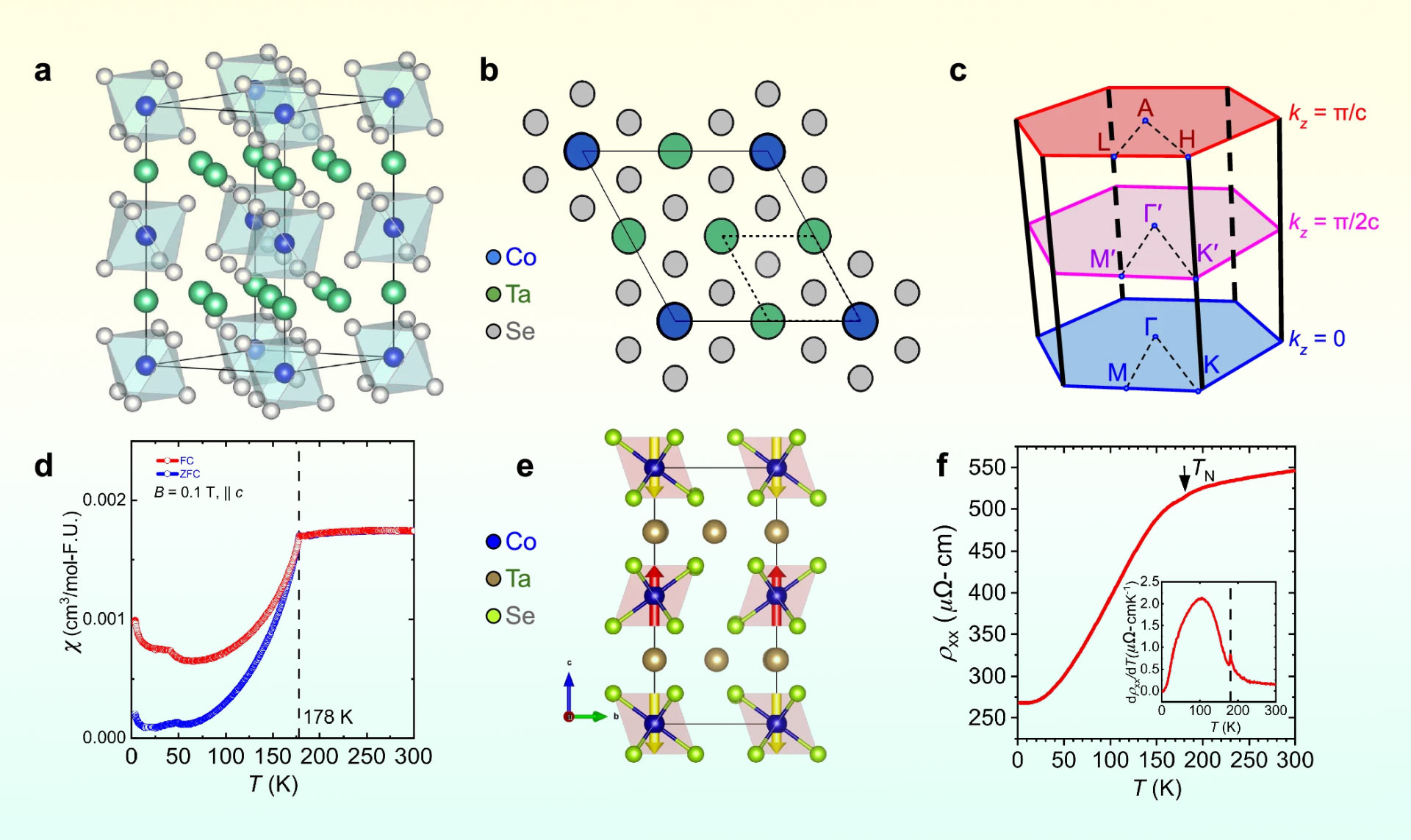
Establishment of altermagnetic crystal and magnetic structure in Co1/4TaSe2. Image credit: Sprague et al., doi: 10.1038/s41467-026-76784-x.
Altermagnets, a class theorists have described only in recent years, have no net magnetization, like antiferromagnets.
But their electrons behave as if the material were magnetic, with the energy of electrons depending on their spin and direction of travel.
This combination is attractive for spintronics, the effort to build faster, more efficient electronics that use electron spin rather than just charge. Because altermagnets produce no stray magnetic fields, devices made from them could in principle be packed closely without interfering with one another.
“Ferromagnetism produces the behavior most people associate with everyday magnets,” said senior author University of Central Florida’s Professor Madhab Neupane and colleagues.
“In these materials, magnetic moments align in the same direction, creating a magnetic field. That property can be useful in electronics, but the resulting stray magnetic fields can interfere with nearby components.”
“Antiferromagnets behave differently. Their magnetic moments point in opposing directions and cancel one another out, largely avoiding the stray fields. However, they lack some of the useful electronic properties found in ferromagnets.”
“Altermagnets offer another possibility by combining desirable characteristics of both,” they added.
“Like antiferromagnets, they can avoid producing unwanted stray magnetic fields. But they can also generate and detect spin currents — the movement of electron spins through a material — that researchers hope to use for future electronics.”
In the study, the researchers used a technique called angle-resolved photoemission spectroscopy, which maps how electrons move inside a crystal, including measurements that distinguish between spin ‘up’ and spin ‘down’ electrons.
They first detected a characteristic splitting in the electronic bands of Co1/4TaSe2.
They then used spin-resolved angle-resolved photoemission spectroscopy to take a closer look and found that those split states carried opposite spin polarizations, key evidence of altermagnetism.
“The significance became clear once the experimental measurements consistently matched our theoretical predictions,” Professor Neupane said.
“Seeing those independent pieces of evidence converge gave us confidence that we had identified a genuine layered altermagnet.”
According to the scientists, the material is distinctive because it is a layered, van der Waals crystal, which could make it easier to combine with other exotic materials, such as superconductors, in layered devices.
Other altermagnet candidates studied so far, mainly manganese telluride and chromium antimonide, are not layered in this way.
“Evidence for altermagnetism in a versatile materials platform opens a lot of new possibilities,” said first author Milo Sprague, also from the University of Central Florida.
“There’s currently a lot of debate in altermagnetic theory about how the spin-polarized electronic states interact with other magnetic phenomena.”
“Now we have a material that we can easily modify to explore these new questions.”
The team’s work was published in the journal Nature Communications.
_____
M. Sprague et al. 2026. Observation of Altermagnetic Spin-Splitting in an Intercalated Transition Metal Dichalcogenide. Nat Commun 17, 9935; doi: 10.1038/s41467-026-76784-x