Named Plumadraco bankoorum, the newly-described species of enantiornithine bird lived in what is now northeastern China during the Cretaceous period, roughly 121 million years ago.
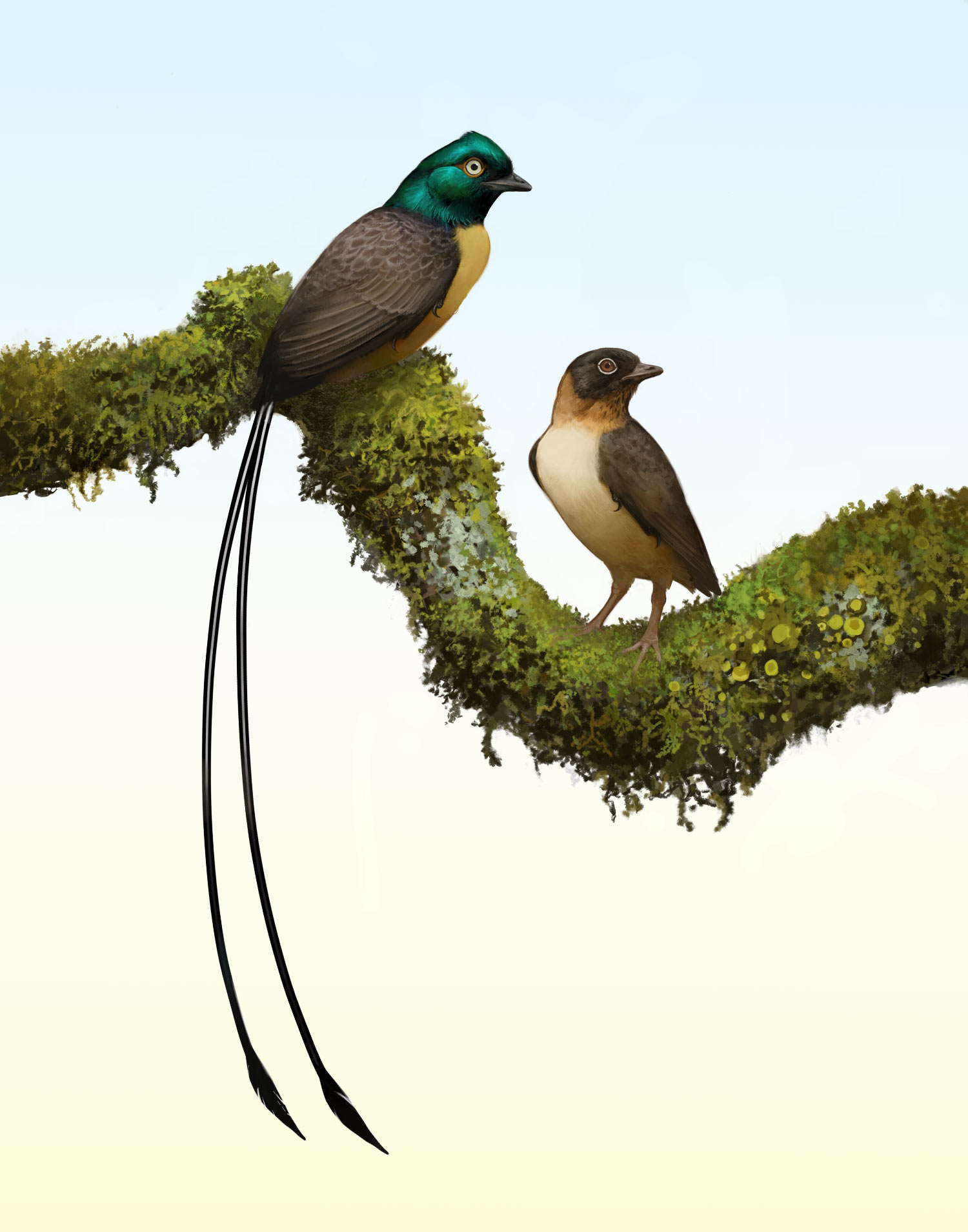
Plumadraco bankoorum is a new bohaiornithid enantiornithine bird with a pair of exceptionally long rectrices. Image credit: Ville Sinkkonen.
Plumadraco bankoorum belonged to the enantiornithines, the most diverse clade of birds during the Cretaceous period, a group that went extinct alongside the non-avian dinosaurs.
While many enantiornithines are known to have carried elongated tail feathers, none previously documented came close to this bird’s proportions.
“Enantiornithines were the most speciose clade of Mesozoic birds, with over 100 genera described to date and specimens recovered from all continents except Antarctica,” said lead author Alex Clark, a Ph.D. candidate at the Field Museum and the University of Chicago, and colleagues.
“Spectacular preservation of enantiornithine specimens from the Early Cretaceous Jehol Biota (130-120 million years ago) in northeastern China often includes soft tissue structures, most commonly in the form of feathers.”
“Body (contour) feathers, followed by remiges, are the most prevalent, with those of the tail (rectrices) being comparatively rare.”
“The majority of enantiornithine specimens preserving soft tissues lack tail feathers all together, and instead only have body contour feathers covering the tail region — a condition absent among all living neornithines.”
Plumadraco bankoorum measured just 14.9 cm (6 inches) from beak to tail, but its twin tail feathers were 29.3 cm (11.5 inches) long.
The tail feathers of the closest rival, Junornis, reached only about 1.6 times its body length.
“Plumadraco bankoorum was the size of an American robin, but its tail feathers were about a foot long, twice the length of its body,” Clark said.
“They’re some of the proportionally longest tail feathers ever found in a fossil bird.”
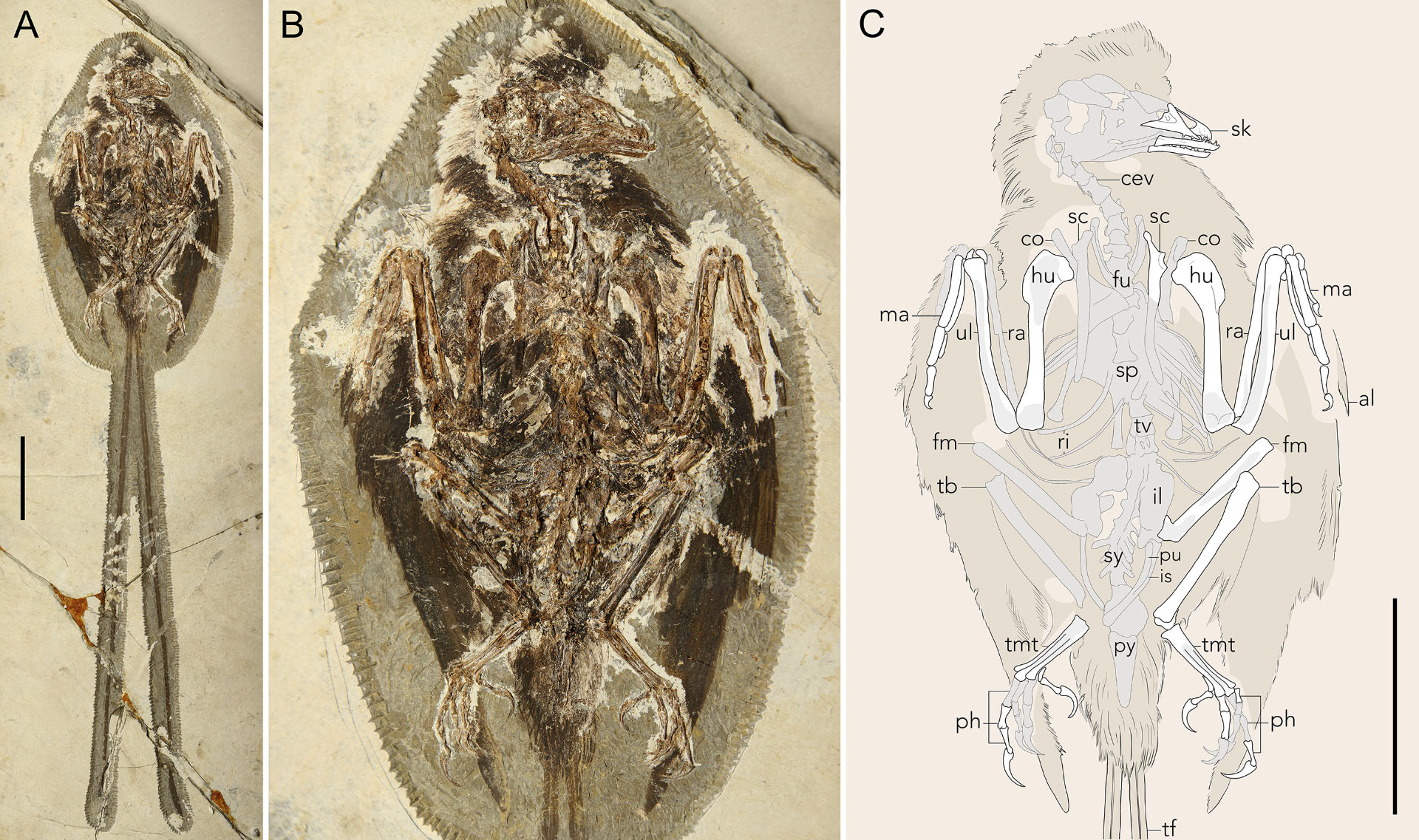
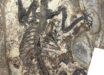
The holotype specimen of Plumadraco bankoorum. Image credit: Clark et al., doi: 10.1371/journal.pone.0347641.
The paleontologists argue that Plumadraco bankoorum was almost certainly male, and that such elaborate plumage evolved under pressure from female mate choice — a dynamic well-documented in modern birds.
The ground-nesting habits attributed to enantiornithines would have favored cryptic, inconspicuous plumage in females tending nests, leaving males free to evolve ever more extravagant ornaments.
“There are many examples of both male and female modern birds with long, showy feathers, but there seems to be this certain threshold where, if feathers reach a certain proportional length, then it tends to be a trait that males have developed in order to attract females,” Clark said.
“Plus, the fossils of some other enantiornithine birds show remnants of muscle tissue along the tail region, and based on those muscles, birds like Plumadraco bankoorum would have had pretty limited movement for their tails.”
“However, they could pump their tail feathers up and down, and that’s a behavior that we see across birds today that do courtship displays only in males.”
The researchers also learned about the color of Plumadraco bankoorum’s tail feathers.
Using a handheld mass spectrometer, they analyzed the chemical makeup of the fossil.
Based on the concentrations of different chemicals present, a chemical instrument that looks a little like a ray gun’s feathers were probably dark brown, or black.
It’s possible that there was some sort of eye-catching color at the tips of its tail feathers — maybe something iridescent or blue, since those colors are produced by the structure of the cells rather than by the pigments whose chemical signatures were measured in the study.
These insights into Plumadraco bankoorum’s physiology and behavior help scientists better understand birds today.
“This fossil, maybe more than any other fossil bird that’s ever been discovered, shows that birds have been evolving costly, elongate, specialized features to attract mates for a long, long time,” Clark said.
“Based on these fossils, female choice in selecting ornamented males has been playing a huge part in how birds look and behave for more than 120 million years.”
The discovery of Plumadraco bankoorum is described in a paper published online in the journal PLoS ONE.
_____
A.D. Clark et al. 2026. Hyperelongate ornamental tail feathers in a new early Cretaceous enantiornithine bird. PLoS One 21 (5): e0347641; doi: 10.1371/journal.pone.0347641