Scientsts from the United States, Europe and China have used the Ultraviolet Spectrograph (UVS) onboard NASA’s Juno spacecraft to map detailed patch structures in Ganymede’s aurorae that parallel those seen on Earth. Their findings indicate that the interplay between magnetic fields and charged particles may be a universal engine for auroral lights, with implications for understanding magnetospheres across the Solar System.

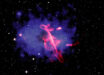
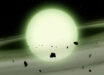
An artist’s concept of aurorae on Jupiter’s moon Ganymede. Image credit: NASA / ESA / G. Bacon, STScI / J. Saur, University of Cologne.
Ganymede, the only moon known to possess its own intrinsic magnetic field, sustains a miniature magnetosphere embedded within that of Jupiter.
Its aurorae arise primarily from oxygen emissions at wavelengths of 130.4 and 135.6 nm, excited by precipitating electrons.
In new research, University of Liège researcher Philippe Gusbin and his collleagues analyzed ultraviolet observations of Ganymede recorded on June 7, 2021, by the Juno spacecraft.
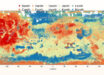
They identified multiple auroral patches on the moon’s leading, downstream hemisphere.
The patches have typical sizes of about 50 km and brightnesses reaching approximately 200 Rayleigh.
“Aurorae are also observed on Ganymede and are caused by the precipitation of electrons in its thin oxygen atmosphere,” Gusbin explained.
“Observations of Ganymede’s aurorae prior to Juno were limited by the spatial resolution of ground-based observations, and they could not resolve the small-scale structures typical of planetary aurorae.”
The morphology and scale of the features resemble auroral ‘beads’ seen at Earth before magnetospheric substorms and at Jupiter during so-called dawn storms.
The apparent absence of similar patches in the southern hemisphere is attributed to viewing geometry, although asymmetries related to Ganymede’s position within Jupiter’s plasma disk cannot be ruled out.
“The ‘beads’ have been observed in the aurorae of Earth and Jupiter, where they are linked to sub-storms and dawn storms, large-scale rearrangements of the magnetosphere that release enormous amounts of energy and produce intense auroral activity,” said Dr. Alessandro Moirano, a postdoctoral researcher at the University of Liège and the National Institute for Astrophysics in Rome.
The findings suggest that comparable physical mechanisms may operate across magnetospheres despite vast differences in scale and environment.
“Juno’s close observations of Ganymede lasted less than 15 minutes, and the spacecraft will never fly over Ganymede again. Therefore, we do not know how common these patches are or how they evolve over time,” said Dr. Bertrand Bonfond, an astrophysicist at the University of Liège.
“Fortunately, ESA’s Juice (Jupiter Icy Moons Explorer) mission is currently on its way to Jupiter, where it will arrive in 2031, and will carry out dedicated observations of Ganymede.”
“The spacecraft is equipped with an ultraviolet spectrograph similar to Juno’s: this will allow us to collect observations over longer periods, monitor the evolution of Ganymede’s aurorae and, hopefully, uncover new mysteries.”
A paper on the findigns was published in the journal Astronomy & Astrophysics.
_____
A. Moirano et al. 2026. Juno’s high-spatial-resolution ultraviolet observations of Ganymede’s auroral patches. Constraints on the magnetospheric source region. A&A 706, L16; doi: 10.1051/0004-6361/202558379