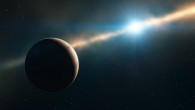
For the first time, astronomers have directly detected radio emission from a planet beyond our Solar System.
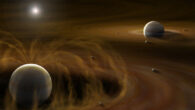
This artist’s impression shows how the gas...
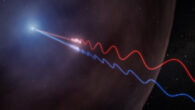
Using NSF’s Very Large Array (VLA), astronomers made the first radio detection of polarized light and Faraday rotation from a gamma-ray burst afterglow,...
By tracking fierce winds racing through the atmospheres of seven ultra-hot Jupiters, astronomers have uncovered the strongest evidence yet that magnetic...
An international research team led by scientists from the University of Bonn, the University Hospital Bonn and the Max Planck Institute of Animal Behavior...
New gamma-ray observations from NASA’s Fermi Space Telescope suggest ultra-magnetic neutron stars called magnetars could be fueling superluminous supernovae,...
A new high-precision calculation of a key component underpinning the magnetic moment of the muon, a heavier cousin of the electron, brings theory and experiment...
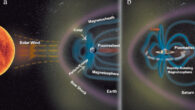
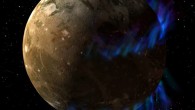
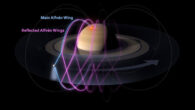
The Jovian system has four large moons, including the largest moon in the Solar System, Ganymede, whereas the Saturnian system is dominated by one giant...
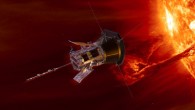
A new analysis of data from NASA’s Parker Solar Probe shows that protons and heavy ions react differently to solar magnetic reconnection events, suggesting...
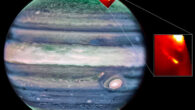
The NASA/ESA/CSA James Webb Space Telescope conducted a clockwise scan around the entire limb of Jupiter, chasing aurora as it rotated into view. This...
Scientsts from the United States, Europe and China have used the Ultraviolet Spectrograph (UVS) onboard NASA’s Juno spacecraft to map detailed patch...
A new analysis of data from four instruments aboard NASA’s Cassini spacecraft has demonstrated the crucial role that Saturn’s small icy moon Enceladus...
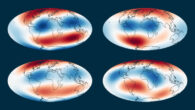
Two immense, ultrahot rock structures located at the base of Earth’s mantle, around 2,900 km beneath Africa and the Pacific, have been shaping Earth’s...
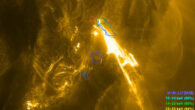
New high-resolution observations by ESA’s Solar Orbiter mission show that solar flares are driven by cascading magnetic reconnection events, unleashing...
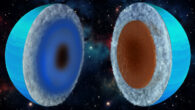
The composition of Uranus and Neptune might be less icy than previously thought, according to a new study by University of Zürich scientists.
Uranus could...
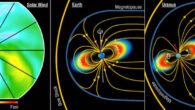
In 1986, NASA’s Voyager 2 provided the only direct measurement of the radiation environment at Uranus. These findings established the well-accepted characterization...
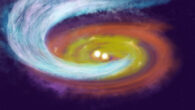
This streamer of gas is channeling matter from the surrounding cloud of a star-forming region in Perseus directly onto a newborn binary star system called...
Any image we have ever seen of the Sun was taken from around the Sun’s equator. This is because Earth, the other planets, and all other operational spacecraft...
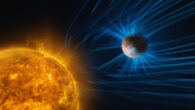
In new research, astronomers using the NASA/ESA Hubble Space Telescope searched for signs of interactions between the magnetic environment and the surfaces...