Bees are the most significant pollinators of flowering plants. This partnership began approximately 120 million years ago, but the uncertainty of how and...
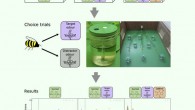
A new study published in the journal eLife elucidates the honeybee’s behavioral strategy to associate sensory cues with rewards of different values....
New research shows how the nematode Caenorhabditis elegans, a long-used model organism, can use electric fields to ‘jump’ across Petri plates or onto...
The rusty patched bumblebee (Bombus affinis) is an important pollinator in North America and a federally listed endangered species. Putting together its...
In a new study published today in the journal Scientific Reports, a duo of researchers at the University of Maryland found that the median lifespan of...
Entomologists have described a new species of the neotropical orchid bee genus Eufriesea from the Islas Marías of Nayarit State, México in the Pacific.
Eufriesea...
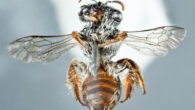
Curtin University researcher Kit Prendergast has named the new bee species Leioproctus zephyr, after her pet dog Zephyr after noticing a protruding part...
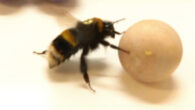
New research led by Queen Mary University of London shows that rolling of wooden balls by buff-tailed bumblebees (Bombus terrestris) fulfils behavioral...
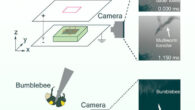
The Earth’s atmosphere is always electrified to a greater or lesser extent, even in fair weather away from thunderstorms. By measuring the electrical...
New research led by China’s Southern Medical University suggests that bumblebees are only able to make use of ordinal ranking memories to guide foraging...
Insects are traditionally thought to respond to noxious stimuli in an inflexible manner, without the ability to modulate their behavior according to context....
A team of researchers at the Auckland University of Technology has profiled the chemical composition of New Zealand honeydew honey and compared its antioxidant...
New research shows that honeybees (Apis mellifera) can visually acquire the capacity to differentiate between odd and even quantities of 1-10 geometric...
The honeybee tongue, foraging liquid food in nature, has a unique segmented surface covered with dense hairs. Since honeybees are capable of using their...
A team of scientists from Jiangnan University, Queen Mary University of London and the University of Oulu has identified a causal link between an increased...
An international team of researchers has documented the unique vibroacoustic signals the eastern honeybees (Apis cerana) use to alert members of their...
A Hox gene, a major developmental gene that regulates the identity of structures on the segments of black-tailed bumblebees (Bombus melanopygus), turns...
Organic chemists at the University of Queensland have found that an unusual bioactive disaccharide called trehalulose, which is a feature of stingless...
Chemists have analyzed protein diversity in venom produced by Apis mellifera ligustica in the marri (Corymbia calophylla) ecosystem in southern-western...
Caffeine is a widely occurring plant defense chemical that occurs in the nectar of some plants, e.g., coffee and citrus, where it may influence pollinator...