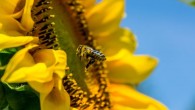
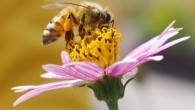
A team of scientists has identified 27 new viruses that infect European honeybees (Apis mellifera) and other bee species.
Galbraith et al identified 27...
A team of scientists from Oregon State University and the University of Minnesota, Saint Paul, has learned that blue fluorescent light in the 430- to 480-nm...
The honeybee (Apis mellifera) has joined the ranks of dolphins, parrots, and primates, in demonstrating the ability to understand the concept of zero numerosity....
Although using flashy colors as camouflage may seem counterintuitive, iridescence obstructs the bumblebee’s ability to identify shape, according to a...
Bigger honeybee colonies actually have quieter combs than smaller ones, according to a team of researchers at Cornell University, Ithaca.
Larger honeybee...
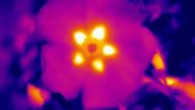
A wide range of flowers produce not just signals that we can see and smell, but also ones that are invisible such as heat. According to new research from...
Honeybees (Apis mellifera) have individually distinct biases in ‘left- and right-handedness’ when flying through obstacles, according to new research...
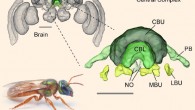
According to a new study led by Lund University scientist Stanley Heinze, a network of compass and speed neurons in the bee brain integrates every detail...
A new study by researchers at the University of Adelaide and Lund University that appears online today in the journal Scientific Reports suggests that...
After only nine generations, the same plant species is larger and more fragrant if pollinated by bumblebees rather than flies, according to University...
String pulling is a popular problem-solving task for investigating cognitive abilities in apes and birds, but has never been tested in insects. Now, buff-tailed...
A team of entomologists led by Utah State University researcher Dr. Michael Orr has described an unusual new species of bee from the deserts of the southwestern...
A team of entomologists has captured Australian blue-banded bees’ unique approach to pollination – headbanging flowers up to 350 times a second.
The...
Bee products were exploited continuously at least from the seventh millennium BC, according to a multinational team of scientists led by University of...
A team of entomologists has discovered that a stingless bee species from Brazil feeds its larvae on a special type of fungus grown in the nest.
Brazilian...
According to a new paper in the journal Current Biology, honeybees may select caffeinated nectar over an uncaffeinated but otherwise equal-quality alternative....
A new study published online in the journal PLoS ONE has found significant contamination of bumblebee pupae by the metal aluminum — a known neurotoxin...