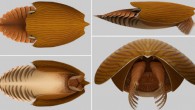
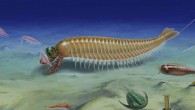
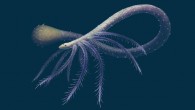
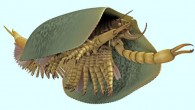
Balhuticaris voltae is the largest bivalved arthropod to date, at almost double the size of the previous record-holder, Nereocaris exilis.
Life reconstruction...
Erratus sperare, a new species of ancient marine arthropod from eastern Yunnan, China, had unique trunk appendages that represent an intermediate stage...
A new genus and species of palaeoscolecid worm has been identified from two specimens found in the Burgess Shale-type deposits in Utah, the United States.
Arrakiscolex...
Paleontologists have described the largest Cambrian hurdiid radiodont known so far, named Titanokorys gainesi, from the Burgess Shale, British Columbia,...
Paleontologists have described two new species from the Cambrian period of Utah, which illuminate the early evolution of nervous and sensory features in...
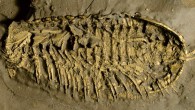
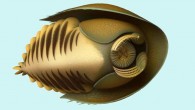
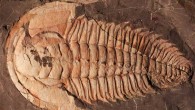
Trilobites had well-developed gill-like structures in their upper leg branches, according to a new imaging study led by the University of California, Riverside.
Trilobite...
Paleontologists have described the first three-dimensional preservation of soft tissue in Namacalathus hermanastes, a skeletal metazoan (multicellular...
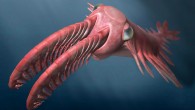
A team of paleontologists from Australia and the United Kingdom has found that ancient deep-sea creatures called radiodonts developed sophisticated eyes...
Paleontologists in China have uncovered exceptionally preserved fossils of a previously unknown genus and species of extinct arthropod, Kylinxia zhangi,...
An enigmatic worm-like animal called Facivermis yunnanicus lost lower limbs for tube-dwelling lifestyle, according to new research published in the journal...
A new species of marine predator that lived about 506 million years ago (Cambrian period) has been identified from exceptionally well-preserved fossils...
Paleontologists have unearthed fossils of a giant trilobite species that inhabited Australian waters approximately 500 million years ago (Cambrian period).
An...
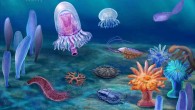
Animal life exploded in diversity and form during the Cambrian period about 500 million years ago. An international team of paleontologists has discovered...
According to a new study to be published in the Proceedings of the National Academy of Sciences, the first plants to colonize the Earth originated around...
A new species of bristle worm that lived about 508 million years ago (Cambrian period) has been identified from fossils found in Marble Canyon and Burgess...
Habelia optata, a close relative of the ancestor of modern-day spiders, scorpions and horseshoe crabs, evolved an extremely complex head to hunt and eat...
Exceptionally well-preserved trilobite fossils from the Cambrian Wulongqing Formation near Guangwei Village in southern Kunming, the capital city of Yunnan...
A microscopic, bag-like marine creature that lived approximately 540 million years ago (Fortunian stage of the Cambrian period) has been identified from...
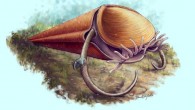
Paleontologists have finally determined what hyoliths — a group of extinct marine creatures — actually are.
Reconstruction of the hyolith Haplophrentis...