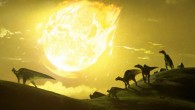
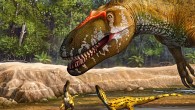
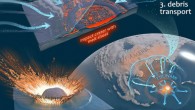
About 66 million years ago, a 10-km-wide asteroid crashed into Earth near the site of the small town of Chicxulub in what is now Mexico. The impact unleashed...
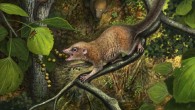
The end-Cretaceous mass extinction 66 million years ago was characterized by a worldwide ecological catastrophe and rapid species turnover. Arboreal (tree-dwelling)...
About 66 million years ago, a massive asteroid crashed into Earth near the site of the small town of Chicxulub in what is now Mexico. The impact eradicated...
Paleontologists have examined tooth morphologies in multiple lineages of sharks that lived during the 27.6-million-year interval around the end-Cretaceous...
A team of paleontologists has digitally reconstructed the facial skeleton and brain endocast of Ichthyornis dispar, a toothed stem bird that lived in North...
A team of planetary scientists from the Department of Space Studies at the Southwest Research Institute has combined computer models of asteroid evolution...
The most famous mass extinction was the disappearance of non-avian dinosaurs at the end of the Cretaceous period, 66 million years ago, after ruling the...
About 66 million years ago, a 10-km- (6.2-mile) wide asteroid crashed into Earth near the site of the small town of Chicxulub in what is now Mexico. While...
About 66 million years ago (the end of the Cretaceous period), a 10-km-wide asteroid crashed into Earth near the site of the small town of Chicxulub in...
Geologists believe they have closed the case of what killed non-avian dinosaurs at the end of the Cretaceous period.
This painting depicts an asteroid...
At the end of the Cretaceous period, about 66 million years ago, a 10-km impactor crashed into Earth near the site of the small town of Chicxulub in what...
A new analysis of non-avian dinosaur diversity shows they were not in decline and were still capable of generating new species at the time of their extinction...
A team of researchers from the US, the UK and Australia has analyzed burn markers from the boundary of the impact site of the Chicxulub crater in the Yucatán...
The end-Cretaceous mass extinction 66 million years ago eradicated roughly 75% of the animal and plant species on Earth, including whole groups like non-avian...
A 10-km asteroid crashed into Earth near the site of the small town of Chicxulub in Mexico at the end of the Cretaceous period, about 66 million years...
The end-Cretaceous mass extinction 66 million years ago eradicated roughly 75% of the animal and plant species on Earth, including whole groups like non-avian...
At a site dubbed Tanis in North Dakota’s Hell Creek Formation, paleontologists have unearthed an assemblage of exquisitely-preserved fossilized organisms...
Paleontologists largely agree that the Chicxulub asteroid impact, possibly coupled with intense volcanic activity in India’s Deccan Traps, wiped out...
The Cretaceous/Paleogene mass extinction ended the reign of the dinosaurs and wiped out 76% of species on Earth. It was caused by the impact of an asteroid...
Ground-dwelling birds survived while their close, tree-dwelling relatives went extinct during the end-Cretaceous mass extinction event, caused by the impact...