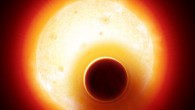
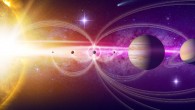
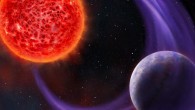
Using ultraviolet data from the NASA/ESA Hubble Space Telescope, astronomers have detected carbon ions — charged particles that interact with magnetic...
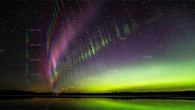
A rare upper-atmosphere phenomenon called Strong Thermal Emission Velocity Enhancement (STEVE) has been well documented by amateur aurora watchers from...
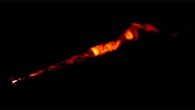
Astronomers using NSF’s Karl G. Jansky Very Large Array have captured unprecedented high-fidelity radio images of a jet of material propelled from the...
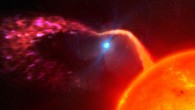
A white dwarf in the binary system LAMOST J024048.51+195226.9 (J0240+1952 for short) completes a full rotation once every 24.93 seconds, making it the...
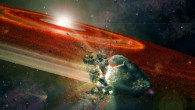
Around 4.567 billion years ago, our Solar System harbored a gap within the protoplanetary disk, near the location where the main asteroid belt resides...
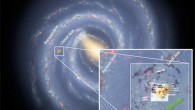
The North Polar Spur and the Fan Region are two bright, large-scale radio structures that are seen on opposite sides of the sky. According to new research,...
Astronomers using the Low Frequency Array (LOFAR), a large radio telescope network located mainly in the Netherlands, have detected coherent low-frequency...
New research shows that the magnetic field of our planet was relatively weak (less than half the strength of the long-term average field) for tens of millions...
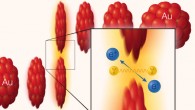
Physicists with the STAR Collaboration at Brookhaven National Laboratory’s Relativistic Heavy Ion Collider (RHIC) have produced definitive evidence for...
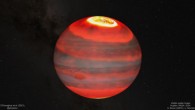
The upper atmosphere of Jupiter is hotter than expected from the amount of sunlight that it receives: the average temperature should be about minus 73...
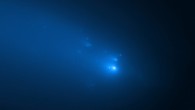
The long-period comet C/2019 Y4 (ATLAS) fragmented during its perihelion in April 2020. About two months later, ESA’s Solar Orbiter observed the dusty...
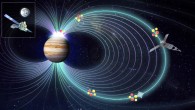
The rapidly rotating, strong magnetic field of Jupiter provides a natural lab that is key to understanding the dynamics of high-energy plasmas. Spectacular...
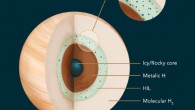
Terrestrial planets (Mercury, Venus, Earth, and Mars) are differentiated into three layers: a metallic core, a silicate shell (mantle and crust), and a...
Bonnethead sharks (Sphyrna tiburo) rely on magnetic fields for their long-distance journeys, according to new research led by scientists from the Florida...
Detailed measurements from the Grand Finale phase of NASA’s Cassini mission revealed distinctive features of Saturn’s magnetic field. These features...
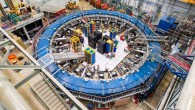
The Standard Model, scientists’ best description of the makeup and behavior of the Universe yet, very precisely predicts the g-factor of a fundamental...
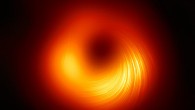
Astronomers using the Event Horizon Telescope (EHT) — a planet-scale array of eight ground-based radio telescopes (ALMA, APEX, the IRAM 30-m telescope,...
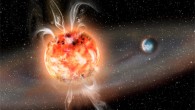
Magnetic interactions between the newfound planet, designated Gliese 1151b, and its host star are the likely source of low-frequency radio emission recently...