Roughly 18,000 years ago, in what is now northern Ukraine, artists carved small female figurines from mammoth ivory and covered them with zigzags and meanders. New research suggests those designs were not purely invented, they appear to echo the natural patterns inside the tusk.
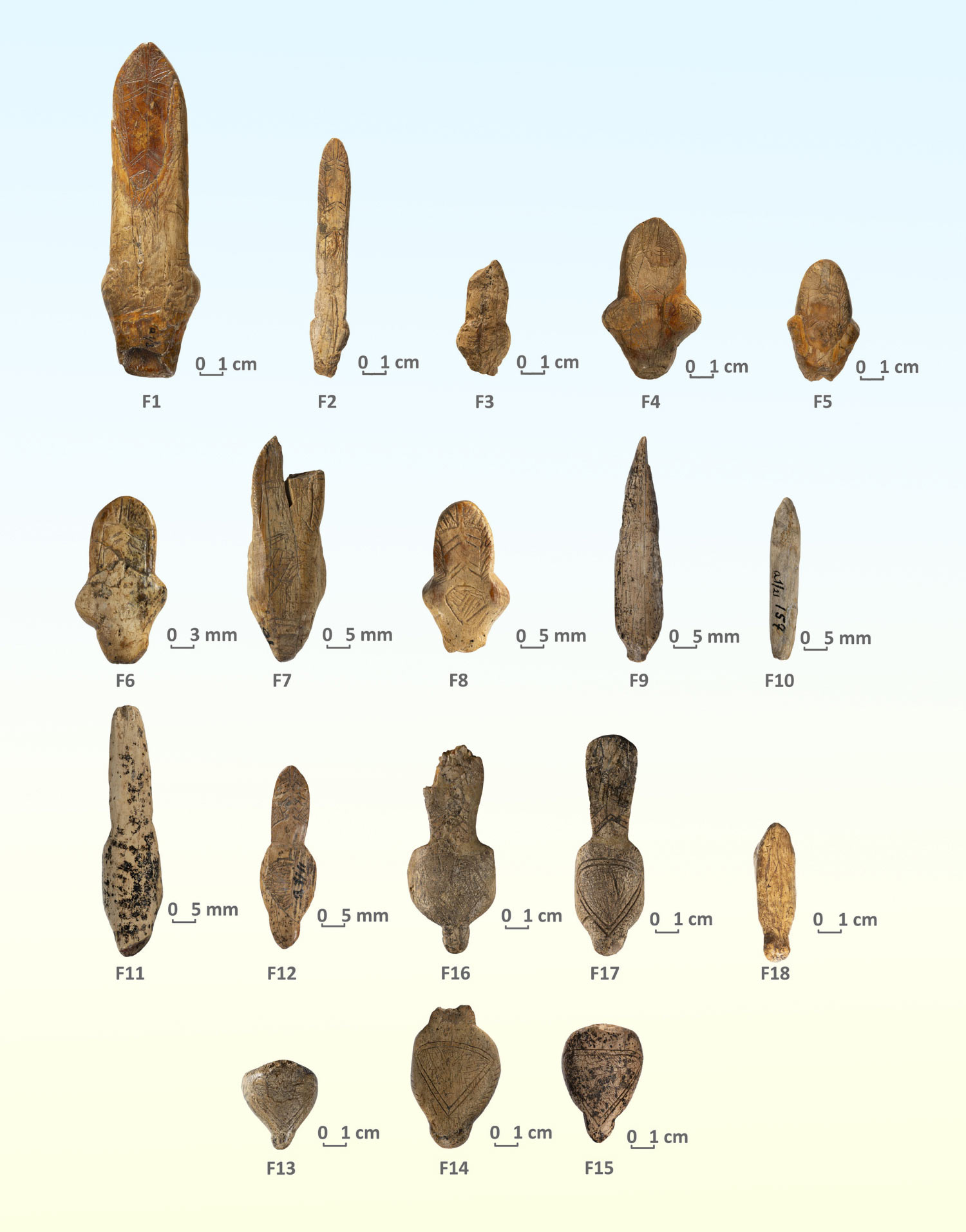
Mizyn figurines. Image credit: Radchenko et al., doi: 10.1038/s40494-026-02988-5.
“The study of Upper Paleolithic figurines in Europe has served to define two key thresholds in human history: the emergence of figurative representation and the transition to abstract and schematized artistic designs,” said University of Stavanger archaeologist Simon Radchenko and colleagues.
“Unfolding over more than 30 millennia, the character and chronology of these developments remain unclear.”
In their research, the archaeologists analyzed an assemblage of 18 anthropomorphic mammoth ivory figurines from Mizyn, a site in Ukraine known for circular structures built of mammoth bones.
Eleven of the figures were found in 1908-1909 excavations and seven about four years later.
In 2022, the National Museum of the History of Ukraine granted limited access so the pieces could be digitally preserved, part of an effort to protect cultural heritage threatened by Russia’s invasion.
Dr. Radchenko and co-authors used photogrammetry to build high-resolution 3D models and a digital microscope to study tool marks.
They also measured 97 engravings, whose cross-sections suggest flint blades were swapped out frequently and used differently on different parts of the design.
“Projects like this not only deepen our understanding of the past but also create new opportunities for research,” said Dr. Oleksandr Naumenko, a researcher at the National Museum of the History of Ukraine.
“At a time when war continues to threaten Ukraine’s cultural heritage, creating high-quality digital records of artifacts is a crucial step in preserving them.”
Dated to between 18,800 and 17,400 years ago, the Mizyn figurines align with the earliest presence of the Epigravettian culture in the region.
“The unique structure of the material means that we can identify the specific part of the ivory from which a figurine form was sourced and the likely strategy used to extract it,” the researchers said.
“The morphometric axis of all 18 anthropomorphic figurines from Mizyn aligns with the longitudinal axis of the mammoth ivory core.”
“All the figurines were made from the central part of the ivory, as indicated by the Schreger pattern (natural cross hatchings visible in the transverse break of the proboscidean dentine of the tusk) and Owen’s lines (a system of concentric dentine growth lines on the cross-section of the figurines.”
According to the team, zigzag ornaments on several figurines resemble Schreger lines, while meanders and parallel lines on others echo Owen’s lines.
On one figurine, the engraved meander nearly aligns with the ivory’s own growth rings.
The scientists argue that these motifs were placed where the natural patterns would be most visible, and that the ornament reflects an active engagement with the material rather than passive imitation.
“This discovery offers an extraordinary window into how Paleolithic peoples perceived and engaged with their material world,” said University of York archaeologist Aimée Little.
“Identifying visual evidence of how mammoths were integrated into artistic traditions, both through the use of their ivory and the deliberate inscription of its natural patterns, represents a genuine breakthrough in our understanding of prehistoric art and material culture.”
“Our findings challenge the long-held assumption that ancient art simply evolved in a straight line from basic to complex forms,” said Dr. Dmytro Kiosak, an archaeologist at the Leibniz Centre for Archaeology.
“We are optimistic that our future digital research will shed more light on the emergence and development of artistic expression in Europe, showing an even more complex, and intriguing picture than we have now,” Dr. Radchenko concluded.
The team’s results were published this month in the journal npj Heritage Science.
_____
S. Radchenko et al. Internal structure of Mammoth ivory inspired the design of Mizyn (Ukraine) Upper Palaeolithic figurines. npj Herit. Sci, published online September 11, 2026; doi: 10.1038/s40494-026-02988-5