Archaeologists in southwestern Germany have unearthed two miniature bird figurines carved from mammoth ivory, among the smallest and most delicate examples of Ice Age art ever found.
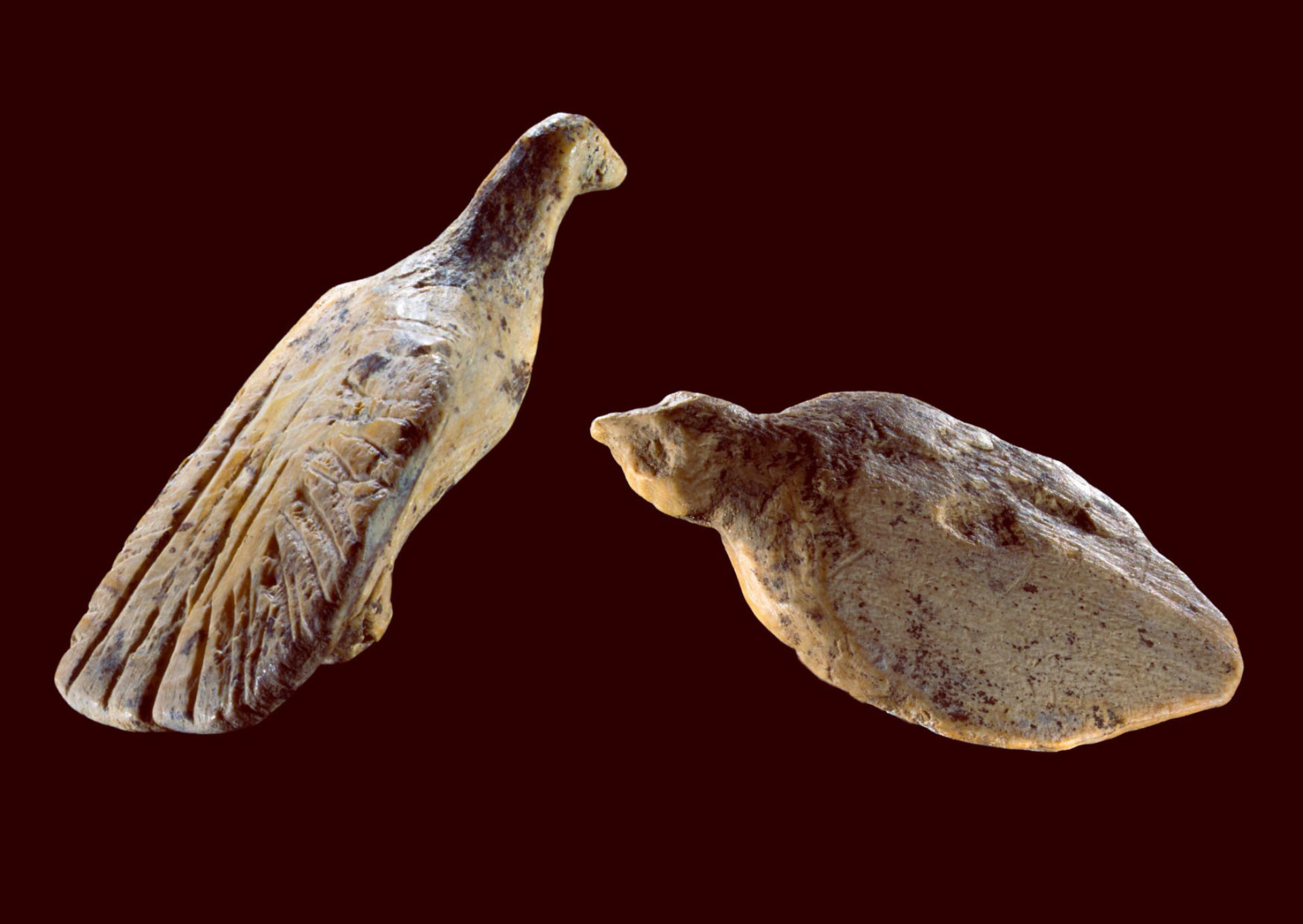
Two bird figurines found at Hohle Fels Cave in Germany. Image credit: Ralf Ehmann / University of Tübingen / Museum of Prehistory and Ice Age Art.
The two ancient figurines, roughly 2 cm (0.8 inches) long and weighing about a gram each, were found in 2025 in the Aurignacian layers of Hohle Fels Cave.
The site is part of a UNESCO World Heritage cluster in the Swabian Jura known for yielding some of the earliest figurative art in human history.
Dated to be about 40,000 years old, the artifacts were found about 1.5 m (5 feet) apart in the same layer, suggesting they may be roughly contemporaneous and possibly even the work of the same hand.
One figurine appears to show a bird crouched low, perhaps brooding over eggs; the other, incomplete, shows outstretched wings that could depict a bird taking flight, landing, or displaying in courtship.
“The figurines demonstrate that the earliest artists were skilled ivory-carvers, who could depict delicate motifs in miniature form,” said Professor Nicholas Conard, director of excavations and an archaeologist at the University of Tübingen.
“Additionally, it seems that specific depictions are associated with specific sites.”
The objects’ naturalistic detail points to a ptarmigan as the likely model for the brooding bird, with the second figure possibly a ptarmigan, grouse or bird of prey.
“The carvings are not highly stylized but instead include many specific and unique features,” Professor Conard said.
“Here the artist has recorded detailed observations that allow us to consider which kind of bird is represented and what the bird could be doing.”
The finds show that humans working in the region roughly 40,000 years ago, near the time modern humans first arrived in the Upper Danube region, were already accomplished ivory carvers capable of rendering fine detail at a tiny scale.
“The figurines in their present state weigh only 1.3 and 0.7 grams and are the smallest and finest depictions from this period 40,00-years-ago, but despite their size, they raise many new questions,” Professor Conard said.
“Our region and landscape have always been the home of a vast range of birds, and nearby Lake Schmiechen is today a bird sanctuary,” added Stefanie Kölbl, managing director of the Museum of Prehistory and Ice Age Art in Blaubeuren.
“Even 40,000-years-ago birds were here. Their song filled the air, and some species came to the region in the course of annual migrations.”
“Their calls signaled warnings, and the residents of the region often used their hollow bones and even mammoth ivory to make flutes that produced magical sounds.”
The team’s paper will be published in the Archäologische Ausgrabungen in Baden-Württemberg.
_____
Nicholas J. Conard et al. 2026. Hochwertige Funde aus dem Mittelpaläolithikum und zwei aurignacienzeitliche Vogeldarstellungen aus dem Hohle Fels bei Schelklingen. In: Archäologische Ausgrabungen in Baden-Württemberg 2025: 46-52