For as long as readers have pored over Homer’s Odyssey they have pictured Ithaca, the homeland Odysseus fights for ten years to reach, as an island unto itself. Now, two scholars say that assumption — held since antiquity — is simply wrong, arguing that Ithaca was a peninsula on the Greek island of Kefalonia.
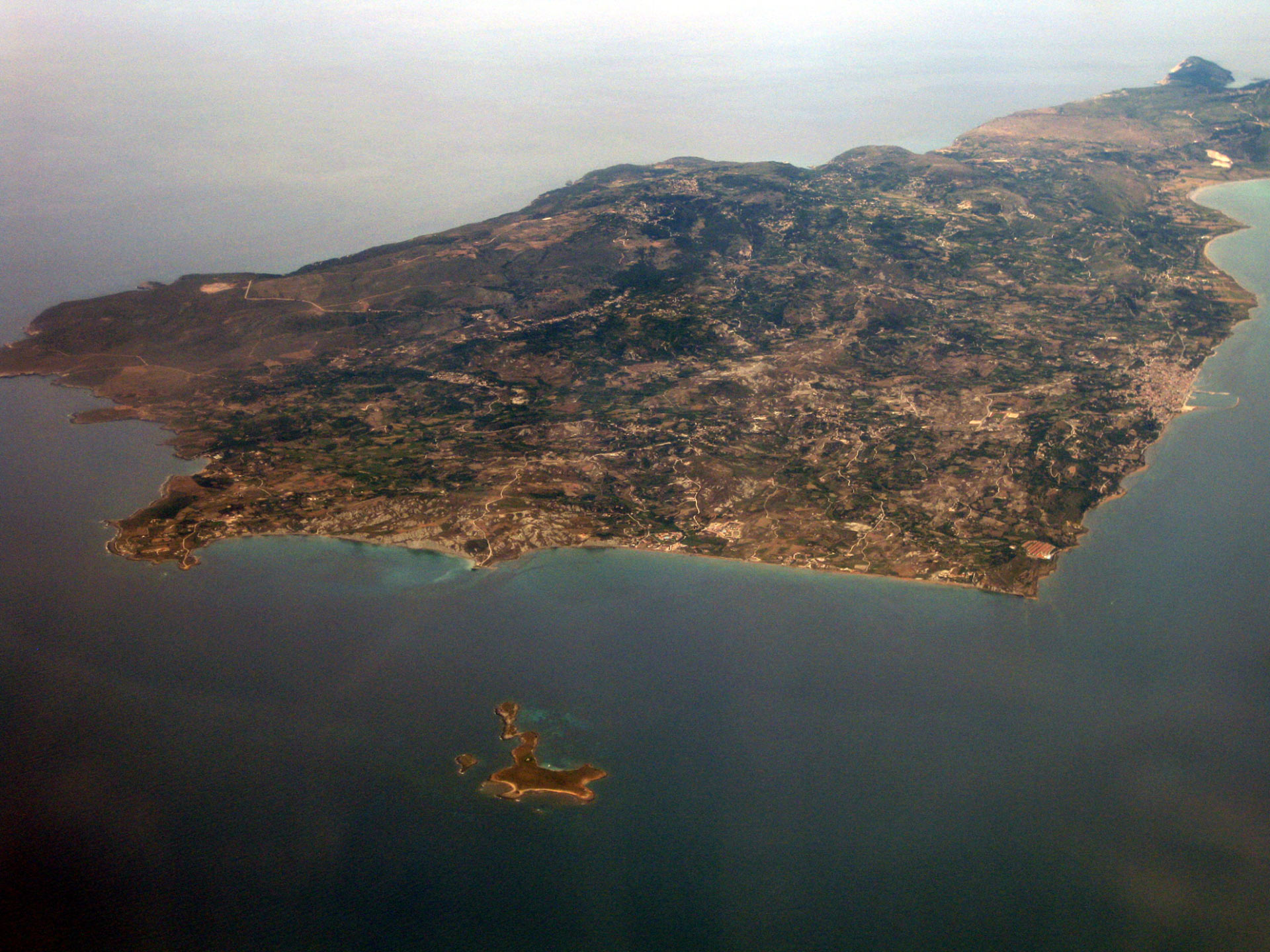
Paliki peninsula on the island of Kefalonia, Ionian Islands, Greece. Image credit: Christos Vittoratos / CC BY-SA 3.0.
Cambridge University’s Professor James Diggle and University of Aberdeen’s Professor John Underhill argue that Homer never actually calls Ithaca an island.
Instead, the poet consistently describes it using Greek words meaning ‘land,’ ‘native land’ or ‘domain,’ even in passages long read as implying it was surrounded by sea.
“Homer has many opportunities to call Ithaca an island, but he never does so,” Professor Diggle said.
“Instead of ‘island’ (νῆσος/nisos), Homer, or his characters, refer to it constantly as ‘land’ (γαῖα/gaia), ‘native land’ (πατρίς/patris, πατρὶςαἶα/γαῖα/patrisgaia), or ‘country/region/area/domain’ (δῆμος’/dimos) even though νῆσος fits just as easily into the poems’ dactylic hexameter meter.”
“Homer uses the phrase ‘δῆμος of Ithaca’ frequently in the poems, as when, for example, Odysseus makes landfall on his homeland at the end of his ten-year-long voyage:
Then the seafaring ship approached the island.
On Ithaca there is a bay of Phorcys,
The old man of the sea: in it, two headlands…”
“This translation can be taken to imply that Ithaca is an island but Homer actually writes ‘In the δῆμος of Ithaca there is a bay of Phorcys,’ that is: ‘In the domain of Ithaca there is a bay of Phorcys,’ clearly implying that Ithaca is a part of the island that the ship is approaching.”
That larger island, according to the researchers, is Kefalonia — and more specifically its western peninsula, Paliki, a location Odysseus is also described as ruling over as leader of the Cephallenians.
Businessman-turned-researcher Robert Bittlestone first proposed in the 2005 book Odysseus Unbound that Paliki matched Homer’s description of a low-lying, west-facing land near three other named islands — a description that doesn’t fit the mountainous, east-facing modern island now called Ithaki.
The catch was that Paliki would have needed to be a true island in the Late Bronze Age, around 1200 BCE, separated from the rest of Kefalonia by a channel that ancient earthquakes and landslides later filled in.
Professor Underhill spent 20 years testing that idea with geological surveys and found the channel never existed.
The two lines of evidence — geology and philology — now reinforce each other.
Recent excavations on Paliki, including at a site called Livadi Marsh proposed as Odysseus’ harbor, have provided further evidence that it was a significant Bronze Age location.
“We are confident that an elegant explanation has emerged that unifies the geoscience, the Homeric texts and Strabo and is entirely consistent with Robert Bittlestone’s founding idea of Odysseus Unbound — that Paliki is the location of Homer’s Ithaca,” the researchers said.
Their paper was published online in the journal Antigone.