Astronomers using ESO’s Very Large Telescope (VLT) have measured carbon and nitrogen isotope ratios in 3I/ATLAS, the third known interstellar visitor to sweep through the Solar System. Their analysis suggests the interstellar comet formed in the cold outer reaches of a protoplanetary disk surrounding a star far older and more metal-poor than our own.
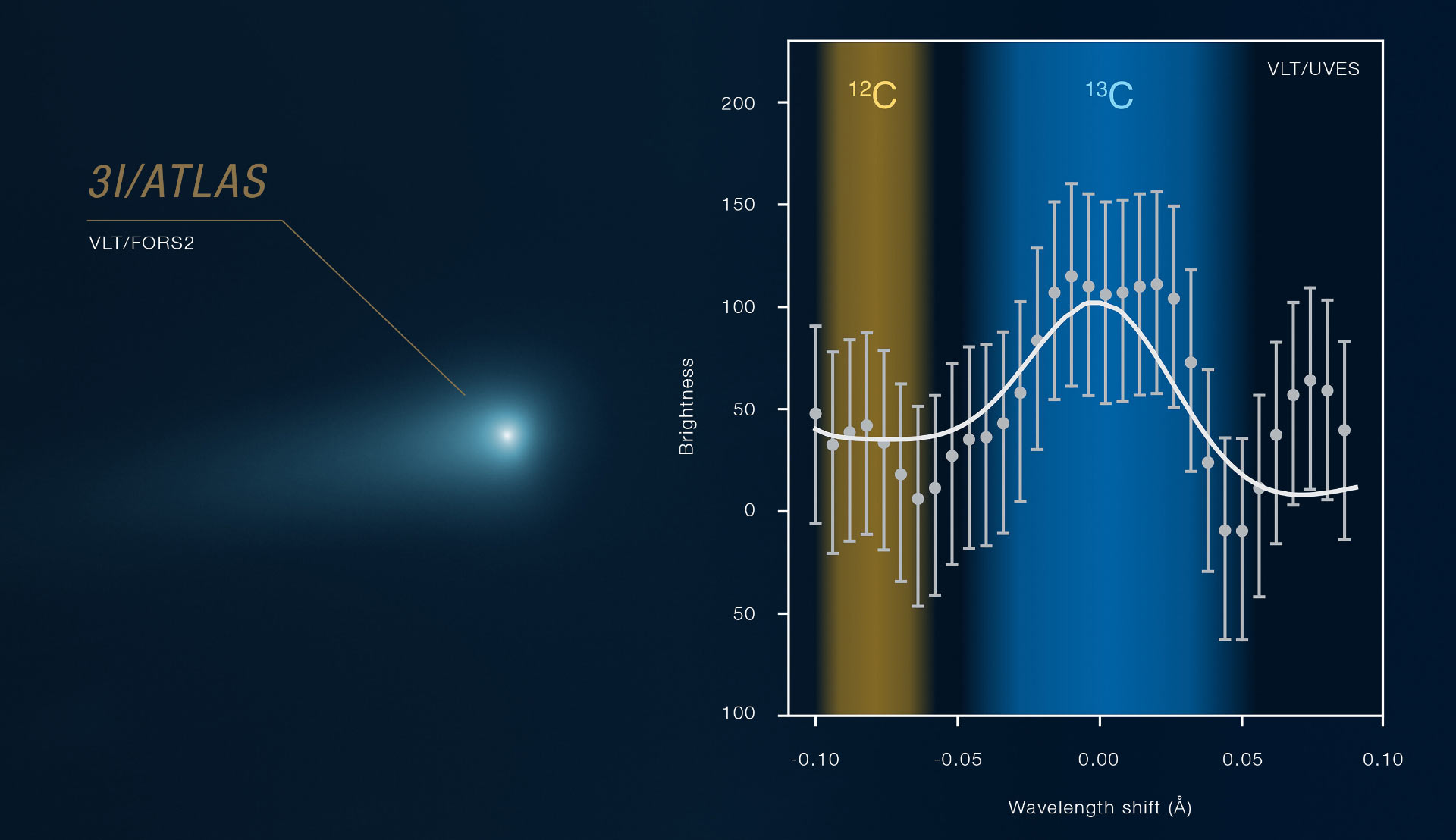
This image shows part of the spectrum of the interstellar comet 3I/ATLAS, captured in December 2025 with the UVES instrument on ESO’s Very Large Telescope. Image credit: ESO / C. Opitom / Manfroid et al. / O. Hainaut.
3I/ATLAS is only the third interstellar object ever detected, following 1I/‘Oumuamua in 2017 and 2I/Borisov in 2019, but it proved bright enough to allow isotopic measurements that weren’t possible for its predecessors.
“Interstellar objects, formed in planetary systems beyond our own and now passing through the Solar System, provide a rare opportunity to study material formed in other protoplanetary disks that may have experienced very different physical and chemical conditions,” said Dr. Cyrielle Opitom, an astronomer at the University of Edinburgh, and colleagues.
“When such objects become active and sublimate, the released gases can be studied spectroscopically, allowing us to directly probe their volatile composition and isotopic ratios.”
“Isotopic ratios are often used to trace the origin and evolution of different species.”
“As fractionation processes are sensitive to the temperature and radiation environment, isotopic ratios allow us to follow the chemical evolution of material from the prestellar stage, through the protostellar and protoplanetary disk stages, and into fully formed planets and planetesimals.”
Dr. Opitom and co-authors observed 3I/ATLAS between December 6 and 26, 2025, after it had passed closest to the Sun.
Using the Ultraviolet and Visual Echelle Spectrograph (UVES) on the VLT, they examined emission from cyanogen (CN), a molecule commonly found in comet atmospheres, to measure ratios of carbon and nitrogen isotopes.
They found a carbon isotope ratio (carbon-12/carbon-13) of about 151 and a nitrogen isotope ratio (nitrogen-14/nitrogen-15) of roughly 363.
Most known solar system comets have carbon isotope ratios near 90 and nitrogen isotope ratios around 150.
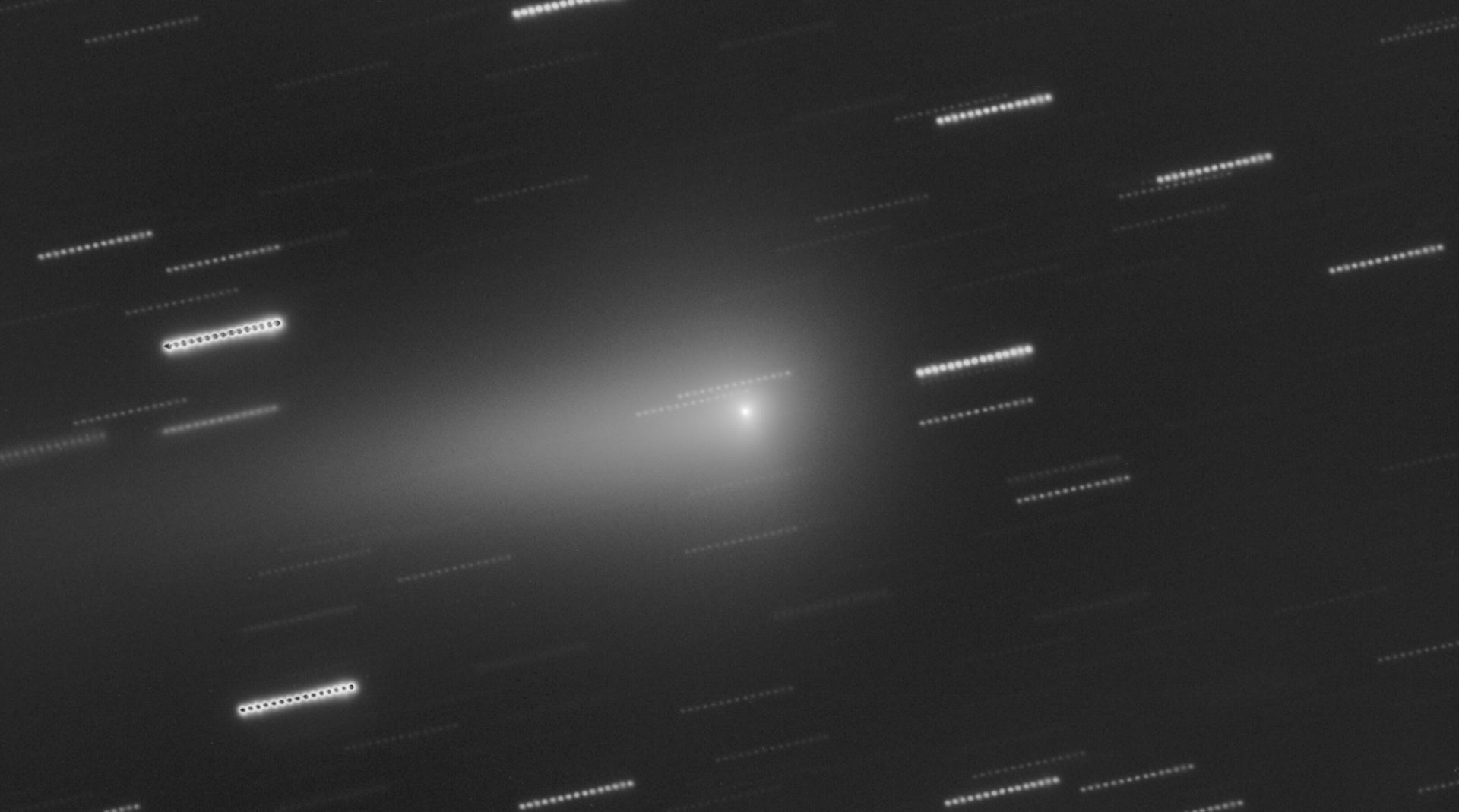
This image of the interstellar comet 3I/ATLAS was taken on January 18, 2026 with the FORS2 instrument on ESO’s Very Large Telescope. Image credit: ESO / O. Hainaut.
“3I/ATLAS is a really exciting opportunity to probe the composition of another planetary system, one that formed long before our Sun and the Solar System even existed,” said Dr. Rosemary Dorsey, an astronomer at the University of Helsinki.
The high nitrogen ratio measured in 3I/ATLAS is consistent with formation far from its parent star, where this isotope-selective chemistry is much less efficient.
Models of galactic chemical evolution predict that older, metal-poor stars should produce planetary material richer in carbon-12 relative to carbon-13.
The unusually high carbon ratio measured by the astronomers matches those predictions and agrees with previous studies suggesting the comet originated around an ancient star with relatively few heavy elements.
“The nitrogen-14/nitrogen-15 ratio is higher than the value of 150 usually measured for solar system comets, close to the values measured in the interstellar medium, prestellar phases or outside of protoplanetary disks,” they said.
“The carbon-12/carbon-13 ratio is higher than the values usually measured for solar system comets and in the local interstellar medium.”
“These measurements are compatible with an origin of 3I/ATLAS in the outer disk around an older low-metallicity star, providing potential insights into the likelihood and efficiency of planetesimal formation around such stars.”
The team’s results appear today in the journal Nature Astronomy.
_____
C. Opitom et al. High nitrogen and carbon isotopic ratios in the interstellar comet 3I/ATLAS. Nat Astron, published online July 6, 2026; doi: 10.1038/s41550-026-02921-7