Paleontologists in China have described a small, previously unknown Jurassic bird whose short tail offers new evidence for how the earliest birds traded their long, dinosaur-like tails for the compact tailbone that helps living birds fly.
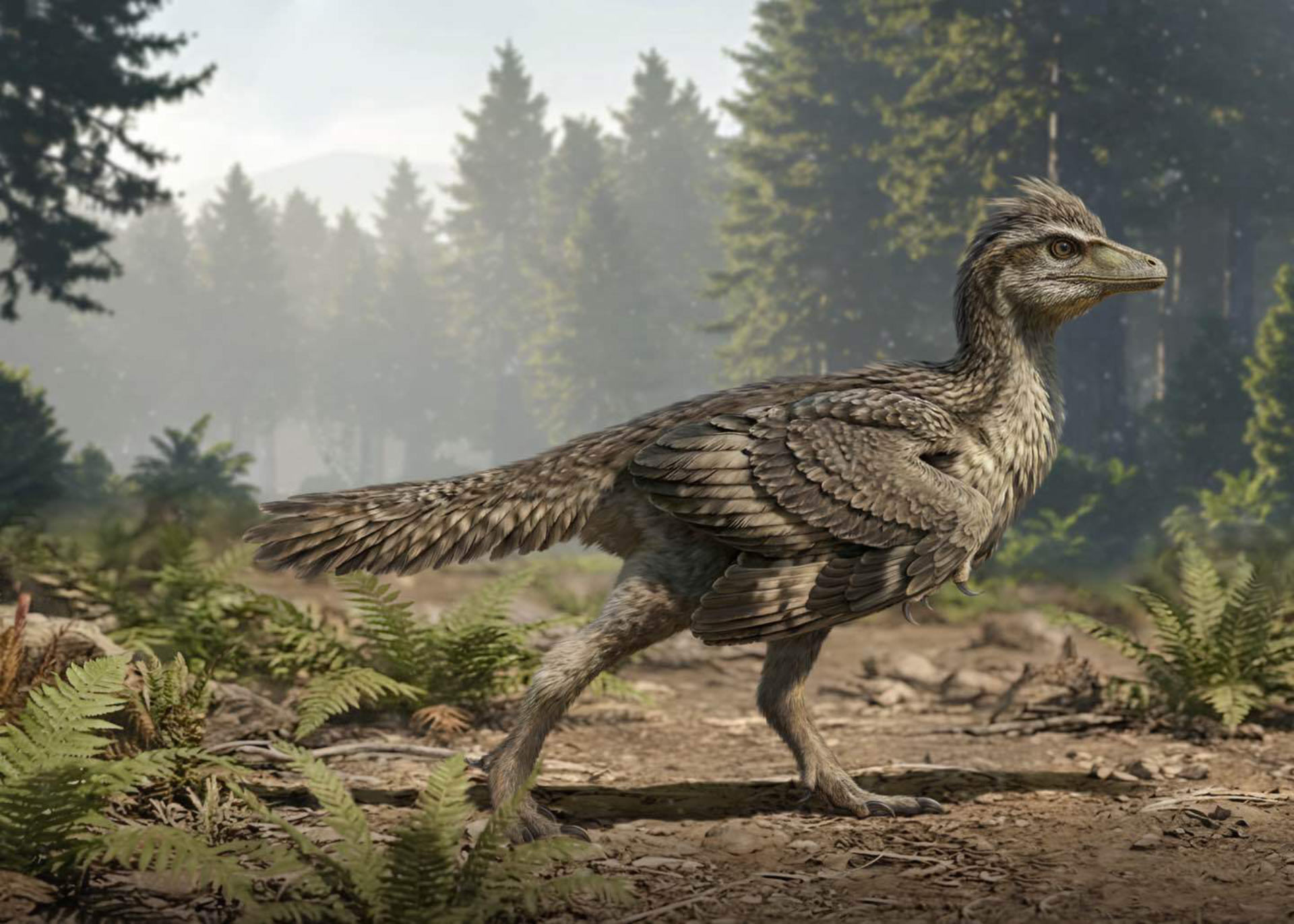
Life reconstruction of Zhengheornis buyu. Image credit: Chung-Tat Cheung.
Modern birds are unique among vertebrates in having a short tail capped by a fused clump of bone called the pygostyle, which anchors their fan of tail feathers and is essential to flight.
Their dinosaur ancestors, by contrast, had long, bony tails with dozens of vertebrae.
How and when that transition happened has been difficult to pin down, largely because so few fossils capture birds in an intermediate stage.
The newly-identified bird species, Zhengheornis buyu, appears to be one of those missing pieces.
“Because long-tailed and short-tailed birds appeared nearly simultaneously in the early fossil record without clear intermediates, evolutionary biologists have long argued that a transitional species having an abbreviated but entirely unfused bony tail was biologically improbable and unlikely to have ever existed,” said Dr. Zhonghe Zhou, a paleontologist with the Institute of Vertebrate Paleontology and Paleoanthropology at the Chinese Academy of Sciences.
The holotype specimen of Zhengheornis buyu was found in 2024 in the Nanyuan Formation near Yangyuan village in Zhenghe country in China’s Fujian province.
The fossil dates 148-150 million years back to the end of the Jurassic period, when some of the earliest birds were beginning to diversify.
It is the fourth bird taxon now known from what paleontologists call the Zhenghe Fauna, joining Fujianvenator, Baminornis and an incomplete specimen represented by a single furcular (wishbone).
Based on the circumference and length of its thigh bone, the authors estimate a body mass of 74 to 163 grams — smaller than the diminutive specimen long held up as the smallest known Archaeopteryx.
“The holotype of Zhengheornis buyu is, to our knowledge, the smallest adult individual of non-pygostylian theropods known thus far,” they said.
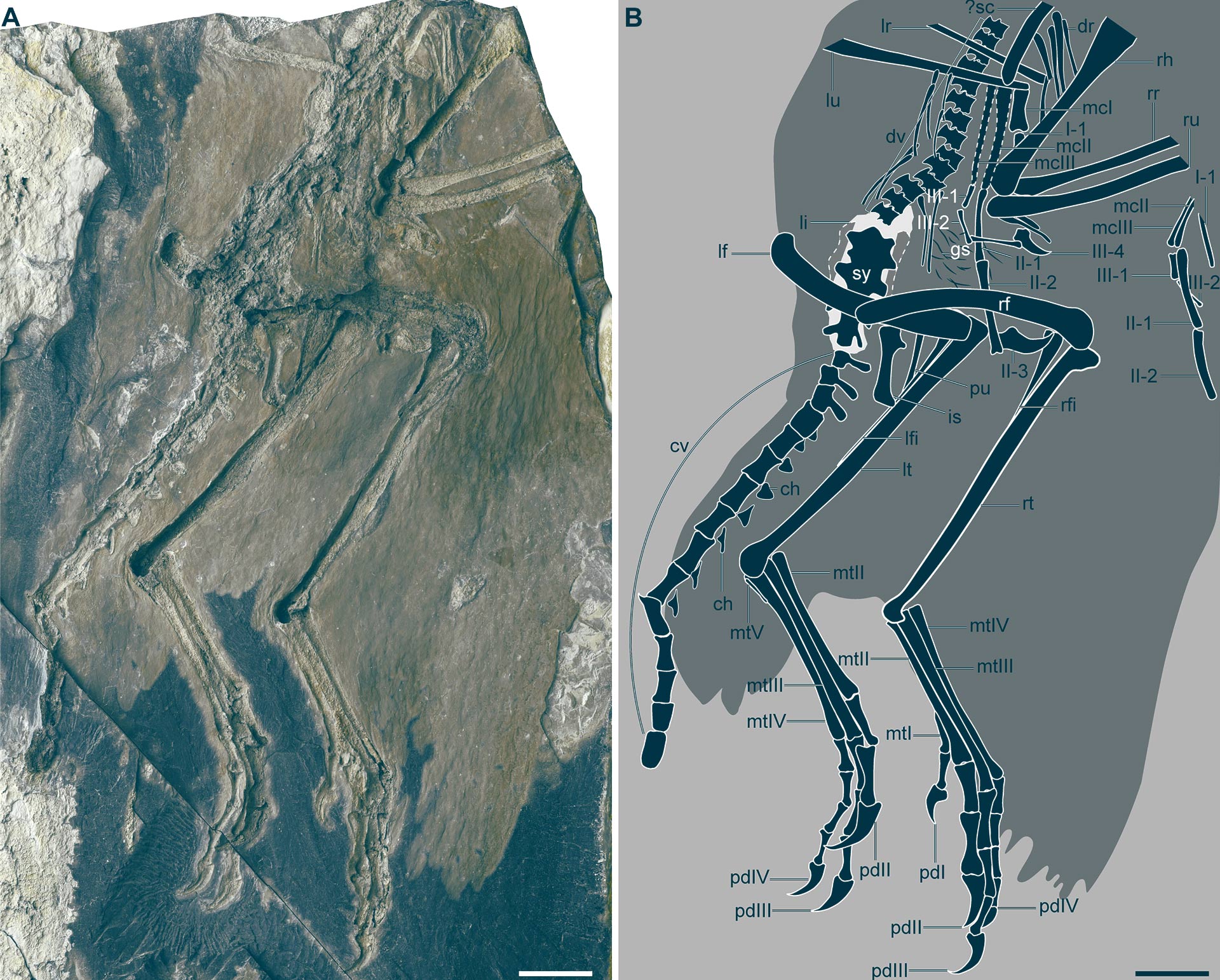
The holotype specimen of Zhengheornis buyu. Image credit: Wang et al., doi: 10.1126/sciadv.aeb5202.
Zhengheornis buyu’s tail contains just 15 vertebrae — far fewer than the 23 to 24 found in Archaeopteryx or the more than 30 in other early bird relatives — yet those vertebrae remain separate rather than fused into a pygostyle.
The two final tail bones are unusually box-shaped, a feature otherwise seen only in the distantly related dinosaur Caudipteryx.
The findings challenge the notion that tail shortening and pygostyle formation occurred simultaneously.
“This anatomical mosaic proves a stepwise evolutionary path: the vertebral reduction and shortening preceded pygostyle fusion in early bird evolution,” said Dr. Min Wang, also from the Institute of Vertebrate Paleontology and Paleoanthropology at the Chinese Academy of Sciences.
The team’s analysis also suggests Zhengheornis buyu was not clearly adapted to either tree-dwelling or ground-dwelling life, in contrast to other Jurassic birds found nearby.
“The disparate body size, skeletal architecture, and niche preferences among co-occurring Zhenghe birds, varying from the generalist Zhengheornis buyu to the cursorial Fujianvenator, provide indisputable evidence that avialans had already underwent a major adaptive radiation by the very end of the Jurassic period,” the paleontologists said.
“This landmark discovery effectively reconciles long-standing academic debates regarding the timing of the initial diversification of early birds.”
Their paper was published this month in the journal Science Advances.
_____
Min Wang et al. 2026. Jurassic avialan reveals stepwise evolution of bony tail in birds. Science Advances 12 (27); doi: 10.1126/sciadv.aeb5202