For nearly 110 years, biologists have puzzled over why domestic cats’ kidneys are packed with unusually large numbers of fat-storing structures called lipid droplets. Professor Masao Miyazaki of Iwate University and colleagues suggest that these kidney droplets serve as a chemical reservoir, helping cats maintain a stable ‘scent signature’ in their urine even as the odor changes over time.
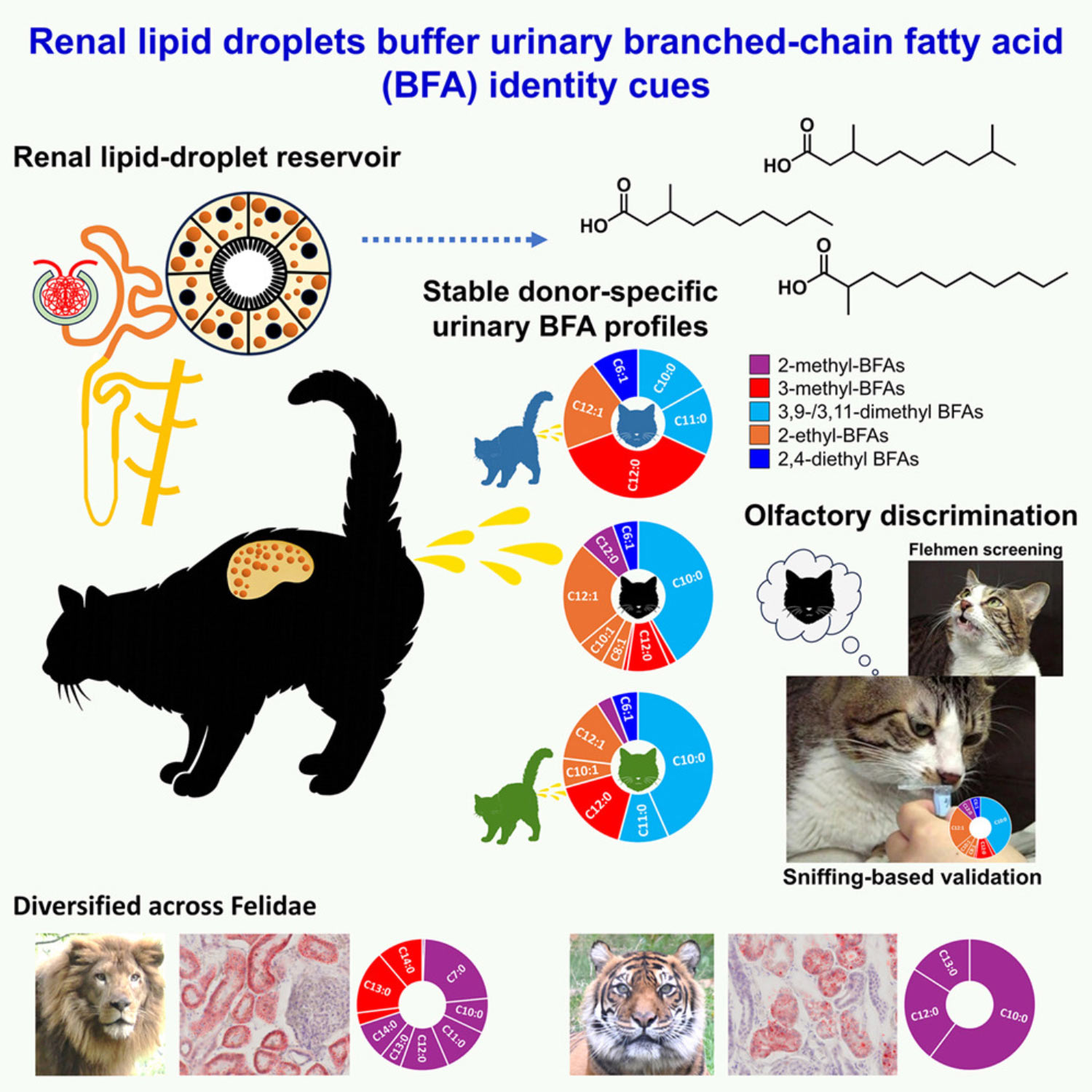
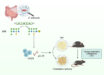
Animals often rely on scent marks to communicate identity across time, yet how chemically dynamic signals remain individually informative is unresolved; Ichizawa et al. show that domestic cats achieve durable chemical individuality through a reservoir-buffered system based on branched-chain fatty acid. Image credit: Ichizawa et al., doi: 10.1016/j.cub.2026.07.045.
Animals that scent-mark their territory face a basic problem: the molecules that make up a scent evaporate and degrade once released into the environment, so the message can shift after the sender has moved on.
Cats get around this using a set of 13 branched-chain fatty acids (BFAs), a class of compounds not previously documented in mammalian urine or other bodily secretions.
According to the new study, each cat has its own distinctive combination and ratio of these fatty acids, and — unlike many more volatile urinary compounds — that chemical fingerprint stays relatively constant over time and evaporates slowly, remaining detectable for at least a day after the urine is deposited.
“Lipid droplets in the cat kidney have been known for more than a century, but why cats have so many of them has remained a mystery,” Professor Miyazaki said.
“Our findings suggest that one of their functions may be to support a stable chemical signature in urine.”
“How BFAs stored in renal lipids are ultimately released into urine is an important question for future research.”
To identify the compounds, the researchers tracked cats’ flehmen response — the gaping expression cats make while drawing scent into a specialized organ in the roof of the mouth — and found it occurred more often in response to unfamiliar cats’ urine than to a cat’s own, fading with repeated exposure to the same sample but resurging when a new individual’s urine was introduced.
In follow-up tests, cats detected differences in the fatty acid mixture even when other urinary components were held constant, showing the animals can actually read this information.
The fatty acids showed up almost exclusively in the kidney, stored inside the long-mysterious lipid droplets in the renal cortex.
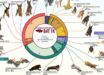
Related compounds and kidney lipid droplets turned up in other wild cat species as well, including lions, tigers, leopards, jaguars and lynxes, though the chemical profiles varied by species.
The discovery could eventually inform methods for managing cat urine odor and, because the fatty acid profiles appear to reliably mark individuals, might one day help conservationists track elusive wild cats through scent alone, without ever having to see them.
“These findings identify an organ-level mechanism that stabilizes small-molecule chemical individuality in domestic cats and reveal a diversified reservoir-supported chemical substrate across felid lineages,” the scientists concluded.
Their paper was published today in the journal Current Biology.
_____
Shota Ichizawa et al. Signatures of branched-chain fatty acids derived from a kidney reservoir confer stable chemical individuality on domestic cats. Current Biology, published online August 19, 2026; doi: 10.1016/j.cub.2026.07.045