Astronomers using the NASA/ESA Hubble Space Telescope have captured this vivid image of NGC 6426, an ancient globular cluster in the Milky Way’s outer halo. This object holds two chemically distinct generations of stars — a cosmic time capsule from an era when the Universe was still forging its heaviest elements.
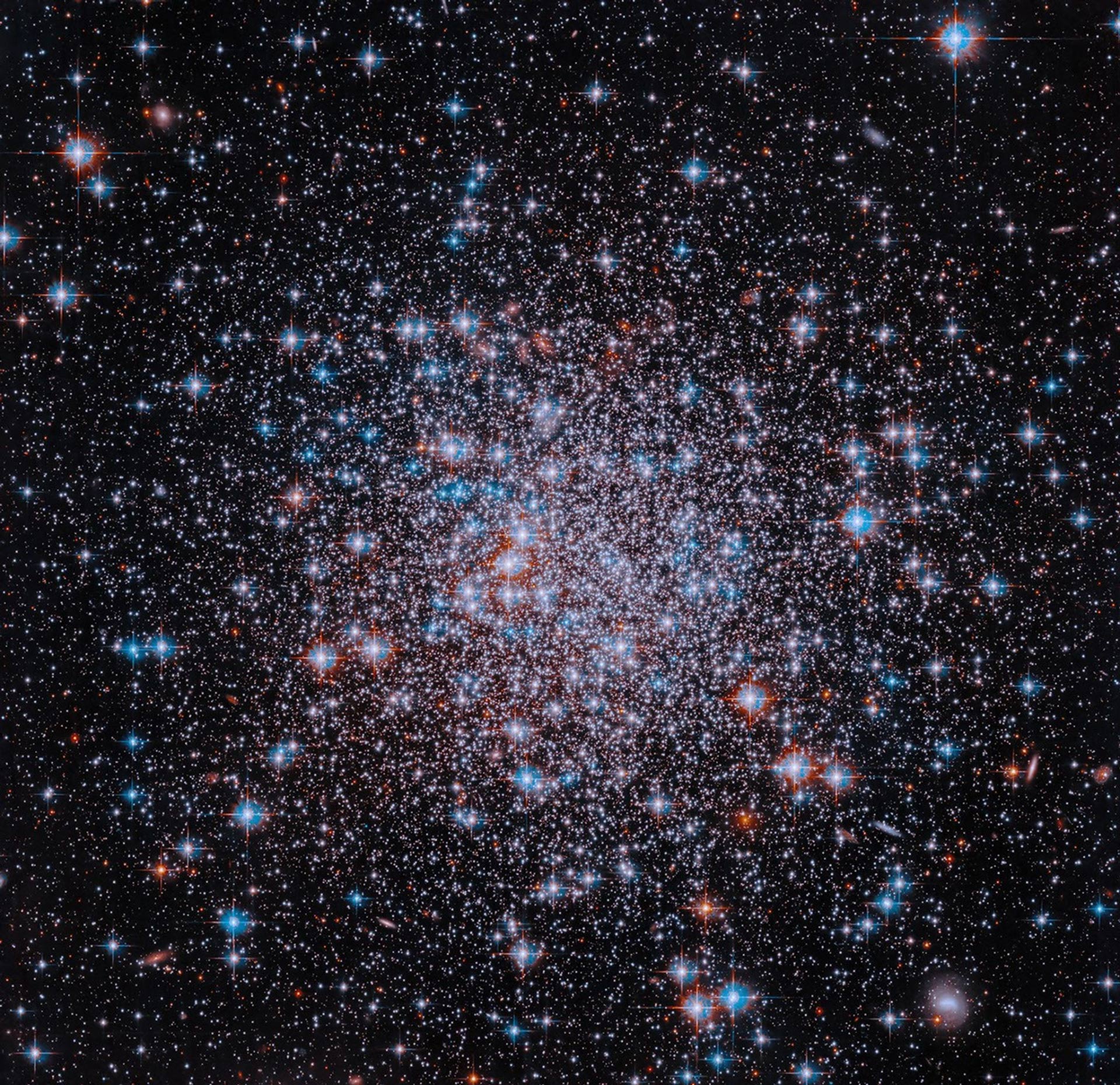
This Hubble image shows NGC 6426, a globular cluster some 67,000 light-years away in the constellation of Ophiuchus. Image credit: NASA / ESA / A. Dotter, Dartmouth College / Gladys Kober, NASA & Catholic University of America.
NGC 6426 is located approximately 67,000 light-years away in the equatorial constellation of Ophiuchus.
Also known as C 1742+031 or GCl 76, this globular cluster was discovered by the German-English astronomer William Herschel on June 3, 1786.
NGC 6426 is estimated to be about 13 billion years old, meaning it formed only a few hundred million years after the Big Bang. Since the Universe is about 13.8 billion years old, the cluster preserves a record of conditions in the young cosmos.
Rather than orbiting within the Milky Way’s disk, it travels through the outer halo, a sparse spherical region surrounding the Galaxy.
Globular clusters were once thought to consist of stars born in a single burst. High-resolution spectroscopy studies indicate that NGC 6426 may harbor two generations of stars.
“NGC 6426 is a spherical collection of stars bound together by their mutual gravity, one of 150 known globular clusters in our Galaxy,” the Hubble astronomers said in a statement.
“These groups of stars are thought to form as a unit from the same collapsing cloud of gas, and thus the stars in them typically have similar ages. The stars in globular clusters tend to be ancient.”
“At approximately 13 billion years old, NGC 6426 is one of the Milky Way’s oldest globular clusters and almost as old as the Universe itself.”
The astronomers used Hubble to capture this image of NGC 6426 as part of a study of globular clusters in the Milky Way’s halo.
“In this image, blue indicates the shorter wavelengths that are visible light, while red depicts the longer wavelengths of visible light, as well as some near-infrared light,” they explained.
“Colors in Hubble images are chosen based on standard image processing techniques to best represent the wavelengths of light that pass through the filters used in the observation.”
“Because the color and temperature of stars are directly related, we know that the blue stars in this image are hotter and the red stars are cooler.”
“The stars of NGC 6426 have low metallicity, which means they have fewer elements that are heavier than hydrogen and helium.”
“These conditions resemble those of the early Universe, when matter was mostly helium and hydrogen and heavier elements were just beginning to form via nuclear fusion within massive stars.”