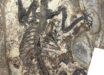
Paleontologists have uncovered the first direct physical evidence that colossal prehistoric crocodiles hunted large plant-eating mammals in what is now Colombia roughly 12 million years ago.
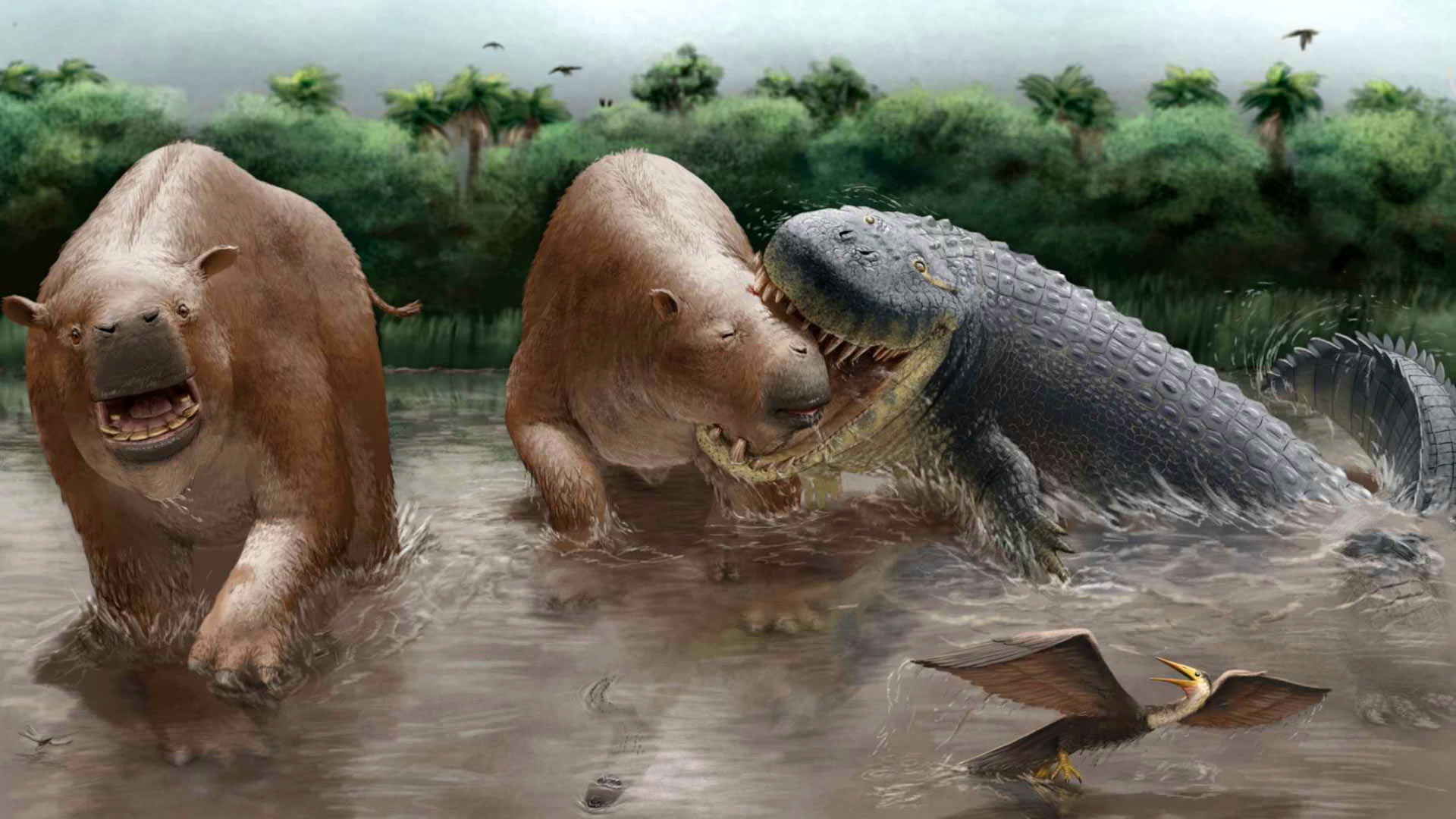
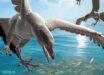
Reconstruction of the faunal assemblage of La Venta, showing the hypothetical predation event with Purussaurus neivensis attacking Pericotoxodon platignathus; also pictured in the foreground are Anhinga cf. A. grandis and Caiman sp. Image credit: Miguel Hernandez.
“There was so much prey available that mammalian predators couldn’t have eaten it all,” said Dr. Oscar Wilson, a postdoctoral researcher at the University of Helsinki.
“Our new study shows that crocodylians in particular were the region’s most important predators, especially when it came to hunting large prey.”
Dr. Wilson and his colleagues from Colombia, France, Argentina, Canada and the United States analyzed four fossilized bones belonging to three species of large hoofed mammals that once lived in the La Venta region of Colombia’s Huila department.
The specimens belong to Pericotoxodon platignathus, a rhinoceros-sized relative of ancient South American ungulates, and two elephant-like herbivores called Xenastrapotherium kraglievichi and Granastrapotherium snorki.
The researchers estimate these creatures weighed between roughly 600 and 1,800 kg.
All four specimens — a skull, a leg bone and two jawbones — bear distinctive marks, circular and bisected puncture wounds, and areas of crushed bone consistent with the bite of a massive crocodylian.
The most likely predator was Purussaurus, an enormous extinct caiman that could exceed 6 m (20 feet) in length and weigh nearly 1,800 kg, making it one of the largest crocodylians known to have existed.
Some of the bite forces needed to produce the punctures approached or exceeded 40,000 newtons per tooth, figures broadly consistent with prior estimates of Purussaurus’ bite strength.
One jawbone, belonging to Xenastrapotherium, showed a second, different set of marks — a series of parallel grooves the researchers attribute to a smaller, land-dwelling species of crocodile relative called Langstonia huilensis.
The scientists interpret this as evidence of a separate scavenging event, distinct from the fatal attack.
Most of the bite marks were concentrated on the animals’ heads and jaws, a pattern that mirrors how modern crocodiles such as the saltwater crocodile and Nile crocodile typically ambush and capture large prey.
The findings bolster earlier theoretical work suggesting that in ancient South America, where large mammalian carnivores were relatively scarce compared to other continents, giant crocodylians and other reptiles filled the ecological role that lions, wolves and bears occupy elsewhere today.
Purussaurus and other predators were likely key regulators of large herbivore populations in Miocene wetland ecosystems.
“The frequency of marks likely made by Purussaurus suggests that it was an important predator in these tropical ecosystems,” Dr. Wilson said.
The results appear this month in the Journal of Vertebrate Paleontology.
_____
Oscar E. Wilson et al. Physical evidence of crocodylian predation on ungulates in the Middle Miocene of Colombia. Journal of Vertebrate Paleontology, published online August 16, 2026; doi: 10.1080/02724634.2026.2701154