New observations of L 98-59d, a member of the five-planet system L 98-59, suggest it harbors a vast global magma ocean that traps sulfur deep inside, forming a previously unrecognized class of extraterrestrial worlds.
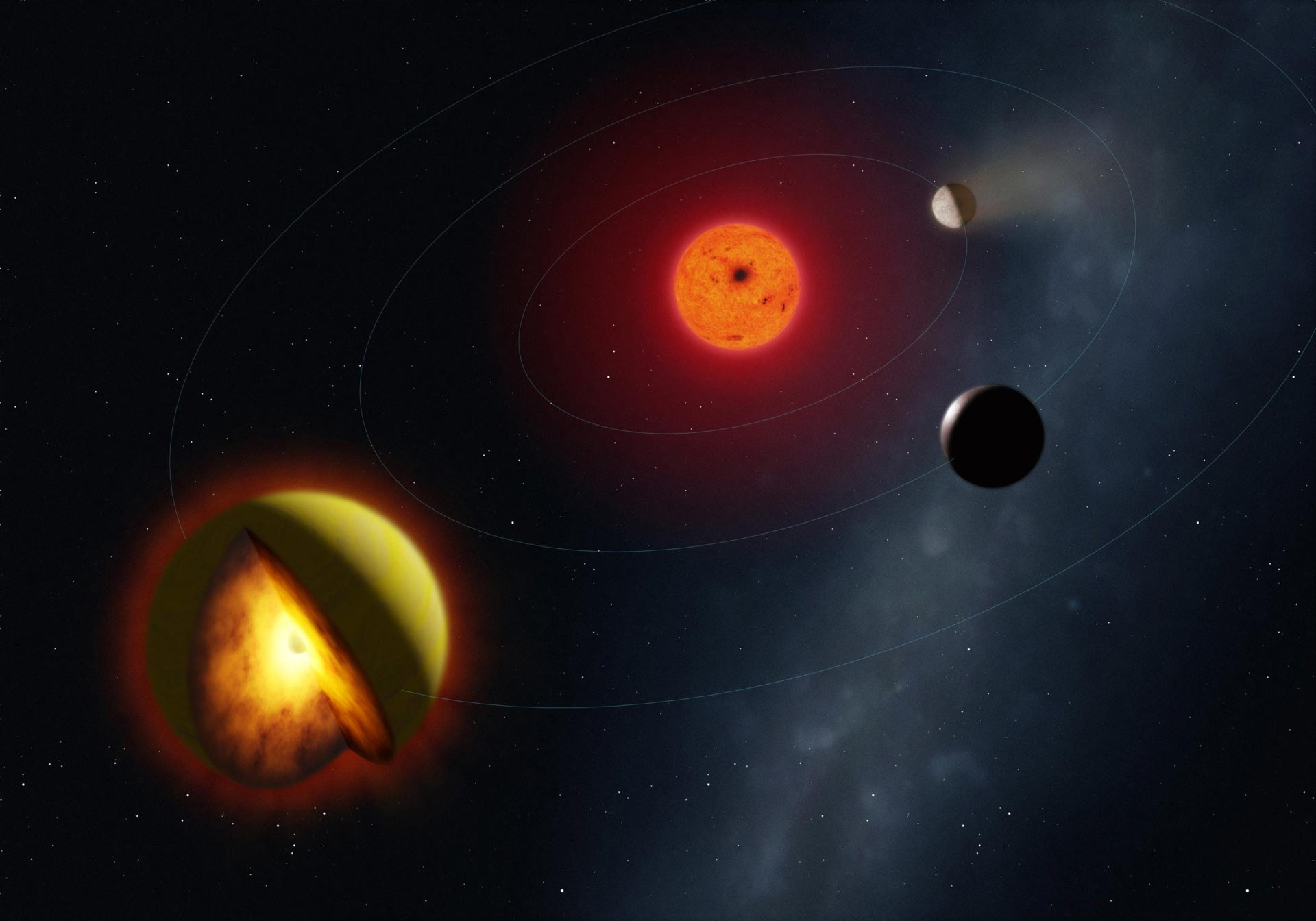
An artist’s impression of the planetary system L 98-59. Image credit: Mark A. Garlick / markgarlick.com.
L 98-59 lies about 34.5 light-years away in the southern constellation of Volans.
Also known as TOI-175, TIC 307210830, this bright M-dwarf is about one-third the mass of the Sun.
The planetary system hosts at least three transiting and two non-transiting exoplanets: L 98-59b, c, d, e, and f.
L 98-59d orbits the parent star once every 7.5 days, is about 1.6 times Earth’s size, and is blasted with around four times the radiant energy as Earth.
In new research, University of Oxford astronomer Harrison Nicholls and colleagues aimed to reconstruct the history of this super-Earth from shortly after its birth to the present day — a span of nearly five billion years.
By directly linking telescope observations to detailed physical models of planetary interiors and atmospheres, they were able to determine what must be happening deep inside the planet.
Their results reveal that the mantle of L 98-59d is likely molten silicate (similar to lava on Earth), with a global magma ocean extending thousands of km beneath.
This vast molten reservoir allows the planet to store extremely large amounts of sulfur deep inside its interior, over geologic timescales.
The magma ocean also helps L 98-59d to retain a thick hydrogen-rich atmosphere containing sulfur-bearing gases such as hydrogen sulfide.
Normally, this would be lost to space over time, due to X-ray radiation produced by the host star.
Over billions of years, chemical exchanges between its molten interior and atmosphere have shaped what telescopes observe on L 98-59d today.
The researchers suggest that L 98-59d may be the first recognized member of a broader population of gas-rich sulfurous exoplanets sustaining long lived magma oceans. If so, the diversity of worlds in our Galaxy may be even greater than previously imagined.
“This discovery suggests that the categories astronomers currently use to describe small planets may be too simple,” Dr. Nicholls said.
“While this molten planet is unlikely to support life, it reflects the wide diversity of the worlds which exist beyond the Solar System. We may then ask: what other types of planet are waiting to be uncovered?”
The paper was published today in the journal Nature Astronomy.
_____
H. Nicholls et al. Volatile-rich evolution of molten super-Earth L 98-59 d. Nat Astron, published online March 16, 2026; doi: 10.1038/s41550-026-02815-8