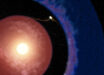
An unusual object discovered by NASA’s Chandra X-ray Observatory may represent a missing link between hidden ‘black hole stars’ and fully exposed supermassive black holes, offering new clues about how the first giants grew.
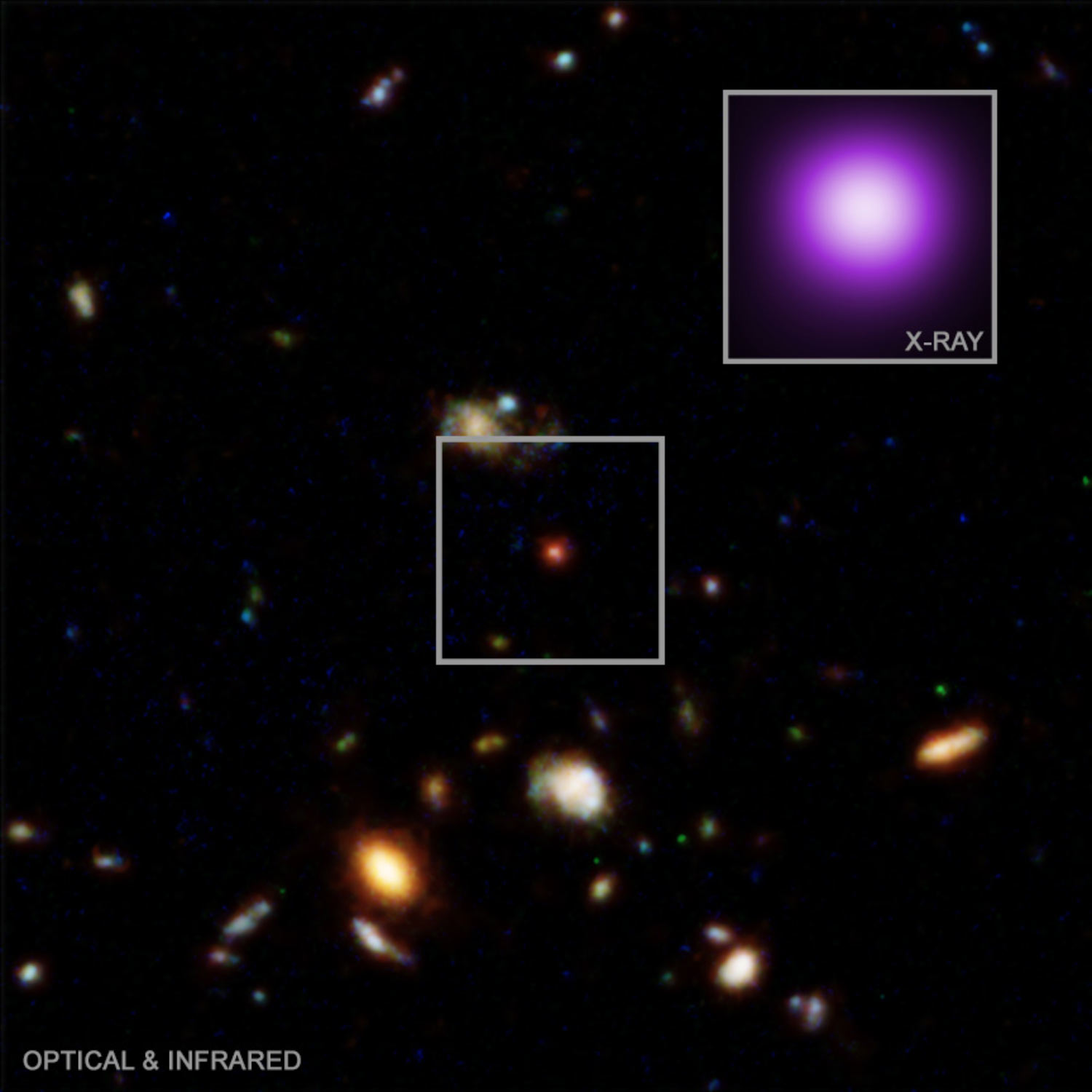
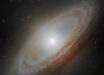
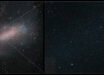
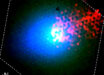
The optical and infrared image from Hubble show the region around the X-ray dot, while the Chandra X-ray image shows the close up. Image credit: NASA / CXC / Max Plank Inst / Hviding et al. / ESA / STScI / HST / CXC / SAO / N. Wolk.
Shortly after the NASA/ESA/CSA James Webb Space Telescope started its science observations, reports of a new class of mysterious objects emerged.
Astronomers found hundreds of small, red objects about 12 billion light-years from Earth or farther, which became known as ‘little red dots’ (LRDs).
Many scientists think LRDs are supermassive black holes embedded in clouds of dense gas, which mask some of the typical signatures in different kinds of light — including X-rays — that astronomers usually use to identify them.
This would make them different from typical growing supermassive black holes, which are not embedded in dense gas, allowing bright ultraviolet light and X-rays from material orbiting the black holes to escape.
Because of this and their potential similarities to stellar atmospheres, astronomers have called this the ‘black hole star’ scenario for LRDs.
The newly-discovered ‘X-ray dot,’ which is located about 11.8 billion light-years from Earth, may provide a crucial bridge between black hole stars and typical growing supermassive black holes.
Designated 3DHST-AEGIS-12014, it exhibits most of the features of an LRD, including being small, red, and located at a vast distance, but it glows in X-ray light, unlike other LRDs.
“Astronomers have been trying to figure out what little red dots are for several years,” said Dr. Raphael Hviding, an astronomer at the Max Planck Institute for Astronomy.
“This single X-ray object may be — to use a phrase — what lets us connect all of the dots.”
The astronomers found this one special object after comparing new data from Webb with a deep survey previously performed by Chandra.
“If little red dots are rapidly growing supermassive black holes, why do they not give off X-rays like other such black holes?” said Dr. Anna de Graaff, an astronomer at the Harvard & Smithsonian’s Center for Astrophysics.
“Finding a little red dot that looks different from the others gives us important new insight into what could power them.”
The researchers suggest that the X-ray dot represents a transition phase from an LRD to a typical growing supermassive black hole.
As the black hole star consumes its surrounding gas, patchy holes in the clouds of gas appear.
This allows X-rays from material falling onto the black hole to poke through, which are observed by Chandra.
Eventually all the gas is consumed, and the black hole star ceases to exist.
There are also hints in the Chandra data of the X-ray dot that there are variations in X-ray brightness, which supports the idea that the black hole is partly obscured.
As the cloud of gas rotates, patches of denser and less dense gas can move across the black hole, causing changes in X-ray brightness.
“If we confirm the X-ray dot as a little red dot in transition, not only would it be the first of its kind, but we may be seeing into the heart of a little red dot for the first time,” said Dr. Hanpu Liu, an astronomer at Princeton University.
“We would also have the strongest piece of evidence yet that the growth of supermassive black holes is at the center of some, if not all, of the little red dot population.”
An alternate idea for the X-ray dot is that it is a more common type of growing supermassive black hole but is veiled in an exotic type of dust that astronomers have not seen before.
Future observations are planned that should be able to shed light on the truth.
“The X-ray dot had been sitting in our Chandra survey data for over ten years, but we had no idea how remarkable it was before Webb came along to observe the field,” said Dr. Andy Goulding, also of Princeton University.
“This is a powerful example of collaboration between two great observatories.”
The discovery is reported in a paper in the Astrophysical Journal Letters.
_____
Raphael E. Hviding et al. 2026. The X-Ray Dot: Exotic Dust or a Late-stage Little Red Dot? ApJL 1000, L18; doi: 10.3847/2041-8213/ae4c88