A new genus and species of titanosaurian sauropod dinosaur related to South American forms has been described by a team of paleontologist led by University of Bath’s Dr. Nick Longrich.
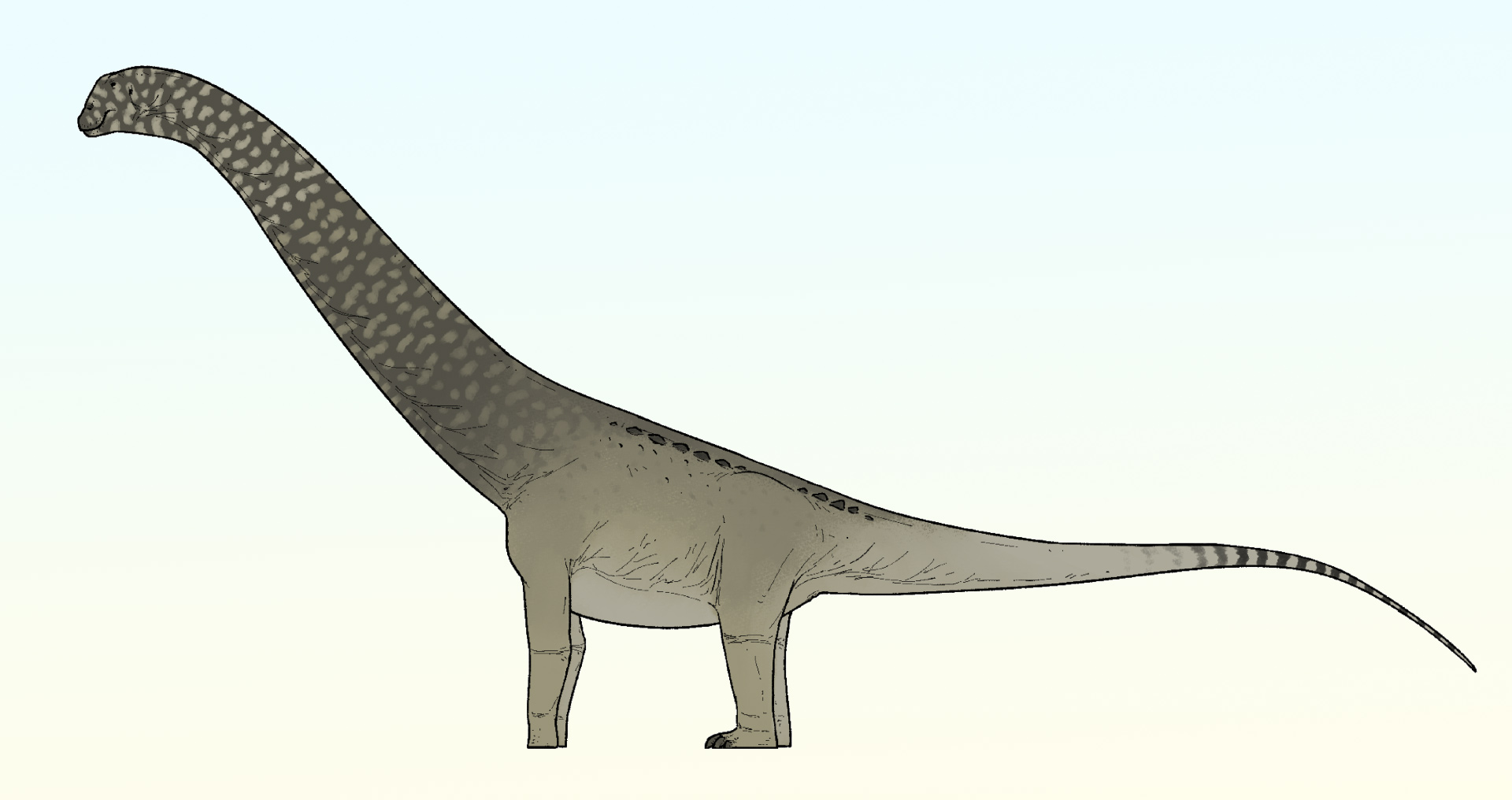
An artist’s reconstruction of Phosphatotitan khouribgaensis. Image credit: Connor Ashbridge.
Phosphatotitan khouribgaensis lived in what is now Morocco during the ‘late, but not latest,’ Maastrichtian age of the Cretaceous period, around 70 million years ago.
“The latest Cretaceous saw the final diversification of dinosaurs before the end-Cretaceous extinction,” Dr. Longrich and his colleagues wrote in their paper.
“Discussions of end-Cretaceous dinosaur diversity have focused on well-sampled faunas from Laurasia.”
“Far less is known about dinosaurian faunas of the southern hemisphere, especially Africa.”
The fossilized remains of Phosphatotitan khouribgaensis were recovered from phosphate deposits at Sidi Chennane, in the Oulad Abdoun Basin of Morocco’s Khouribga region.
The material includes dorsal and tail vertebrae, along with portions of the sacrum and pelvis.
“The phosphates of the Oulad Abdoun Basin of the Khouribga province consist of phosphatic sandstones, marls and limestones,” the paleontologists wrote.
“These were deposited in a warm, shallow epicontinental sea during the Late Cretaceous and Early Paleogene as part of a belt of phosphates that formed along the margins of the Atlantic and the Tethys Ocean.”
Despite being found in North Africa, Phosphatotitan khouribgaensis appears closely related to Lognkosauria, a group of titanosaurs previously known only from South America, including some of the largest land animals ever to exist.
This connection suggests that these dinosaurs were once widespread across the ancient supercontinent Gondwana before Africa and South America split apart more than 100 million years ago.
Alternatively, it raises the possibility that dinosaurs later crossed narrow ocean barriers between the continents.
“The new species differs from titanosaurs described from the Cretaceous of Africa and Europe but resembles South American Lognkosauria, and especially Patagotitan, in having short dorsal and caudal centra, expanded dorsal and caudal neural spines, and a broad pubis,” the researchers wrote.
Unlike its colossal South American relatives, Phosphatotitan khouribgaensis was relatively modest in size.
The scientists estimate the species weighed roughly 3.5 to 4 tons — far smaller than giants like Patagotitan. This reduced size may reflect environmental pressures or geographic isolation.
They suggest that parts of North Africa may have functioned like islands during the Late Cretaceous, a setting that often favors smaller-bodied species.
“Phosphatotitan khouribgaensis, along with previously reported hadrosaurids, suggests that Morocco supported a unique, endemic fauna in the latest Cretaceous, distinct from those found elsewhere in Africa,” the authors wrote.
“High sea levels in the Late Cretaceous may have created isolated landmasses, with distinct faunas emerging that reflect a combination of vicariance, endemism, and regional extinction.”
“The high degree of endemism in latest Cretaceous dinosaurs means that our understanding of dinosaur diversity is likely to be highly incomplete and complicates attempts to understand global patterns in dinosaur diversity prior to the end-Cretaceous extinction.”
The discovery of Phosphatotitan khouribgaensis is reported in a paper published in the journal Diversity.
_____
Nicholas R. Longrich et al. 2026. A Titanosaurian Sauropod with South American Affinities (Lognkosauria: Argentinosauridae) from the Late Maastrichtian of Morocco and Evidence for Dinosaur Endemism in Africa. Diversity 18 (5): 241; doi: 10.3390/d18050241