Astronomers using ESO’s Visible and Infrared Survey Telescope for Astronomy (VISTA) have observed the densest, most crowded regions at the centers of the Large and Small Magellanic Clouds, our Milky Way Galaxy’s closest dwarf companions, offering an unprecedented look at areas that have long resisted detailed study.
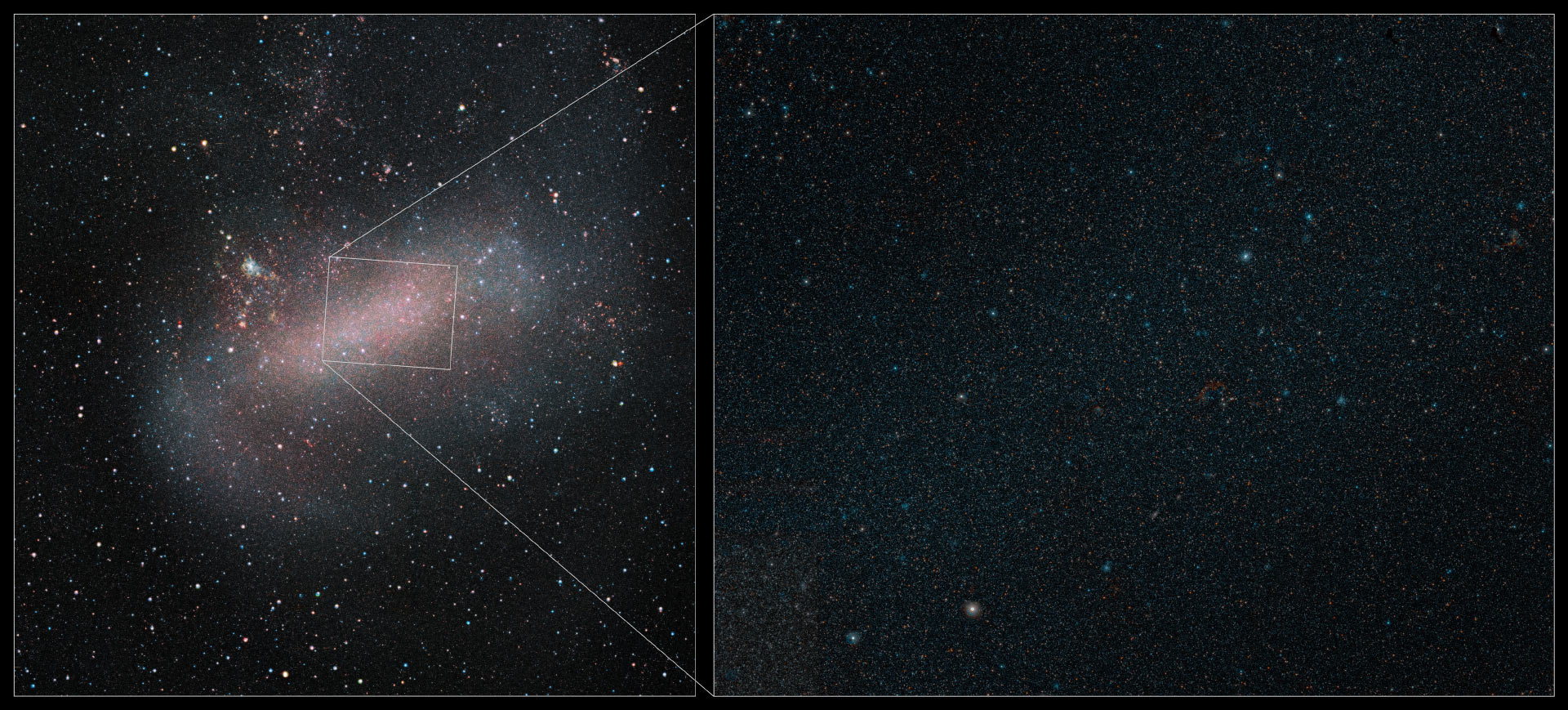
This image from ESO’s VISTA telescope shows the Large Magellanic Cloud. Image credit: ESO / Cioni et al.
“The central regions of galaxies are hard to study: dust partially blocks our view, and stars are so densely packed that it’s difficult to tell them apart,” said Professor Maria-Rosa Cioni from the Leibniz Institute for Astrophysics and her colleagues.
“To uncover these hidden stars in the Magellanic Clouds, we used the VISTA telescope.”
“Over several years, VISTA’s high-resolution infrared camera pierced through the dust to image the cores of these galaxies, finding a treasure trove of information about the inner lives of our nearest galactic neighbors.”
The astronomers targeted a roughly 1.77-square-degree patch at the core of each galaxy — the Large Magellanic Cloud’s dense stellar bar and the Small Magellanic Cloud’s tightly packed core — regions where overlapping stars, gas, and dust have made it difficult even for powerful surveys like Gaia and Hubble to resolve individual stars.
By taking about 40 observations, they built a catalog of nearly 2.5 million detections, split roughly evenly between the two galaxies.
Roughly two-thirds of these sources are likely genuine stars, while the remainder may be blended stars or background galaxies.
The catalog is already being used to study stellar kinematics, pulsating variable stars, ongoing star formation, and possible substructure within the ancient stellar populations at each galaxy’s heart.
“With these data, astronomers could then measure the subtle motion of stars in the cores, which is key to pinpoint the exact location of the centers of these galaxies,” the authors said.
“As well as this, by monitoring the periodic changes in the brightness of certain stars, which can be used to measure distances, they will be able to reconstruct the 3D structure of the cores of these galaxies.”
“Now that this unique dataset has been publicly released, the wider astronomical community can also access the information within, potentially digging up more secrets from deep inside our cosmic companions.”
The results will be published in the journal Astronomy & Astrophysics.
_____
M.-R. L. Cioni et al. 2026. Deep VISTA observations of the Magellanic Clouds (VMCDeep). A&A, in press; arXiv: 2608.28323