Astronomers have found new evidence that 3I/ATLAS, only the third confirmed interstellar object ever detected entering the Solar System from beyond, formed in an extremely cold environment far from any star.
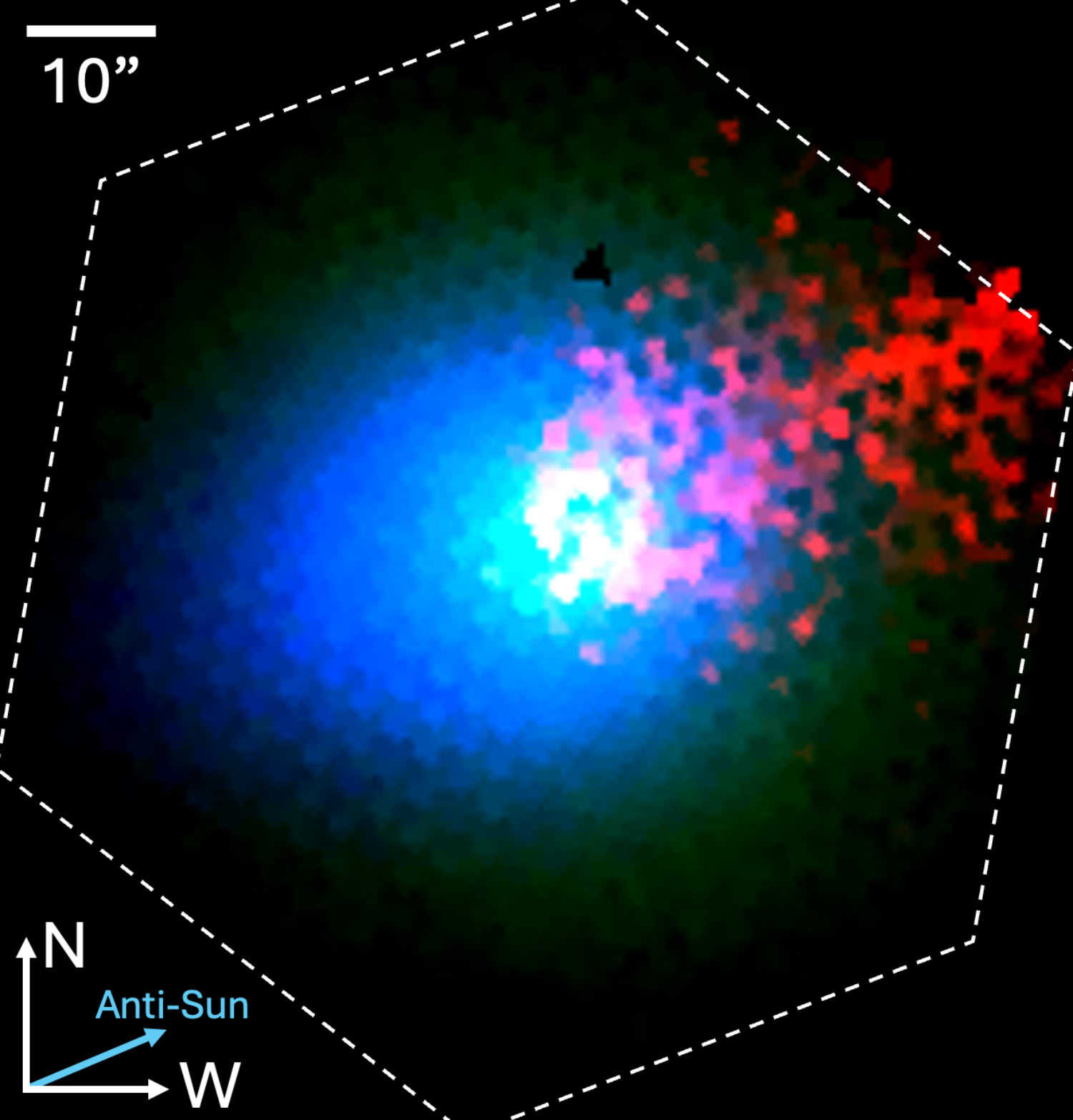
The distribution of dust (blue), gas (green) and ions (red) in the interstellar comet 3I/ATLAS. Image credit: Lea Ferellec.
“This object gives us a rare chance to study material that formed somewhere completely different to our own Solar System,” said Northumbria University astronomer Léa Ferellec and colleagues.
“Finding that it’s so rich in nitrogen tells us it likely formed in extremely cold conditions, far from its home star.”
“Every one of these objects we study helps us understand a little more about how planets form around other stars.”
Using the WEAVE Large-IFU instrument on the William Herschel Telescope in Spain, the astronomers observed the 3I/ATLAS’ plasma tail on November 30 and December 2, 2025, after it passed closest to the Sun.
They detected five different ion species in the tail — including nitrogen, carbon monoxide, carbon dioxide, water, and methylidyne ions — allowing them to measure how these gases relate to one another.
By measuring the ratio of ionized nitrogen to ionized carbon monoxide, they determined that 3I/ATLAS contains proportionally more nitrogen gas than typical solar system comets.
Because nitrogen is only efficiently trapped in cometary ice at very low temperatures, this points to the comet having formed in a frigid environment, likely below 30 K.
This finding aligns with other recent studies showing the comet is enriched in deuterium and other isotopic signatures consistent with cold, distant formation conditions, possibly in the outer reaches of its parent star’s planet-forming disk.
“Powerful, large-format integral field units with high sensitivity in the blue optical spectrum — like WEAVE-LIFU on the William Herschel Telescope — are opening new frontiers for the study of comets and other solar system objects,” said Dr. Rubén Sánchez-Janssen, director of the Isaac Newton Group of Telescopes who was not involved in this study.
The team’s paper was published in the Monthly Notices of the Royal Astronomical Society.
_____
L. Ferellec et al. 2026. Ion abundances in the plasma tail of 3I/ATLAS show that it is N2-rich. MNRAS 551 (3): stag1402; doi: 10.1093/mnras/stag1402