Using the spectral data from the Mid-Infrared Instrument (MIRI) onboard the NASA/ESA/CSA James Webb Space Telescope, astronomers have detected methane on 3I/ATLAS. This is the first direct detection of methane in an interstellar object.

Hubble captured this image of 3I/ATLAS on July 21, 2025, when the comet was 446 million km (277 million miles) from Earth. Image credit: NASA / ESA / David Jewitt, UCLA / Joseph DePasquale, STScI.
“Interstellar objects (ISOs) are planetesimals that formed around other stars and were later ejected from their birth systems through dynamical interactions,” said Caltech astronomer Matthew Belyakov and his colleagues.
“During their brief transit through our Solar System, ISOs offer discrete glimpses into extrasolar small-body populations and provide a valuable point of comparison for assessing commonalities and differences in planetesimal formation processes throughout the galaxy.”
3I/ATLAS is the third confirmed interstellar object after 1I/’Oumuamua and 2I/Borisov, with an estimated nucleus diameter of 2.6 km (1.6 miles).
In contrast to 1I/’Oumuamua, which had an inactive appearance, 3I/ATLAS has an extended coma.
“A concerted effort has been undertaken to characterize the chemical makeup of 3I/ATLAS’ coma,” the astronomers said.
“Ground-based spectroscopy at visible wavelengths yielded detections of gas-phase cyanogen and atomic nickel, while radio observations by the ALMA added methanol and hydrogen cyanide to the molecular inventory.”
“Pre-perihelion space-based observations in the near-infrared with Webb and SPHEREx uncovered fluorescence signatures from water, carbon dioxide, and carbon monoxide.”
“Post-perihelion SPHEREx measurements indicated a significant increase in carbon monoxide production and the emergence of an additional emission feature at 3.2-3.4 μm, likely due to organics.”
“Further evidence of 3I/ATLAS’ evolving activity includes a bluing visible color and the apparent asymmetry between its pre- versus post-perihelion water production trends.”
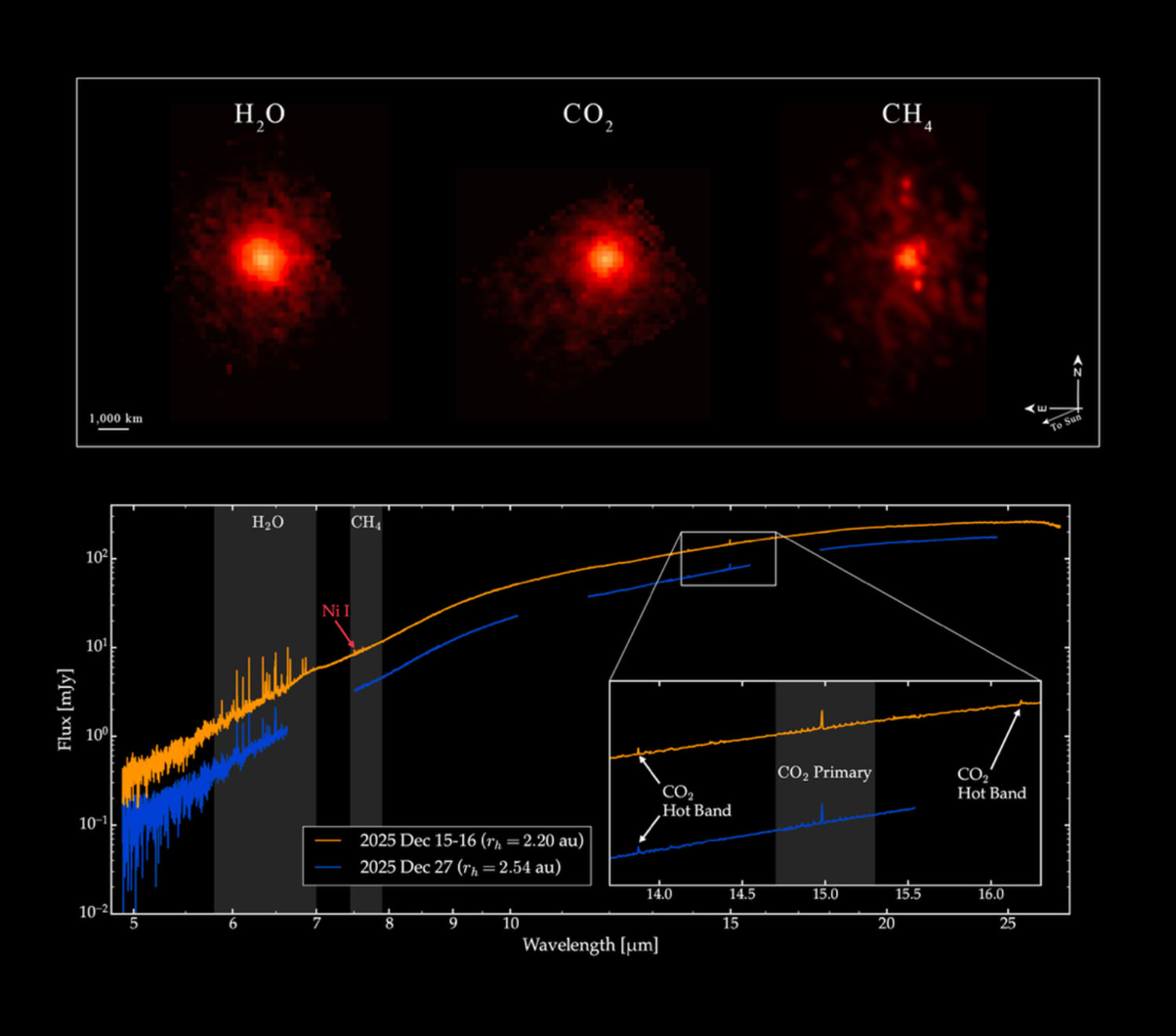
The top image shows 3I/ATLAS as seen with Webb’s MIRI instrument, along with contours that illustrate where different gases were located at the time the comet was viewed; water vapor spreads far beyond the nucleus because much of it is released from icy grains in the coma, while carbon dioxide and methane are most concentrated near the comet’s nucleus; the bottom image shows the spectrum, with the labels indicating the features from the various gases that Webb found escaping from the comet. Image credit: NASA / ESA / CSA / STScI / M. Belyakov, Caltech / I. Wong, STScI / A. Pagan, STScI.
The new Webb observations were taken using the MIRI instrument on two separate dates as 3I/ATLAS traveled back out of our Solar System after swinging around the Sun.
The first observation occurred December 15-16, 2025, when the comet was roughly 329 million km (205 million miles) from the Sun, followed by a second on December 27, when it had retreated to about 379 million km (236 million miles).
“Methane is highly volatile, meaning it sublimates from solid ice into a gas very easily,” the researchers said.
“Its delayed appearance in comet 3I/ATLAS suggests it was buried below the comet’s top surface layer and protected from sublimation until heat from the comet’s close pass to the Sun reached deeper parts of the icy subsurface.”
“The amount of methane relative to water found is surprisingly high, with few similar analogs in our own Solar System.”
3I/ATLAS was already known to be a carbon dioxide-rich oddity, and Webb confirmed it remains so.
The comet continues to release far more carbon dioxide relative to water when compared to typical solar system comets.
Together, methane and carbon dioxide abundances point to an origin story unlike anything that formed around our Sun.
“Additionally, Webb observed a sharp decline in gas production as comet 3I/ATLAS moved farther from the Sun, with water showing the most pronounced drop,” the scientists said.
“This is expected behavior for an object like this — as the comet gets less heat from the Sun, the surface gets colder and less ice is being vaporized.”
A paper on the findings was published April 8, 2026 in the Astrophysical Journal Letters.
_____
Matthew Belyakov et al. 2026. The Volatile Inventory of 3I/ATLAS as Seen with JWST/MIRI. ApJL 1001, L11; doi: 10.3847/2041-8213/ae5700