Paleontologists have identified a new species of the axolotl genus Ambystoma from several fossilized specimens found deep in the rocky outcrops of the Mexican state of Hidalgo. Named Ambystoma quetzalcoatli, the species is closely related to the living species from the central part of the Trans-Mexican Volcanic Belt, including the modern Mexican axolotl (Ambystoma mexicanum) and other lake-dwelling species.
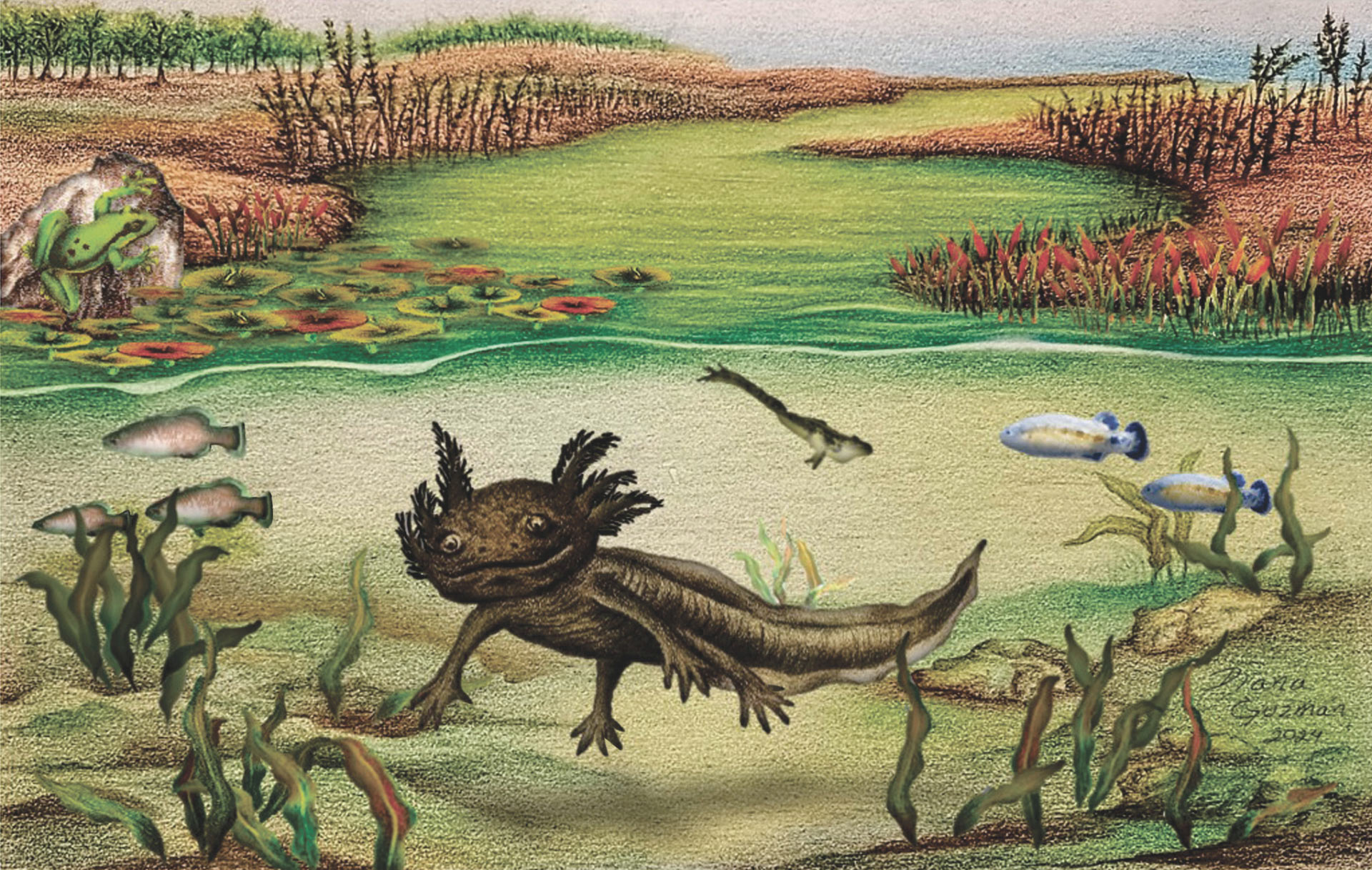
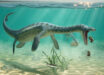
Reconstruction of the Santa María Amajac paleolake during the Late Pliocene; the paleobiodiveristy of the paleolake included microvertebrates such as the ambystomatid salamander Ambystoma quetzalcoatli, Paleocharacodon guzmanae and Goodea-like fishes, anurans and numerous species of terrestrial and aquatic plants such as Nymphaea sp., Scirpus sp., Typha sp. Image credit: Diana Guzmán-Madrid.
Ambystoma quetzalcoatli lived roughly 4.2 million years ago, during the Late Pliocene epoch, in a now-vanished mountain lake in what is today the Santa María Amajac area of Hidalgo.
The species represents the oldest known record of the genus Ambystoma in Mexico.
“Ambystoma is a salamander genus endemic to North America, named by in 1838,” said Universidad Nacional Autónoma de México paleontologists Jorge Herrera-Flores and María Patricia Velasco-de León.
“This genus stands out among modern salamanders in their unique developmental biology, characterized by paedomorphosis of some species, with adult individuals retaining larval traits later in life.”
“All living species of Ambystoma are distributed in North America with a geographical range from southern Canada, through most of the United States and the Mexican Plateau.”
“The genus Ambystoma includes 38 living species, of which 18 occur in Mexico, and 17 are endemic to the country.”
“The fossil record of Ambystoma is relatively good, especially for the United States where fossils of the tiger salamander (Ambystoma tigrinum) are common, and a few extinct species have been named.”
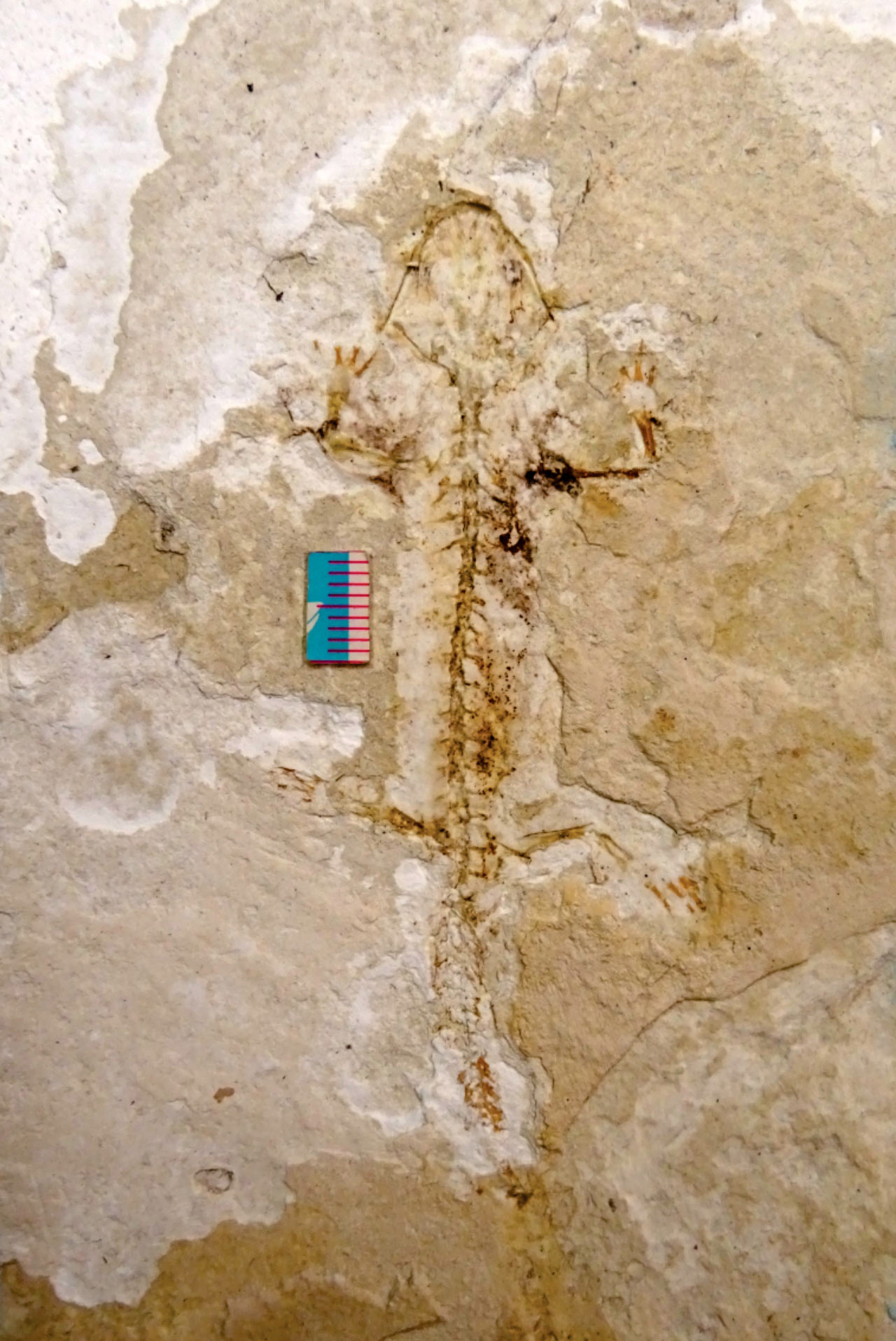
The skeleton of subadult Ambystoma quetzalcoatli. Image credit: Jorge A. Herrera-Flores & María Patricia Velasco-de León, doi: 10.26879/1644.
In their study, the researchers studied several fossil salamander specimens collected in the early 2000s from the Sanctorum fossil site of the Santa María Amajac area.
They then compared the fossils with several related Mexican species, confirming that the material represents a new Ambystoma species.
The new species possessed a combination of skeletal features not seen in living relatives.
The first is a distinctive V-shaped opening at the front of the premaxilla bones.
The second is a gap at the top of the skull that persists across different stages of development, a trait associated with the retention of juvenile features into adulthood, known as paedomorphosis.
The third is an unusually shaped bone at the base of the skull — the parasphenoid.
“We found three key morphological aspects of the skull that support the naming of Ambystoma quetzalcoatli as a distinct species,” the scientists said.
The discovery of Ambystoma quetzalcoatli also sheds light on the biodiversity of the ancient Amajac lake system.
The region has already yielded several fossil species found nowhere else, including extinct oaks, a beetle, a diatom and a goodeid fish.
The authors argue that geographic isolation created by surrounding mountain ranges may have promoted the evolution of unique local species.
“The description of a new species of fossil ambystomatid confirms the high diversity and morphological disparity that exist within the Ambystomatidae through its evolutionary history, especially for the Mexican species,” they concluded.
“Further, the Santa María Amajac area is confirmed as a cornerstone to understand the origin of modern megadiverse faunas in Mexico, with further potential for new finds.”
The team’s paper was published online in May 2026 in the journal Palaeontologia Electronica.
_____
Jorge A. Herrera-Flores & María Patricia Velasco-de León. 2026. Ambystoma quetzalcoatli sp. nov., a new species of fossil axolotl (Caudata: Ambystomatidae) from the Pliocene of Santa María Amajac, Hidalgo, Mexico. Palaeontologia Electronica 29 (2): a19; doi: 10.26879/1644