Paleontologists have identified a new genus and species of pan-shinisaur lizard from a partial upper jaw discovered in southern France, pushing the presence of its lineage in Europe back by at least 30 million years.
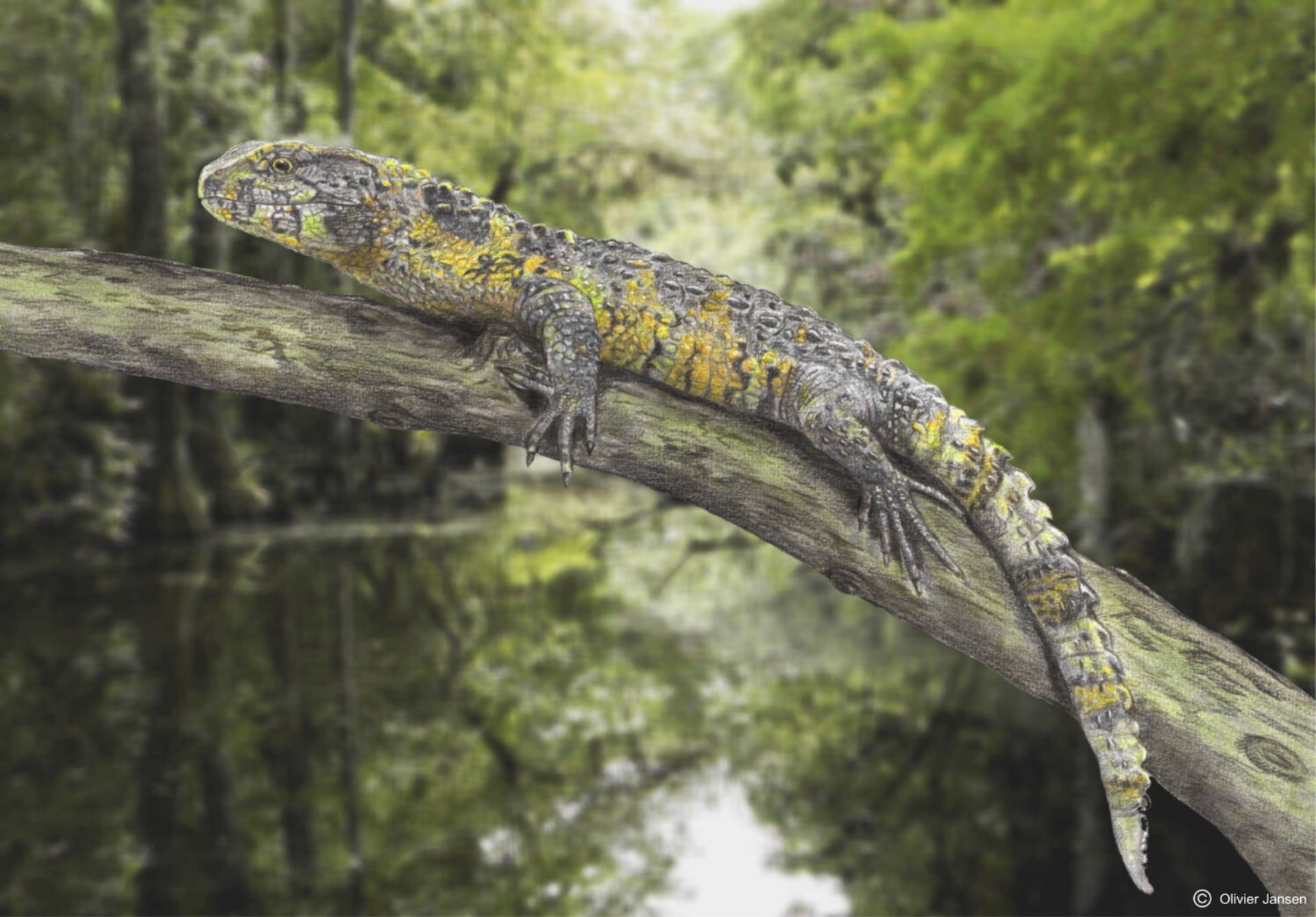
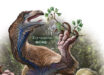
Paleoartistic reconstruction of Acutodon villeveyracensis, the oldest known member of the pan-shinisaur lineage ever found in Europe. Image credit: Olivier Jansen.
Pan-shinisaurs are an evolutionary group of anguimorph lizards that originated in the Early Cretaceous.
Today, the lineage survives in only one living species: the Chinese crocodile lizard (Shinisaurus crocodilurus), an endangered semi-aquatic reptile restricted to small forest streams of southeastern China and northern Vietnam.
Scientists estimate that only a few hundred remain in the wild, threatened by habitat destruction, poaching and climate change.
“The Chinese crocodile lizard is an endangered species that represents the only living species in the clade Pan-Shinisaurus (equivalent to Shinisauria),” said Dr. Olivier Jansen, a paleontologist with the Laboratoire Paléontologie Évolution Paléoécosystèmes Paléoprimatologie at the Université de Poitiers and CNRS, and his colleagues.
“This species survives in small subpopulations in lowland forests of southeastern China and northern Vietnam.”
“It faces severe threats, including habitat destruction and escalating levels of poaching, which is partially driven by food consumption and medicines, but largely by high demand in the illegal pet trade.”
“The Chinese crocodile lizard is also affected by climate change, being a semi-aquatic specialist adapted to remote and densely vegetated, clean streams within evergreen broadleaf forests, dependent on annual moderate cool temperatures.”
“While this species is currently on the brink of extinction, the evolutionary history of this group remains poorly understood, and the species could disappear before we untangle the mysteries of its origins.”
The newly-described pan-shinisaur species, named Acutodon villeveyracensis, lived in what is now France during the Campanian age of the Late Cretaceous, roughly 83 million years ago.
“This Cretaceous record is the oldest in Europe for pan-shinisaur lizards,” the paleontologists said.
“It pre-dates the occurrence of this clade in Europe by around 30 million years, raising questions about the paleobiogeographic history of pan-shinisaur lizards.”
The holotype and only material of Acutodon villeveyracensis was unearthed near the town of Villeveyrac in the Hérault region of France.
The specimen is a fossilized upper jawbone about 2.8 cm (1.1 inches) long, lined with slender, recurved teeth.
It shared several unusual anatomical traits with living and extinct crocodile lizards, including distinctive tooth replacement structures known as resorption pits.
The researchers concluded that the combination of features was unique enough to warrant naming an entirely new genus and species.
“Acutodon villeveyracensis is attributed to a pan-shinisaur anguimorph based on a toothed maxilla sharing multiple characters with the living Chinese crocodile lizard and its fossil relatives, notably tall, tapered, and recurved teeth, with mesiodistally constricted tooth bases lacking basal infoldings but possessing medial resorption pits, and a posteromedially shifted anterior superior alveolar foramen,” they said.
Using skull proportions from living crocodile lizards, the scientists estimated that Acutodon villeveyracensis may have exceeded 1 m (3.3 feet) in length.
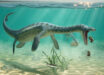
“This species was certainly a predator, competing in size and habitat type with two other large squamates present in this ecosystem (i.e., a terrestrial monstersaur and a freshwater mosasaur),” they said.
“The peculiar dentition of Acutodon villeveyracensis, composed of thin, tapered, and recurved teeth, is consistent with a diet that included fishes, and by analogy with the Chinese crocodile lizard, it possibly also fed on other small vertebrates such as frogs, salamanders, and albanerpetontids that inhabited the marshes of the freshwater floodplain of Villeveyrac (Hérault, France).”
The discovery of Acutodon villeveyracensis is described in a paper published this week in the Journal of Vertebrate Paleontology.
_____
Olivier Jansen et al. A new pan-shinisaur lizard (Anguimorpha) from the lower Campanian of Villeveyrac (Hérault, France). Journal of Vertebrate Paleontology, published online May 20, 2026; doi: 10.1080/02724634.2026.2636649