Paleontologists have described a gigantic new species of mosasaur — stretching up to 13.2 m (43 feet) long and armed with serrated teeth — and given it an unexpected name: T. rex (short for Tylosaurus rex).
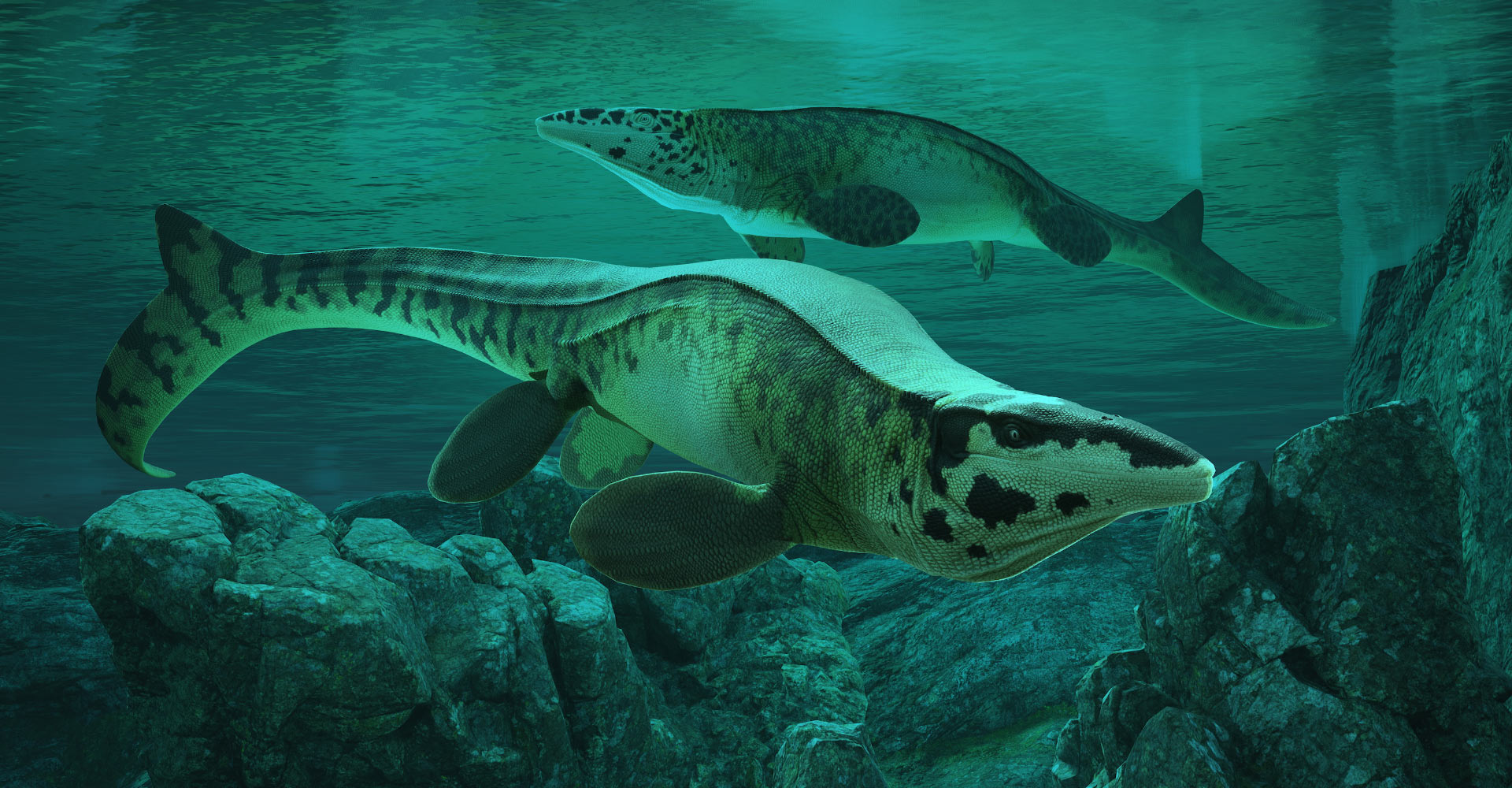
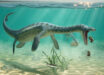
Life reconstruction of Tylosaurus rex in the Cretaceous-era Western Interior Seaway of North America. Image credit: Alderon Games / Path of Titans.
Mosasaurs were a group of giant marine reptiles that lived during the Late Cretaceous epoch, roughly 100 million to 66 million years ago.
Though often compared to dinosaurs, they were actually more closely related to modern monitor lizards and snakes.
Mosasaurs are generally divided into four major subfamilies (Mosasaurinae, Plioplatecarpinae, Tylosaurinae and Halisaurinae), each of which independently evolved flippers, streamlined aquatic bodies and, in some cases, enormous size.
Among them, tylosaurine mosasaurs stood out for their toothless snouts, elongated tails and relatively weakly ossified limbs, adaptations linked to life in open water.
They were also the first mosasaurs to reach truly gigantic proportions, exceeding 8 m (26 feet) in length.
Fossils of tylosaurines have been found across Europe, Asia, New Zealand, Africa and Antarctica, though they were especially abundant in North America’s Western Interior Seaway.
“Everything is bigger in Texas and that includes the mosasaurs, apparently,” said study’s lead author Dr. Amelia Zietlow, a paleontologist at the American Museum of Natural History.
Dr. Zietlow began this study as a Ph.D. student when she came across a mosasaur fossil in the American Museum of Natural History’s research collection that appeared to be misidentified as Tylosaurus proriger.
After comparing the specimen with the holotype of Tylosaurus proriger, she and her colleagues concluded that their specimen, along with more than a dozen similar fossils held at other institutions, belonged to an entirely different mosasaur.
The differences were substantial: larger in stature than Tylosaurus proriger, the fossils also bore finely serrated teeth — a trait uncommon among mosasaurs.
And while most Tylosaurus proriger specimens come from what is now Kansas and date to roughly 84 million years ago, the newly identified fossils are predominantly from Texas and are about 4 million years younger.
“The holotype for the newly described Tylosaurus rex is a giant specimen displayed at the Perot Museum that was first discovered in 1979 along an artificial reservoir near Dallas,” the paleontologists said.
Beyond Tylosaurus rex’s impressive size, the new species had a suite of adaptations for exceptionally strong jaw and neck muscles, suggesting that it was a powerful predator.
“Besides being huge, roughly twice the length of the largest great white sharks, Tylosaurus rex appeared to be a much meaner animal than other mosasaurs,” said study’s co-author Dr. Ron Tykoski, curator of vertebrate paleontology at the Perot Museum.
“Through our study and examination of well-preserved fossils collected throughout the north Texas region, we have evidence of violence within this species to a degree not previously seen in other Tylosaurus specimens.”
“Some of this aggressive behavior can be seen in a Tylosaurus rex specimen housed in the Perot Museum’s collection nicknamed ‘The Black Knight,’ which is missing the tip of its snout and has a fractured lower jaw, damage that researchers say could only be inflicted by its own species.”
“Other well-known mosasaur specimens that were previously known as Tylosaurus proriger and will now take the name Tylosaurus rex include ‘Bunker,’ a massive specimen on display at the University of Kansas that was discovered in 1911, and ‘Sophie,’ which is on display in the Yale Peabody Museum.”
The team’s paper appears today in the Bulletin of the American Museum of Natural History.
_____
Amelia R. Zietlow et al. 2026. A gigantic new species of Tylosaurus (Squamata: Mosasauridae) from Texas, and a revised character list for phylogenetic analyses of Mosasauridae. Bulletin of the American Museum of Natural History 482; doi: 10.1206/0003-0090.482.1.1