Analyzing 1.75-billion-year-old microfossils from ancient Australian seabeds, paleontologists say ancient eukaryotes — the ancestors of every plant, animal and fungus — huddled in oxygenated seafloor patches for over a billion years before breaking free into open water.
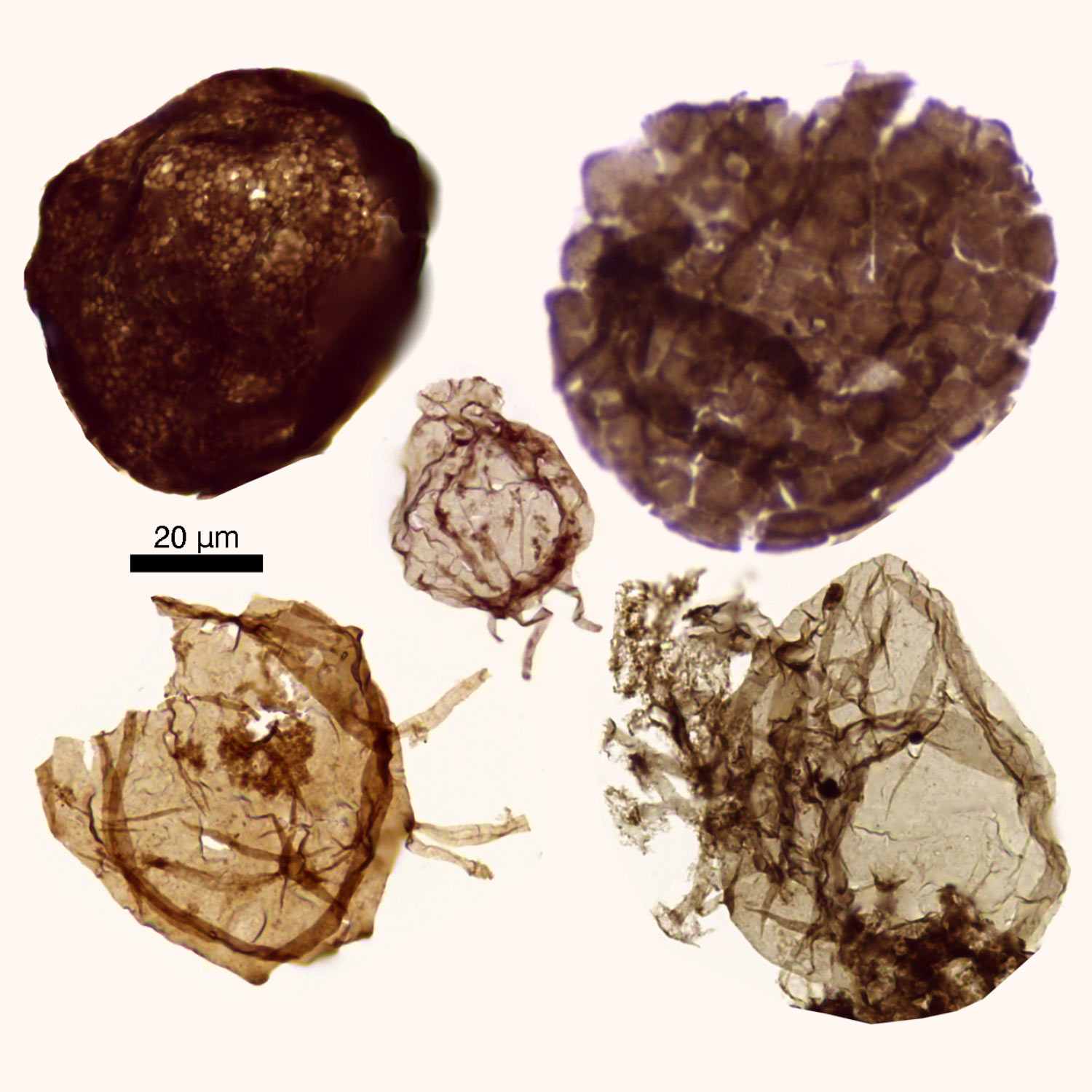
Fossil eukaryotes from Northern Territory, Australia. Image credit: Lechte et al., doi: 10.1038/s41586-026-10533-4.
Eukaryotes include humans, plants, animals, fungi and many microscopic organisms.
Knowing where and how they first evolved is central to understanding how life on Earth became diverse and complex.
“We wanted to know what environments earliest eukaryotic life inhabited, in particular as a test of whether early eukaryotic fossils had already acquired mitochondria, giving them the ability to occupy aerobic environments,” said McGill University’s Professor Galen Halverson.
“We found that the oldest eukaryotes that we’ve seen so far already needed oxygen in some capacity,” added Dr. Leigh Anne Riedman, a paleontologist at the University of California, Santa Barbara.
“And we were able to figure out that they were living on or within the seafloor by the way they were distributed across the samples.”
In the study, the paleontologists examined microscopic fossils preserved in fine-grained rocks from the McArthur and Birrindudu basins of Northern Territory, Australia.
Today, this region of Australia ranges from outback and savanna to the billabongs and forests of Kakadu National Park.
But between 1.75 to 1.4 billion years ago, it was a shallow inland sea replete with lagoons, offshore mudflats and calm coastal waters.
To understand the habitats of the ancient eukaryotes, the researchers analyzed the chemistry of the rocks themselves.
Using oxygen‑sensitive elements such as iron, they were able to determine that the seawater in which these early eukaryotes lived contained oxygen, even though at this time, most of the oceans lacked oxygen.
“We found that the earliest eukaryotes for which we have fossils lived in predominantly near-shore, oxygenated, benthic (on the seafloor) settings,” Professor Halverson said.
“This shows that the availability of oxygen was dictating eukaryote evolution from its early stages,” Dr. Riedman said.
Many scientists had assumed early eukaryotes lived without oxygen or drifted through the water.
The finding that oxygen was part of early life on Earth calls long-held assumptions into question.
The location of the fossils provided further clues about how these early organisms lived.
“The distribution of the fossils also shows that the eukaryotes likely lived on the seafloor, and probably didn’t expand out into the open oceans until about a billion years later, which would have transformed the biosphere once more,” said Dr. Maxwell Lechte, a paleontologist at the University of Sydney.
The findings align with recent studies of micro-organisms closely related to the ancestors of eukaryotes, which suggest an ability to use oxygen.
“Eukaryotes represent most of the visible life around us,” Professor Halverson said.
“Understanding how they originated is a longstanding major question in science that links to making sense of the biodiversity present today on Earth and possible on other habitable planets.”
A paper describing this research was published this month in the Nature.
_____
M.A. Lechte et al. Early fossil eukaryotes were benthic aerobes. Nature, published online May 20, 2026; doi: 10.1038/s41586-026-10533-4