Physicists from the ATLAS Collaboration at CERN’s Large Hadron Collider have confirmed that quantum entanglement — the phenomenon Albert Einstein called ‘spooky action at a distance’ — can survive in some of the most extreme conditions ever produced in a laboratory.
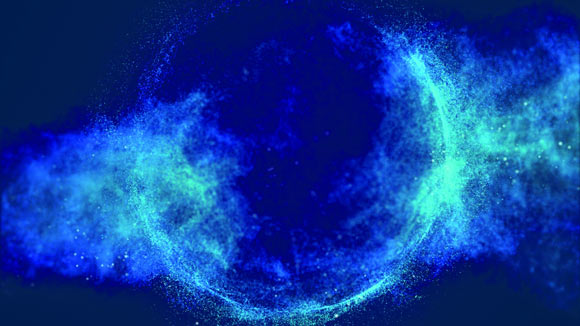
In 2012, physicists from the ATLAS and CMS experiments at CERN announced the discovery of a new boson looking very much like the Higgs boson. Image credit: Daniel Dominguez / CERN.
“Quantum entanglement is one of the fundamental features of quantum mechanics, lying at the heart of quantum information science and quantum field theory,” said University of Oxford’s Professor Alan Barr and his colleagues.
“Today, it underpins emerging technologies such as quantum computers, ultra-secure quantum communication networks and next-generation sensors.”
“For instance, in quantum computing, entanglement is used to manipulate multiple qubits in a single operation, rather than individually. This allows multiple calculations to be performed simultaneously.”
“However, it was unknown whether quantum entanglement remains intact under more extreme conditions — such as the short-lived particles produced during highly energetic collisions.”
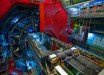
Using the ATLAS detector at the Large Hadron Collider (LHC), the physicists found strong evidence of entanglement between pairs of Z bosons, heavy, short-lived particles generated when a Higgs boson decays.
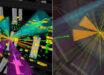
The Z bosons themselves vanish almost instantly, but the researchers were able to infer their spins by tracking the electrons and muons they leave behind, reconstructing the angles at which those particles flew apart after collisions occurring at 13 trillion electron volts.
“The Z bosons studied were produced in the decay of a Higgs boson — the particle discovered at the LHC in 2012 — which briefly splits into two Z bosons before each one decays further into pairs of electrons or muons,” the scientists said.
“The Higgs bosons are generated by smashing together protons travelling at 99.99% the speed of light: collisions that have energies of thirteen trillion electron volts.”
“Although the Z bosons vanish almost instantly, the ATLAS detector can precisely track the electrons and muons they leave behind.”
The new finding ranks among the highest-energy confirmations of entanglement ever recorded, extending a phenomenon long associated with delicate, small-scale lab experiments into the realm of violent, high-energy particle collisions.
“Entanglement is both the most promising and the most puzzling aspect of quantum reality,” said University of Oxford’s Professor Chris Timpson.
“These collider experiments detecting entanglement present a new frontier in investigations of the foundations of quantum mechanics.”
“This measurement demonstrates the scientific power of the ATLAS Collaboration and the unique capabilities of the LHC,” added University of Oxford’s Professor Daniela Bortoletto.
A paper describing this research was published this month in the journal Physical Review Letters.
_____
G. Aad et al. 2026. Measurements of 𝑍-Boson Pair Entanglement in Decays of Higgs Bosons at the ATLAS Experiment. Phys. Rev. Lett 137, 111804; doi: 10.1103/y1nh-1b82