A tubular marine creature that lived on the seafloor more than 540 million years ago may have survived in toxic, sulfur-rich waters by teaming up with bacteria.
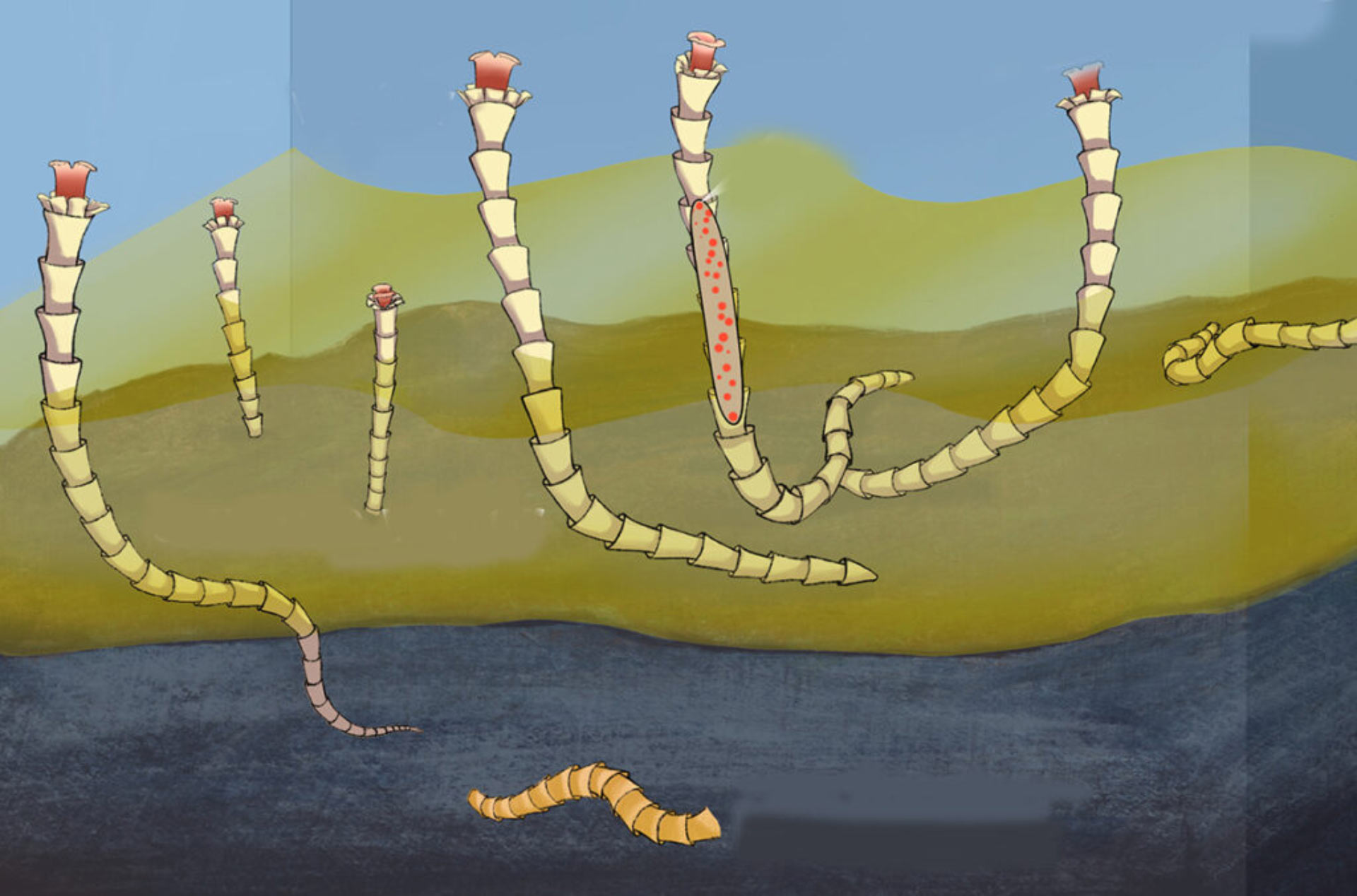
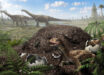
Reconstruction of Conotubus hemiannulatus and its symbiotic relationship with sulfur-oxidizing bacteria. Image credit: David Fike.
The ancient animal, known as Conotubus hemiannulatus, lived in the final stretch of the Ediacaran period, shortly before the Cambrian explosion of animal life.
“The phylogenetic affinity of Conotubus hemiannulatus remains uncertain,” said Nanjing University’s Dr. Yongbo Peng, Virginia Tech’s Dr. Shuhai Xiao, and their colleagues.
“It has been assigned to the family Cloudinidae or to the informal group of cloudinomorphs, based on its funnel-in-funnel tubular morphology, which is reminiscent of Cloudina, a contemporaneous tubular fossil with a global distribution.”
The creature’s fossils were found in the Dengying Formation in Shaanxi province, southern China.
They were preserved as pyrite (fool’s gold), which formed quickly as the organisms were buried.
“Specimens range in length from 3 to 80 mm, with apertural diameters of 0.3 to 12 mm and apical diameters of 0.1 to 4 mm,” the paleontologists said.
“Some specimens exhibit transverse annulations or apertural rims, potentially reflecting periodic growth or taphonomic modification.”
In the new study, the researchers analyzed molybdenum isotopes in the specimens.
They found that, compared with contemporaneous Ediacaran seawater, the fossils were strongly depleted in molybdenum-98, by more than 4.6 parts per thousand.
Such low values are otherwise known from modern tube worms at deep-sea cold seeps, which host sulfur-oxidizing bacteria in their tissues.
The fossils’ sulfur signatures suggest Conotubus hemiannulatus lived where oxygen and sulfide overlapped, and that bacteria were actively processing sulfur in their habitat.
The scientists concluded that the Ediacaran animal may have engaged in chemosymbiosis, a partnership in which microbes convert chemicals such as hydrogen sulfide into food for their host.
They describe it as the earliest geochemically supported case in the fossil record.
Such a partnership could also have helped the animal cope with sulfide, which is toxic to most animals.
“There are a whole host of organisms that have these partnerships in the environment today,” said co-author Professor David Fike, a researcher at Washington University in St. Louis.
“Previously, we didn’t know if that is a relatively recent evolutionary event, or if that emerged all the way back when animals first evolved.”
The results appear in the Proceedings of the National Academy of Sciences.
_____
Zhenfei Wang et al. 2026. Chemosymbiotic trophic strategy in an Ediacaran tubular animal. PNAS 123 (35): e2526201123; doi: 10.1073/pnas.2526201123