Early sauropodomorph skulls from the Late Triassic are scarce. A newly described one from South Africa’s Eastern Cape belongs to a previously unknown species: Nyana rooiwalensis.
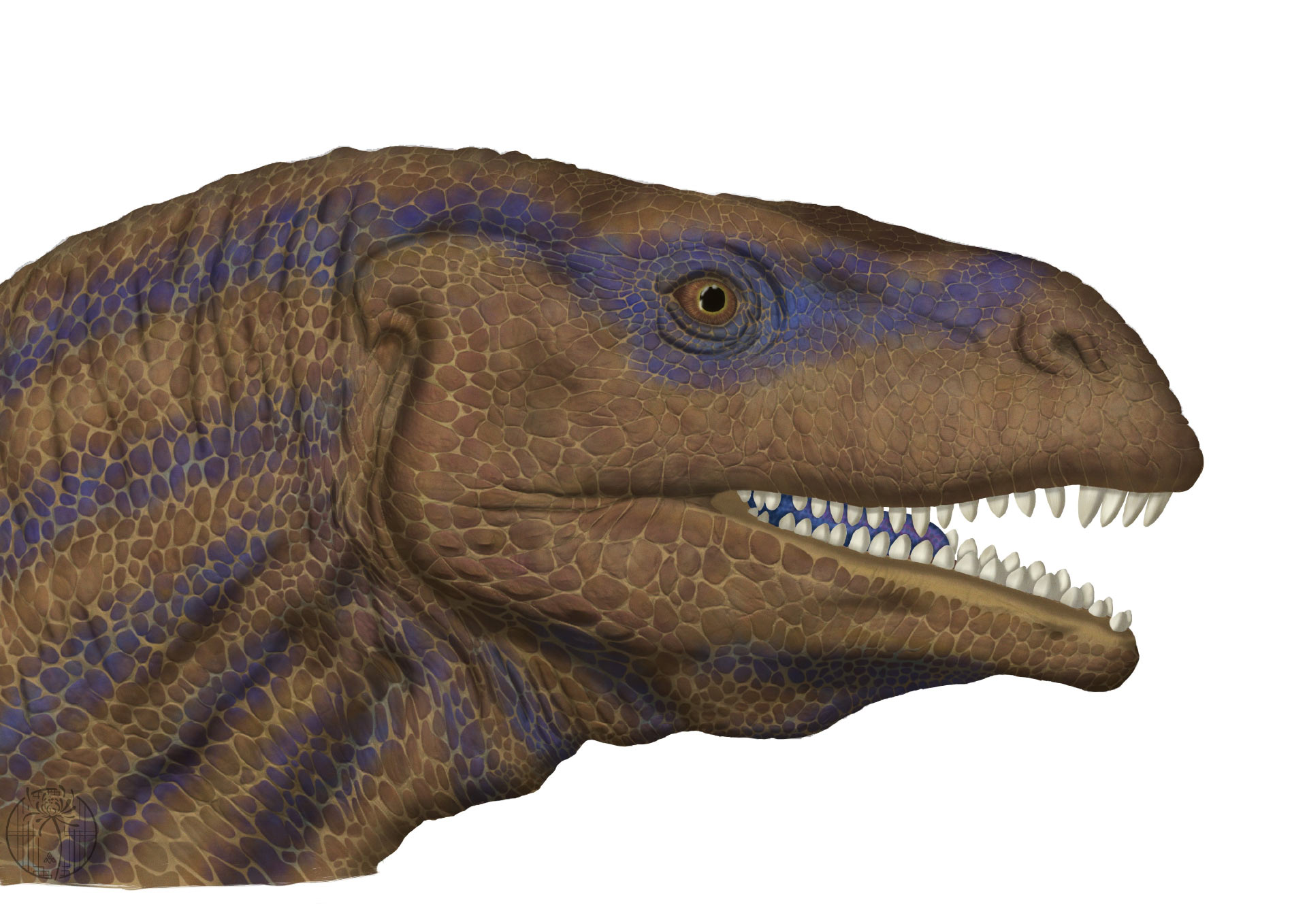
Nyana rooiwalensis. Image credit: Steven Saunders / Atashni-Moopen.
Nyana rooiwalensis was a type of sauropodomorph, a group that includes giant, long-necked sauropods, such as Brontosaurus.
The new species roamed the Earth during the Late Triassic epoch, roughly 220 million years ago.
A well-preserved, near-complete skull and several postcranial bones of a juvenile Nyana rooiwalensis were collected in 2018 on the outskirts of Qhemegha village in Eastern Cape province, South Africa.
The fossil came from the lower Elliot Formation, which records a 30-million-year interval spanning the Late Triassic to the Early Jurassic.
“Triassic sauropodomorph cranial material is known primarily from Argentina, Brazil and Europe and is sparsely distributed across the phylogenetic tree,” University of the Witwatersrand paleontologist Atashni Moopen and her colleagues wrote in their paper.
“In southern Africa, only two Late Triassic species preserve cranial elements, Mbiresaurus and Kholumolumo, both represented by limited material.”
The preserved skull of Nyana rooiwalensis measures 21.3 cm (8.4 inches) and includes a largely intact braincase, the palate and a hyoid, the small bone structure of the throat.
It also has the rings of bone that supported the eye, along with parts of the spine, limbs and a jaw.
The complete skull would have been longer than that of the largest known adult Massospondylus, a well-known South African relative.
“The holotype and only specimen includes the first almost complete and articulated dinosaur skull from the South African Late Triassic and is one of only a handful of such skulls from this time in the southern continents,” the paleontologists wrote in the paper.
To study the fossil, they scanned it with a powerful X-ray beam at the European Synchrotron Radiation Facility.
They also cut thin slices from the dinosaur’s leg bones to read its growth record.
Growth rings in bone, which work somewhat like tree rings, showed at most two lines of arrested growth, and the bone’s surface and structure indicated it was still growing actively when it died. The skull’s sutures, the seams between bones, were still open. The researchers estimate it was at least in its third year of life.
Yet the animal was already large — more than four times the size of juvenile Massospondylus and Mussaurus individuals of comparable age, making it one of the largest juvenile dinosaurs known from the Late Triassic.
“Extrapolation of these growth curves suggests that adult Nyana rooiwalensis may have reached multi-ton body masses,” the scientists wrote.
The proportions of its limb bones suggest that Nyana rooiwalensis walked on two legs.
According to the authors, the findings support the idea that rapid growth arose early in sauropodomorph evolution, well before the true giants appeared.
Their phylogenetic analysis puts Nyana rooiwalensis as a close relative of either Sarahsaurus, from North America, or Ngwevu, from South Africa.
Depending on the analysis, it is either an early-branching member of a group called massopodans or a member of Massospondylidae.
“If Nyana rooiwalensis is a massospondylid, it is the first Triassic member of the clade recovered from South Africa and indicates that the clade had a southern Gondwanan distribution in the Late Triassic prior to the radiation across Pangea in the Early Jurassic,” the paleontologists wrote.
“If the new species is considered an early-branching massopodan, this suggests that this clade was widely distributed prior to the massospondylid radiation.”
“The placement of Nyana rooiwalensis, as the sister taxon of Sarahsaurus aurifontanalis, provides a biogeographic link between the early-diverging sauropodomorphs of southern Africa and western North America.”
A paper describing the discovery was published this week in the journal Royal Society Open Science.
_____
Atashni Moopen et al. 2026. Nyana rooiwalensis: South Africa’s earliest near-complete sauropodomorph dinosaur skull from the Late Triassic of the Eastern Cape Province. R. Soc. Open Sci 13 (11): 261002; doi: 10.1098/rsos.261002