Astronomers at the Curtin University node at the International Centre for Radio Astronomy Research (ICRAR) have found a white dwarf that beams out radio pulses every 7.9 minutes while circling a star much like our Sun. It is the first time such a signal has been traced to a white dwarf with a Sun-like partner.
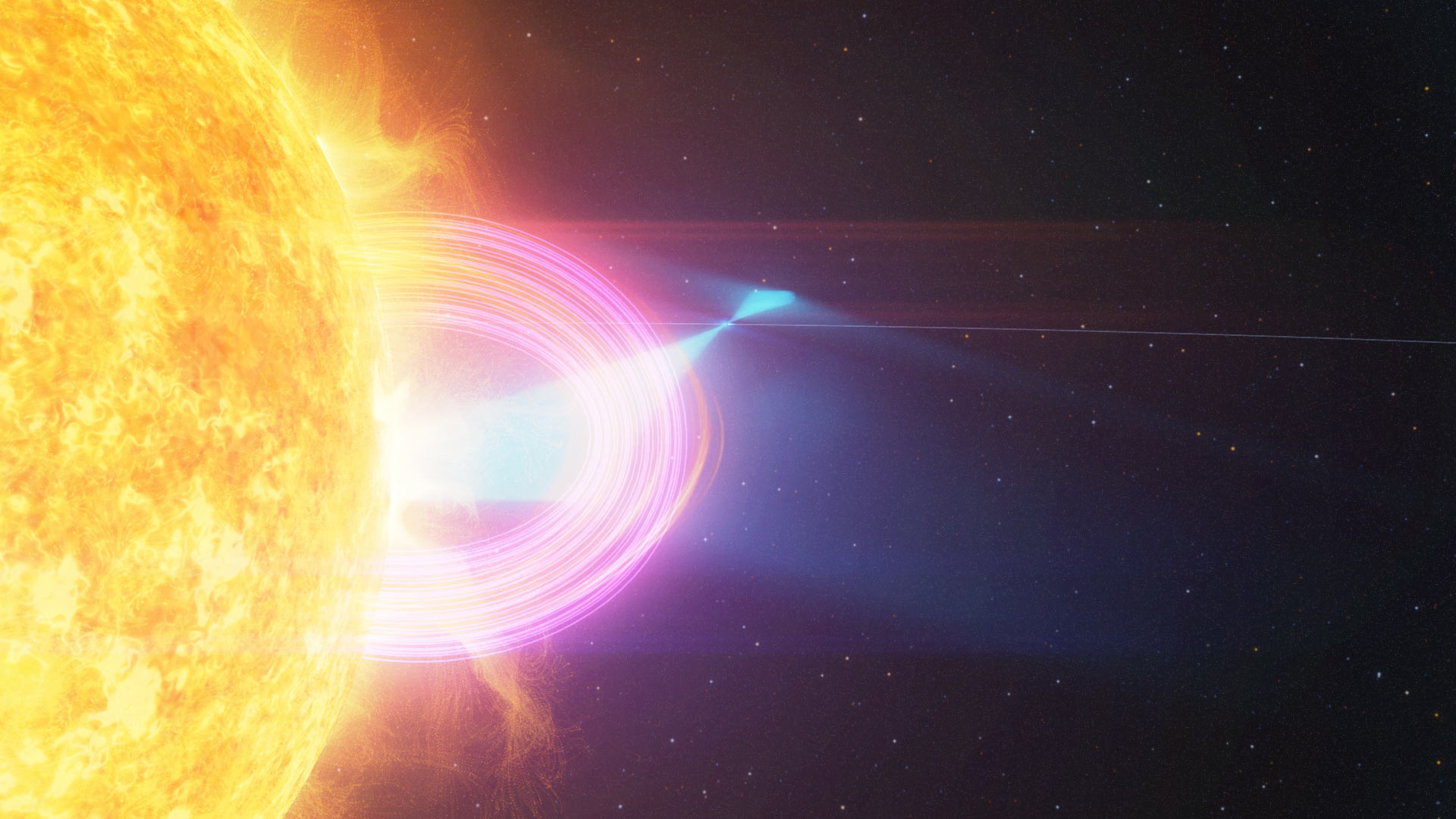
An artist’s impression of the GPM J071507-114153 binary system. Image credit: N. Hurley-Walker.
Called GPM J071507-114153, the binary system consists of a low-mass white dwarf and a G-type star.
It belongs to a rare class of objects known as long-period transients (LPTs).
These objects switch their radio emission on and off over minutes to hours.
Only about a dozen are known, since the first was found in 2021 by the same team.
Earlier LPTs with white dwarfs were mostly paired with smaller, cooler red dwarfs.
Until now, it was unclear which star in these pairs produced the pulses.
The signal from GPM J071507-114153 is clear enough to show the white dwarf moving along its orbit, which places the source close to the white dwarf, or possibly on it.
“This is the first time the pulses are clear enough to see the white dwarf moving in its orbit around its companion, so we know that the pulsations are coming from a region close to the white dwarf, or possibly even from the white dwarf itself,” said Dr. Sam McSweeney, an astronomer at ICRAR and a commissioning scientist with the Square Kilometre Array Observatory.
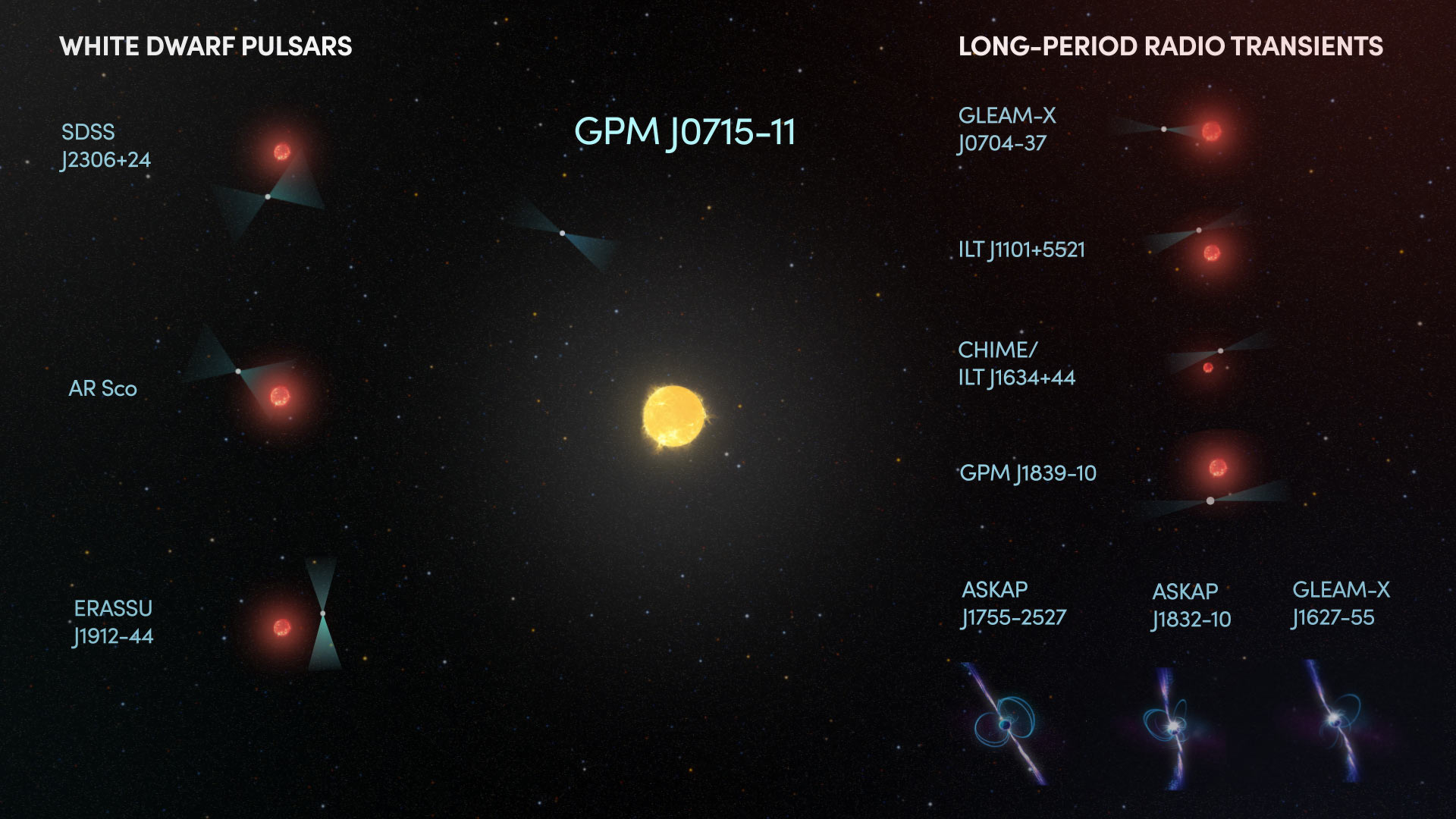
GPM J071507-114153 joins a growing collection of known long-period transients. Image credit: N. Hurley-Walker.
Dr. McSweeney and colleagues processed more than 100 hours of radio data at the Pawsey Supercomputing Research Centre to confirm the motion.
They revealed stellar flares on the Sun-like star, similar to those that cause aurorae on Earth.
They also saw the white dwarf pass behind what is likely a stellar prominence, a huge loop of plasma erupting from the star’s surface.
“The pulses emitted by the white dwarf allowed our team to detect stellar flares on the Sun-like star, similar to those that create aurorae here on Earth,” said Dr. Natasha Hurley-Walker, an astronomer at ICRAR.
“As a bonus, we also saw the white dwarf moving behind a region with a strong magnetic field, most likely a ‘stellar prominence,’ which is a large loop of plasma erupting from a star’s surface.”
“It’s amazing that by using radio wavelengths we can detect the storms on a star over 5,000 light-years away.”
The findings were published today in the journal Nature Astronomy.
_____
S.J. McSweeney et al. A long-period transient with a Sun-like companion. Nat Astron, published online November 12, 2026; doi: 10.1038/s41550-026-03016-z