In a pair of papers published in the journal Physical Review Letters, a team of MIT physicists has shown that the neutrino laser — a concept proposed just a year ago — cannot actually be built, no matter how advanced the technology becomes.
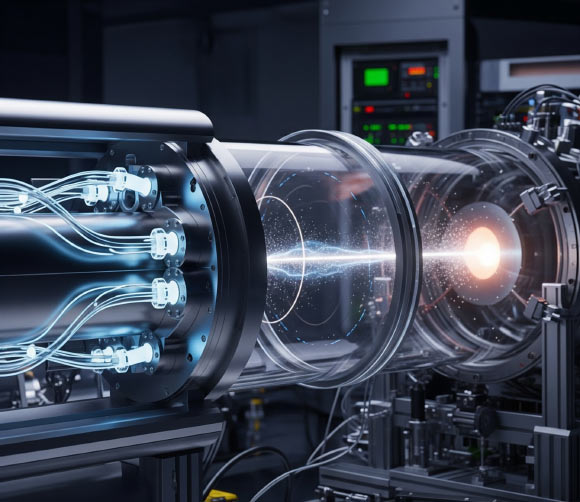
In 2025, B.J.P. Jones & J.A. Formaggio devised an idea for a laser that shoots a beam of neutrinos.
Put forward by MIT Professor Joe Formaggio and Dr. Ben Jones from the University of Texas at Arlington, the idea of the neutrino laser was elegant in its ambition.
Cool a cloud of radioactive atoms down to nanokelvin temperatures — a billionth the chill of interstellar space — and the atoms should settle into a Bose-Einstein condensate, a bizarre quantum state where they act as a single, synchronized entity.
In this state, the physicists proposed, the atoms’ radioactive decay would speed up dramatically, and the neutrinos they emit as a byproduct would stream out together in a tight, laser-like beam, dramatically shortening radioactive half-lives in the process.
But according to MTI Professor Wolfgang Ketterle, the Nobel laureate who co-discovered Bose-Einstein condensates in 1995, the idea was too good to be true.
Working with MIT physicists Hanzhen Lin and Yu-Kun Lu, Professor Ketterle presents a two-part analysis demonstrating that the neutrino laser concept, along with a similar proposal for gamma-rays, is physically and fundamentally impossible.
Neutrinos are emitted with roughly a million times more energy than the visible photons used in ordinary lasers, meaning the atom releasing one recoils at velocities equivalent to Mach 10, fast enough that it essentially vanishes from the condensate almost instantly. This leaves no time for the kind of quantum ‘imprint’ the amplifying effect would require.
“As long as the recoil atom stays in the condensate, it can make the condensate superradiant,” Professor Ketterle said.
“But when a neutrino is emitted at a million electronvolts, the atom recoils at velocities equivalent to Mach 10, faster than a fighter jet. This is so fast that the atom would almost instantly disappear.”
Even in an idealized scenario where an imprint could form, the researchers found it would function backward: rather than telling the condensate to emit the next neutrino in the same direction, it would signal the opposite, preventing any beam from building up.
They trace this anti-correlation to the fact that neutrinos are fermions — a class of particle, including electrons, that behaves fundamentally differently from the photons that make ordinary superradiant lasers possible.
“These two papers are sort of punch one and punch two,” Professor Ketterle said.
“Each paper would have killed the proposal.”
“When a new idea — such as the one we proposed — is shared, it is the duty of the community to scrutinize it,” Professor Formaggio said.
“Such is the scientific process. Indeed, it was great to see how our paper generated a lot of thinking outside of our original concept. We suspect that will continue.”
_____
Yu-Kun Lu et al. 2026. Fundamental Impossibility of a Superradiant Neutrino Laser. Phys. Rev. Lett 137, 101804; doi: 10.1103/8x7k-rwx2
Hanzhen Lin et al. 2026. Can Bose-Einstein Condensates Enhance Radioactive Decay? Phys. Rev. Lett 137, 101805; doi: 10.1103/rnx6-wqpf