El Soplao, a fossil site tucked into the hills of Cantabria in northern Spain, stands out for yielding amber pieces with a blue-violet hue and abundant bioinclusions, according to a new review paper.
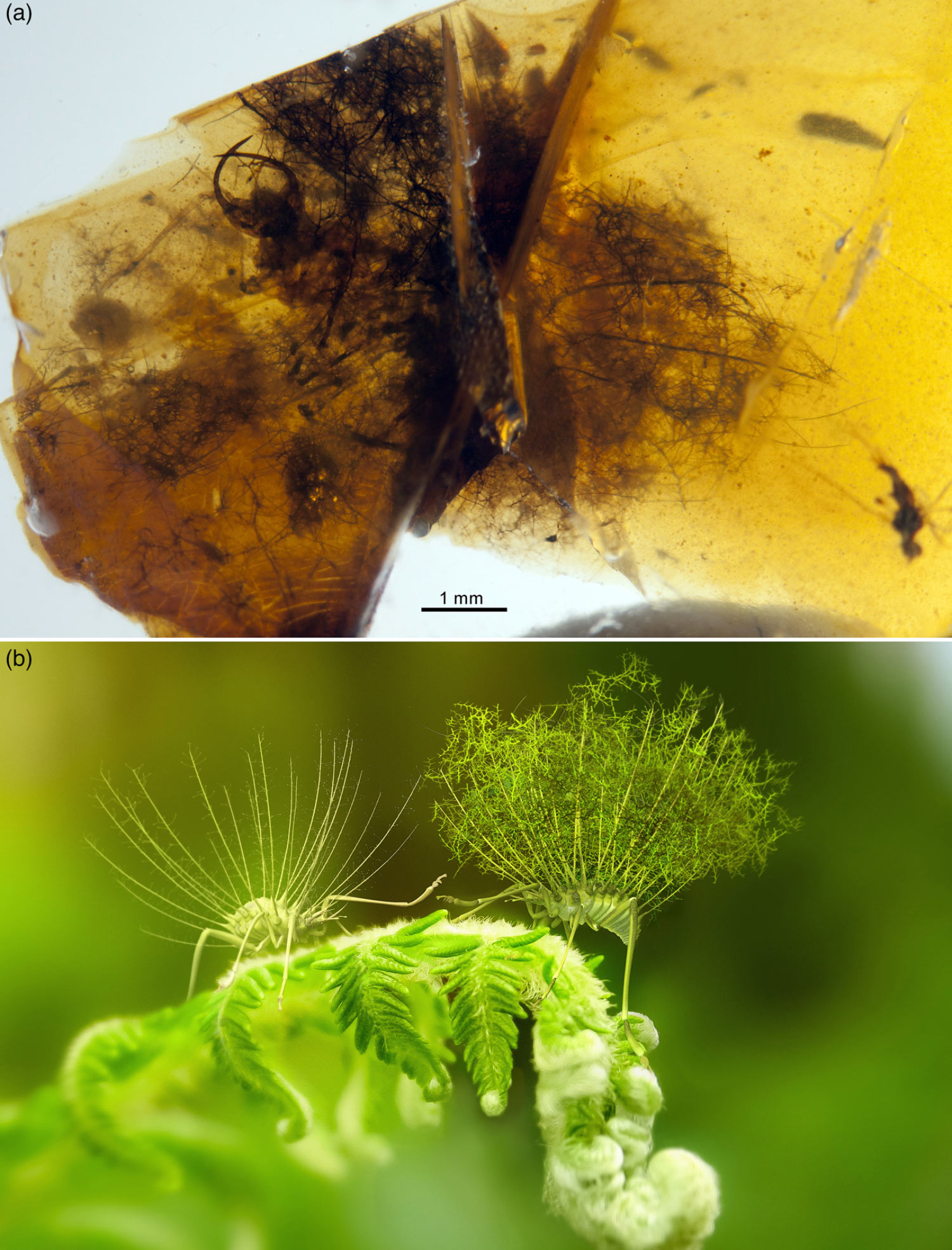
The larval lacewing Hallucinochrysa diogenesi and its debris-carrying behavior. (a) photograph of the holotype in ventrolateral view; (b) life reconstruction of two late-instar larvae in dorsolateral view, one bearing a complete debris packet showing their life appearance and the other devoid of it to showcase its peculiar anatomy. Image credit: J.A. Peñas.
The El Soplao site was uncovered by chance during roadworks in 2005 but wasn’t recognized as a major fossil deposit until two geologists identified it in 2007.
Since then, excavations have produced more than 1,500 arthropod specimens trapped in amber, the fossilized tree resin prized for preserving ancient organisms in extraordinary detail.
“In the Iberian Peninsula, the occurrence of fossilized plant resin (amber) spans a broad stratigraphic range within the Mesozoic, from the Carnian in the Late Triassic to the Maastrichtian in the Late Cretaceous, with only rare occurrences in the Cenozoic,” said first author Dr. Alba Sánchez-García from the Universitat de València and colleagues.
“The Albian ambers (Early Cretaceous) are the most fossiliferous and of paramount significance because they allow the reconstruction of terrestrial ecosystems during a period of major biotic change, marked by the rapid diversification of flowering plants.”
What sets the El Soplao deposit apart, according to the researchers, is both the quality and the distinctiveness of its amber.
The pieces glow with a characteristic blue-violet hue, a trait traced to a chemical compound called guaiazulene.
Many specimens preserve anatomical detail down to microscopic structures, allowing scientists to study not just what ancient creatures looked like, but how they behaved.
The amber dates to the Albian stage of the Early Cretaceous, roughly 105 million years ago, a pivotal period when flowering plants were beginning their rise to dominance over the gymnosperm-dominated forests.
“Regarding its botanical origin, studies suggested that one of the El Soplao resin producers may have belonged to the conifer family Cheirolepidiaceae,” the paleontologists said.
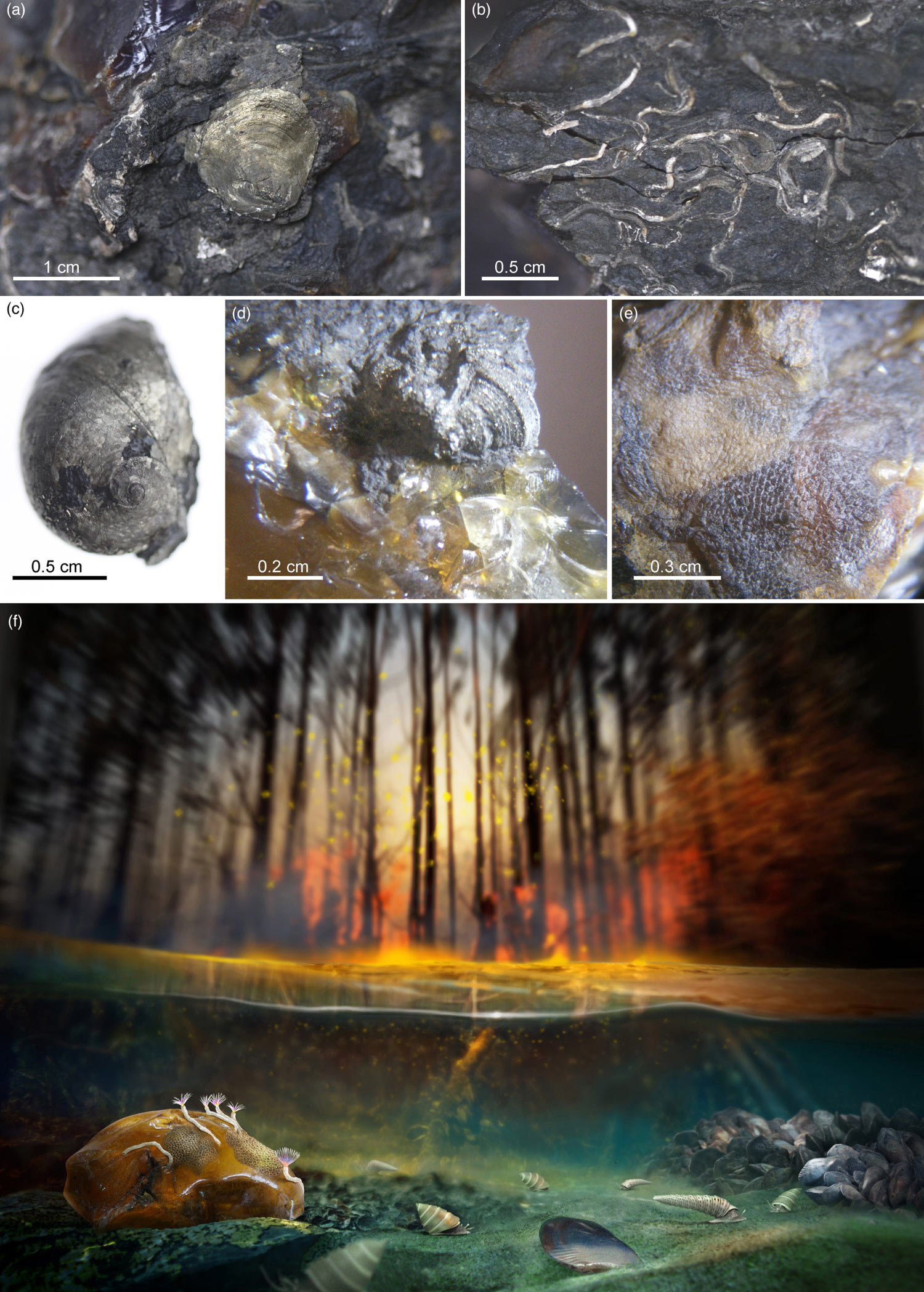
Marine or brackish-water invertebrates associated with El Soplao amber and their contextualization within a paleoecological reconstruction of the Cretaceous (Albian) Spanish amber forest of El Soplao: (a) photograph of a pyritized ostreid attached to an amber piece; (b) serpulids preserved as carbonate fossils attached to the surface of an amber piece; (c) gastropod preserved as a pyritized internal mold; (d) gastropod preserved as a pyritized internal mold in rock contiguous to an amber piece; (e) bryozoan colony preserved as an impression on the surface of an amber piece; (f) hypothetical swamp environment and resiniferous forest under the recurring influence of fires. Image credit: J.A. Peñas.
Among the discoveries are the oldest tick known to science, a lacewing larva that camouflaged itself with plant debris more than 100 million years before its modern descendants still use the same trick, and a fly preserved mid-meal with pollen from an extinct gymnosperm group clumped on its body — direct evidence of pollination before flowering plants took over that ecological role.
Theropod dinosaur feathers have also turned up in the El Soplao amber, some showing signs of having been pulled from living animals that brushed against sticky resin.
“Bioinclusions are generally three-dimensionally preserved, showing high anatomical fidelity,” the researchers noted.
“Based on the observation of broken inclusions and microtomographic data, most correspond to hollow casts.”
“Impressions in amber are rare, but some examples are known, such as wing imprints or Frenelopsis axes imprinted on a large amber flow.”
The El Soplao deposit has yielded 40 named species so far, 32 of them new to science, spanning crustaceans, spiders, insects and more.
Despite nearly two decades of study, key questions remain unresolved, including why ants are entirely absent from El Soplao and other Spanish amber deposits despite appearing in amber of similar age elsewhere in the world.
“Ongoing multidisciplinary research at the El Soplao fossil site, including continued fieldwork, seeks to refine interpretations of taphonomic pathways and ecological patterns through the application of state-of-the-art techniques and analytical approaches,” the scientists said.
“In this context, the site constitutes a reference Konservat-Lagerstätte for understanding the structure and functioning of Cretaceous forested ecosystems, still dominated by conifers, during a key interval of terrestrial change.”
The paper was published August 13, 2026 in the Journal of the Geological Society.
_____
Alba Sánchez-García et al. 2026. The El Soplao Konservat-Lagerstätte: a key Cretaceous amber deposit from Spain. Journal of the Geological Society 183 (5): jgs2025-022; doi: 10.1144/jgs2026-022