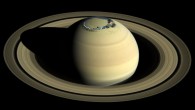
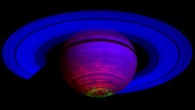
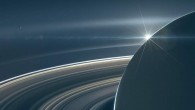
Saturn is unique among planets observed to date in that some of its aurorae are generated by swirling winds within its atmosphere, and not just from the...
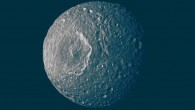
Mimas, the smallest and innermost of Saturn’s eight main moons, may be warm enough to harbor a global, liquid water ocean beneath a 24-31-km (15-19-mile)...
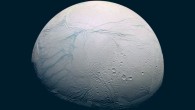
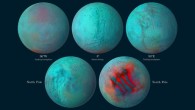
Observations from NASA’s Cassini spacecraft established that Enceladus, the sixth-largest of Saturn’s moons, has a global subsurface ocean. An analysis...
Detailed measurements from the Grand Finale phase of NASA’s Cassini mission revealed distinctive features of Saturn’s magnetic field. These features...
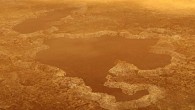
Kraken Mare, a sea of liquid methane on Saturn’s moon Titan, is at least 100-m (330 feet) deep near its center, according to an analysis of data collected...
Using the spectral data collected by the Visual and Infrared Mapping Spectrometer (VIMS) onboard NASA’s Cassini spacecraft, a team of researchers has...
Spectral data gathered by the Visual and Infrared Mapping Spectrometer (VIMS) onboard NASA’s Cassini spacecraft provide strong evidence that the northern...
The heliosphere is a giant magnetic bubble that contains our Solar System, the solar wind and the solar magnetic field. Outside the heliosphere is the...
Saturn is orbited by 82 moons, and tidal friction within the giant planet causes the moons to migrate outwards. In a study published this week in the journal...
A team of planetary researchers from the United States and the United Kingdom has created a 2D map of densities and temperatures in Saturn’s thermosphere...
Enceladus, an ocean-harboring moon of Saturn, erupts a plume that contains gases and frozen sea spray into space. By understanding the composition of the...
At the end of its mission in 2017, NASA’s Cassini spacecraft performed a set of ‘Grand Finale’ orbits bringing it closer to Saturn than ever before....
Using radar and infrared data from NASA’s Cassini orbiter spacecraft, a team of planetary geologists has identified and mapped the major geological units...
Vast longitudinal dunes up to 330 feet (100 m) in height in the equatorial deserts of Saturn’s moon Titan are the Solar System’s most monumental surface...
Saturn’s moon Enceladus is erupting a plume of gas and ice grains from its south pole. According to new research using data from NASA’s Cassini mission,...
The famous ring system of Saturn may be much older than some planetary scientists think, according to a new study published in the journal Nature Astronomy.
NASA’s...
Small methane-filled lakes on the surface of Titan were likely formed by explosive, pressurized nitrogen just under the hazy moon’s surface, according...