By tracking fierce winds racing through the atmospheres of seven ultra-hot Jupiters, astronomers have uncovered the strongest evidence yet that magnetic fields shape weather on worlds beyond our Solar System.
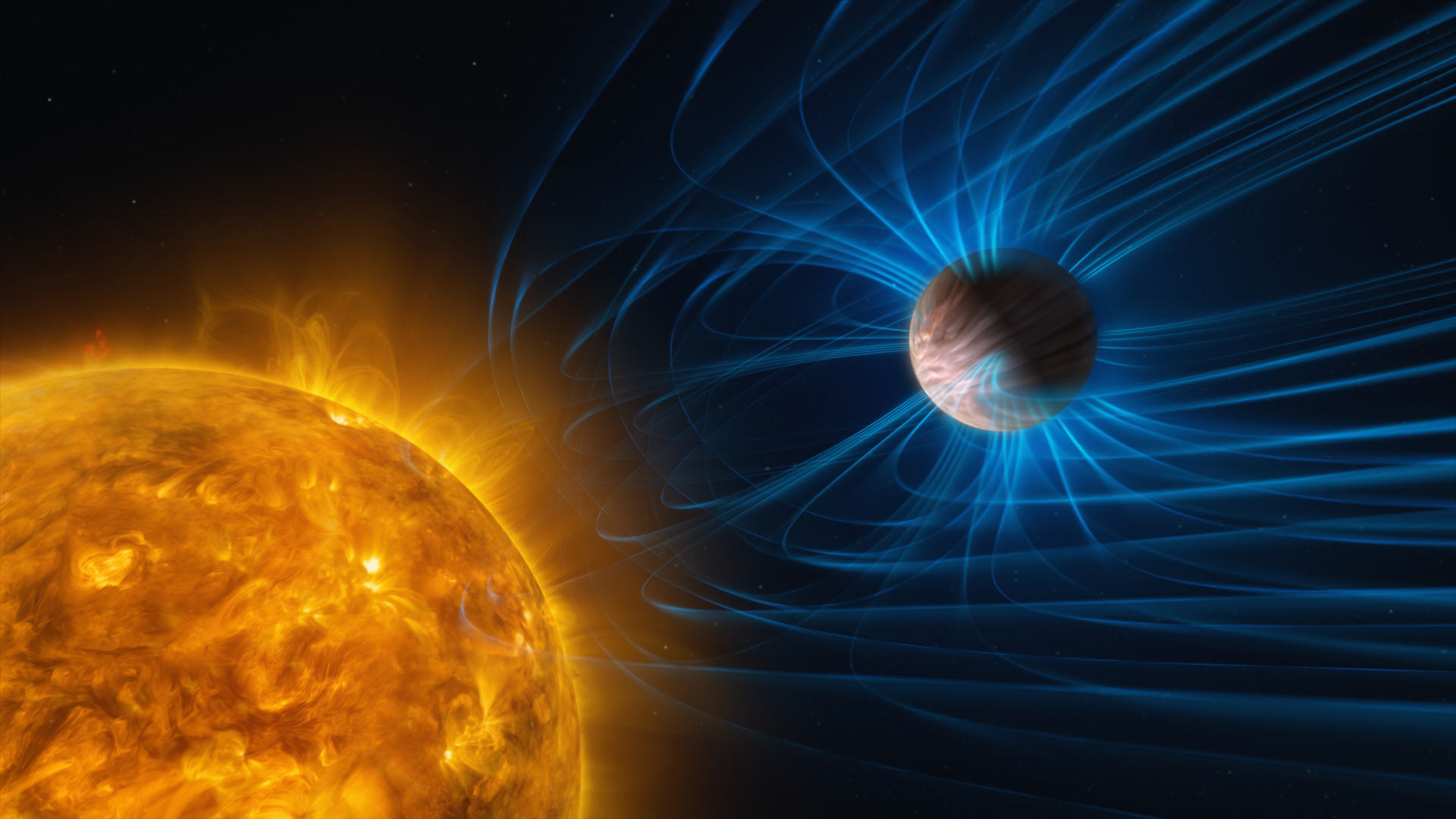
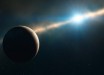
This illustration shows magnetic activity in an ultra-hot Jupiter. Image credit: ESO / M. Kornmesser / L. Calçada.
The magnetic field of Earth influences our atmosphere in complex ways, and is therefore a key factor in understanding what keeps the planet habitable for life.
Magnetic fields are also present in other Solar System planets, like Jupiter and Saturn.
However, for the past 15 years, no one succeeded in directly measuring the strength of the magnetic fields of exoplanets — until now.
“This breakthrough opens a completely new window on exoplanet research,” said Dr. Julia Seidel, an astronomer with the Laboratoire Lagrange at the Observatoire de la Côte d’Azur.
“It’s the first time we can compare the magnetic environments of other worlds — a key step toward ultimately understanding which planets can stay alive, keep their water, and perhaps even, one day, host life as we know it.”
The astronomers measured wind speeds on seven tidally-locked ultra-hot Jupiters orbiting different stars.
The wind speeds in the sample ranged from around 7,200 km/h to over 25,000 km/h; in comparison, the fastest winds measured on Jupiter reach speeds of around 1,500 km/h.
For their measurements, the researchers used data from the ESPRESSO instrument on ESO’s Very Large Telescope and from a similar instrument on the Gemini North telescope.
But when they looked at how the wind speeds varied with planet temperature, they saw a very intriguing pattern emerge: the hotter the planet, the slower the wind.
“This is totally counter intuitive because, all things being equal, hot planets have more energy to accelerate the winds,” said Professor Vivien Parmentier, also from the Laboratoire Lagrange at the Observatoire de la Côte d’Azur.
“Something must happen that slows down the wind speeds for hotter objects.”
The scientists concluded that the most consistent explanation for this mystery is the presence of planet-wide magnetic fields, since these fields can work as a brake, slowing down the motion of charged particles in the atmosphere.
The data therefore allowed the authors to infer the strength of the magnetic field in each of the studied planets.
They found them to be comparable in strength to those found in our Solar System: approximately four times as strong as Saturn’s or about half the strength of Jupiter’s.
Such strong magnetic fields could affect more than just the wind on these distant planets.
“Here on Earth, we know the beauty of the northern and southern lights, where particles from the Sun hit our magnetic field and are guided toward the poles, colliding with gases in the atmosphere to produce colorful displays of green, pink, and purple,” said Dr. Bibiana Prinoth, an astronomer at ESO.
“On the studied exoplanets, the magnetically driven aurorae could be even more dramatic. “
The study appears today in the journal Nature Astronomy.
_____
J.V. Seidel et al. Magnetic field strengths of hot giant exoplanets consistent with Solar System values. Nat Astron, published online June 2, 2026; doi: 10.1038/s41550-026-02870-1