A supermassive black hole 6 billion times the mass of the Sun lurks in MRG-M0138, a gravitationally lensed quiescent galaxy seen when the Universe was just 3 billion years old, according to an analysis of data collected by the NIRSpec Integral Field Spectrograph onboard the NASA/ESA/CSA James Webb Space Telescope.
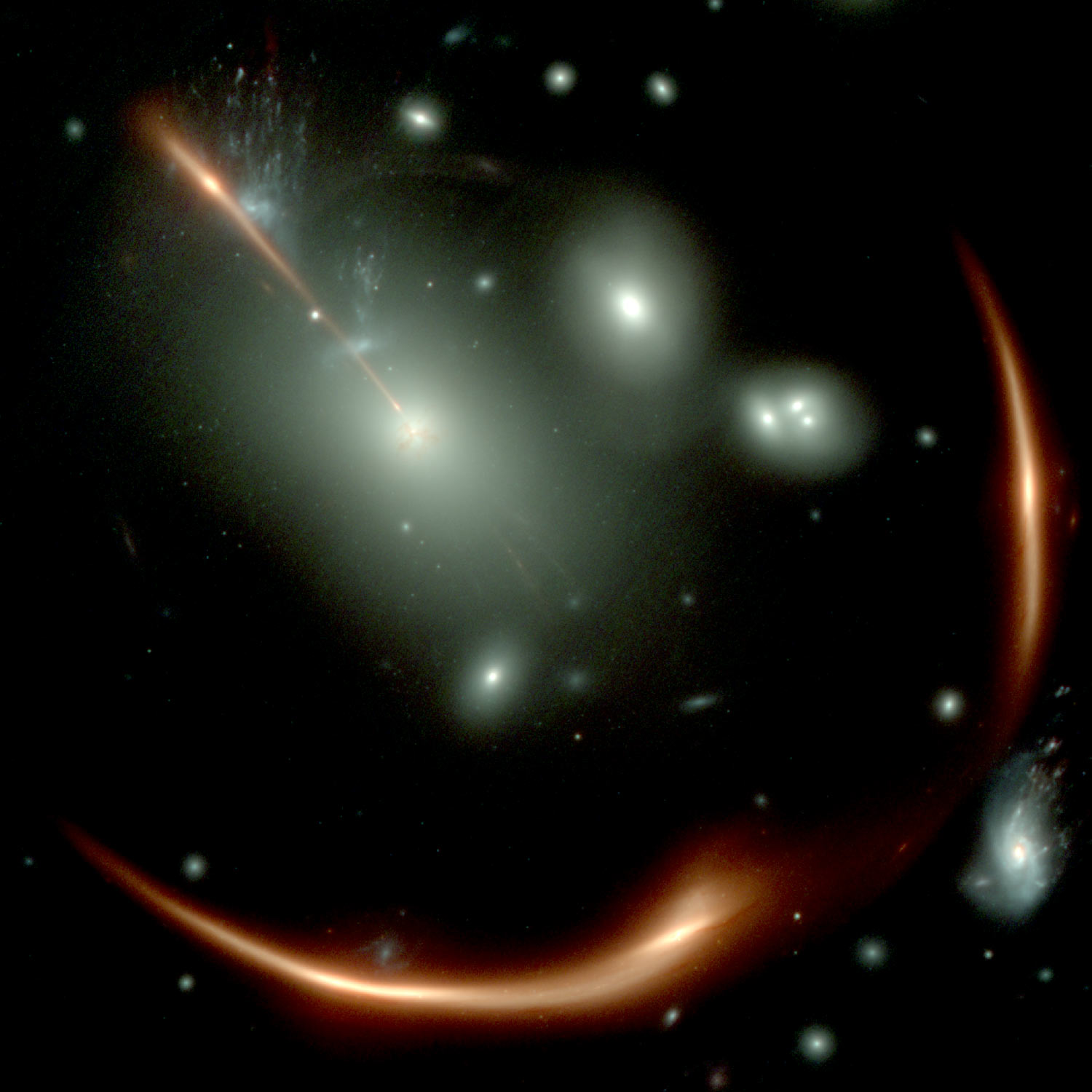
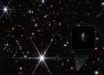
This Webb image shows the highly distorted red galaxy MRG-M0138 seen through a foreground cluster of galaxies (white sources). Image credit: NASA / ESA / CSA / Webb.
MRG-M0138 is located over 10 billion light-years away, behind a massive cluster of galaxies that magnifies and stretches its appearance.
As a result, the distant galaxy appears about 30 times larger than it normally would.
MRG-M0138 is no longer forming stars and its central black hole is also quiet.
“We were able to detect this black hole at a distance of 10 billion light years by combining Webb’s sharp vision with a natural magnifying glass,” said Dr. Andrew Newman, an astronomer at the Carnegie Institution for Science and the University of Southern California.
Dr. Newman and his colleagues observed MRG-M0138 with Webb’s NIRSpec Integral Field Spectrograph.
“By combining the Webb data with gravitational lensing, we could peer inside the black hole’s sphere of influence, where its gravity boosts the speeds of stars.”
“This is one of the best techniques we have to weigh a black hole, so we were excited to extend it to a much earlier period in cosmic history.”
“Only a handful of dormant black holes this massive have been found before, all in the nearby Universe.”
The discovery offers new clues about how black holes and galaxies grew together in the early Universe.
Nearby galaxies show close connections between the masses of their central black holes and the properties of the galaxies around them.
But it has been difficult to test whether these relationships already existed billions of years ago.
The new findings suggest that the densest galaxies were sites of rapid black hole growth early in the history of the cosmos.
Although now dormant, MRG-M0138 was probably a powerful quasar in its past.
“Determining how stars collectively move within the core of this distant galaxy has allowed us to measure the mass of its otherwise undetectable supermassive black hole,” said University College London’s Professor Richard Ellis.
“By demonstrating the feasibility of such a technique for galaxies in the early Universe, we can now undertake a more complete census of how black holes develop over time and infer their role in shaping galaxy evolution.”
The results appear in the journal Science.
_____
Andrew B. Newman et al. 2026. A stellar dynamical mass measurement of an inactive black hole at redshift 2. Science 392 (6802): 1065-1068; doi: 10.1126/science.adx5816