Using data from ESA’s Gaia mission and the NASA Exoplanet Archive, astronomers at Cornell University have identified 45 rocky exoplanets in the empirical habitable zone and 24 worlds in the narrower 3D habitable zone, offering scientists a focused guide in the search for extraterrestrial life.
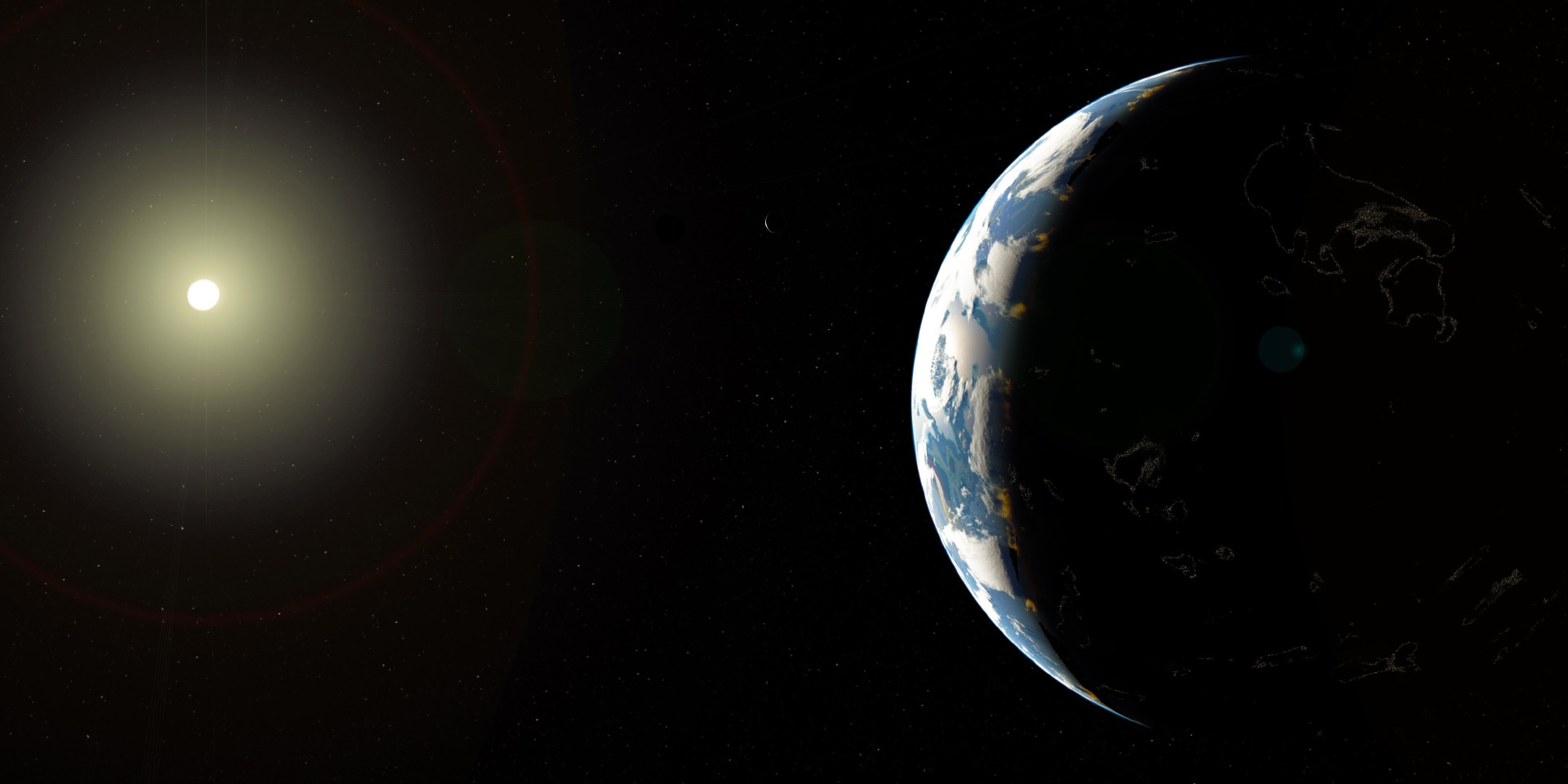
An artist’s impression of a planetary system around a slightly hotter star than our Sun. Image credit: Gillis Lowry.
“Several successful ground- and space-based searches have increased the number of known exoplanets to over 6,000,” said Cornell University’s Professor Lisa Kaltenegger and her colleagues.
“An underexplored aspect of these discoveries is that the growing number of exoplanets allows observers to build a target list that can probe the limits of the habitable zone empirically.”
In the study, the astronomers pinpointed 45 rocky worlds that may support life in the habitable zone, and another 24 in a narrower 3D habitable zone that makes a more conservative assumption of how much heat a planet can take before it loses its habitability.
They include some famous exoplanets, including Proxima Centauri b, TRAPPIST-1f and Kepler 186f, as well as others that are not as well known, such as TOI-715b.
The most interesting planets of those listed are TRAPPIST-1d, e, f and g, which are 40 light-years from Earth, as well as LHS 1140 b, which is 48 light-years away. Whether these planets could have liquid water depends in part if they can hold an atmosphere.
The worlds that get light from their stars most similar to what modern Earth receives from the Sun are the transiting planets TRAPPIST-1e, TOI-715b, Kepler-1652b, Kepler-442b, Kepler-1544b and the planets Proxima Centauri b, Gliese 1061d, Gliese 1002b, and Wolf 1069b, which make their stars wobble.
The authors also hope the planets they have identified near the edges of the habitable zone will shed light on exactly where habitability ends and if scientists’ theories about those limits are correct.
“While the idea of the habitable zone has been developed since the 1970s, new observations will be critical in establishing whether certain assumptions need adapting,” Professor Kaltenegger said.
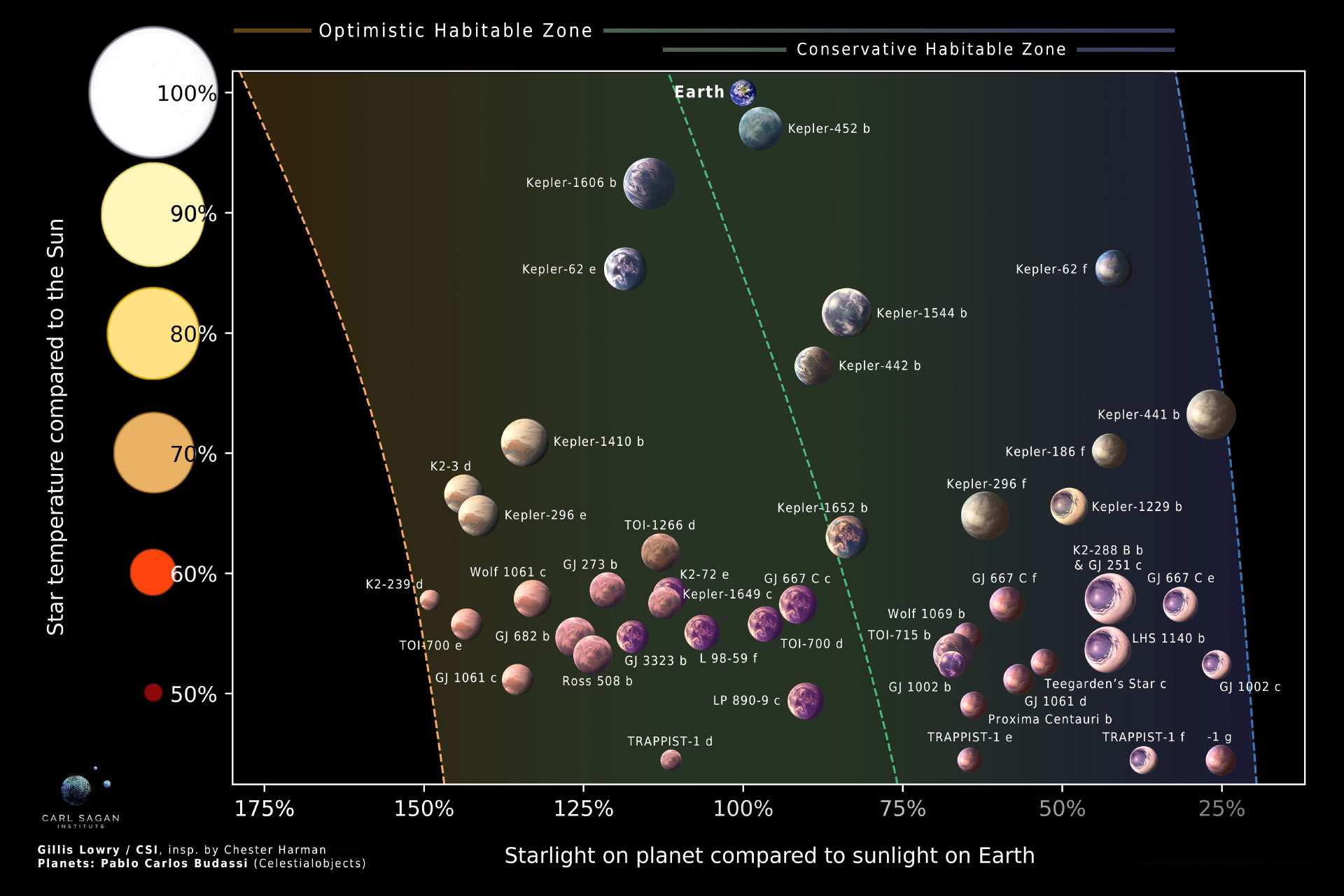
A diagram depicting habitable zone boundaries across star type with rocky exoplanets. Image credit: Gillis Lowry / Pablo Carlos Budassi.
In addition, exoplanets with unusual elliptical orbits around their star can trace the importance of a changing amount of heat hitting a world and help answer the question of whether a planet needs to stay in the habitable zone or can cross in and out of it and still remain habitable.
The transiting planets that can test the limit of habitability on the inner edge are K2-239d, TOI-700e, K2-3d, as well as the planets Wolf 1061c and Gliese 1061c, which make their stars wobble.
TRAPPIST-1g and Kepler-441b and Gliese 1002c can probe the outer edge of habitability where it gets extremely cold.
“While it’s hard to say what makes something more likely to have life, identifying where to look is the first key step — so the goal of our project was to say, Here are the best targets for observation,” said Gillis Lowry, a graduate student at San Francisco State University.
The researchers also earmarked the best planets to observe with different techniques, to give scientists the best odds of finding signs of life if they exist on these worlds.
The list they’ve created will guide astronomers studying the night sky with the NASA/ESA/CSA James Webb Space Telescope, the upcoming Nancy Grace Roman Space Telescope, the Extremely Large Telescope, the Habitable Worlds Observatory and the proposed Large Interferometer For Exoplanets (LIFE) project.
“Observing these small exoplanets is the only way to confirm if they have atmospheres, and whether astronomers need to refine their ideas of what limits the habitable zone,” Lowry said.
The team’s paper was published today in the Monthly Notices of the Royal Astronomical Society.
_____
Abigail Bohl et al. 2026. Probing the limits of habitability: a catalogue of rocky exoplanets in the habitable zone. MNRAS 547 (3): stag028; doi: 10.1093/mnras/stag028