A new close-up of the Triangulum galaxy, captured with ESO’s Very Large Telescope (VLT), traces the tangled gas and dust that shape how stars are born and how galaxies evolve.
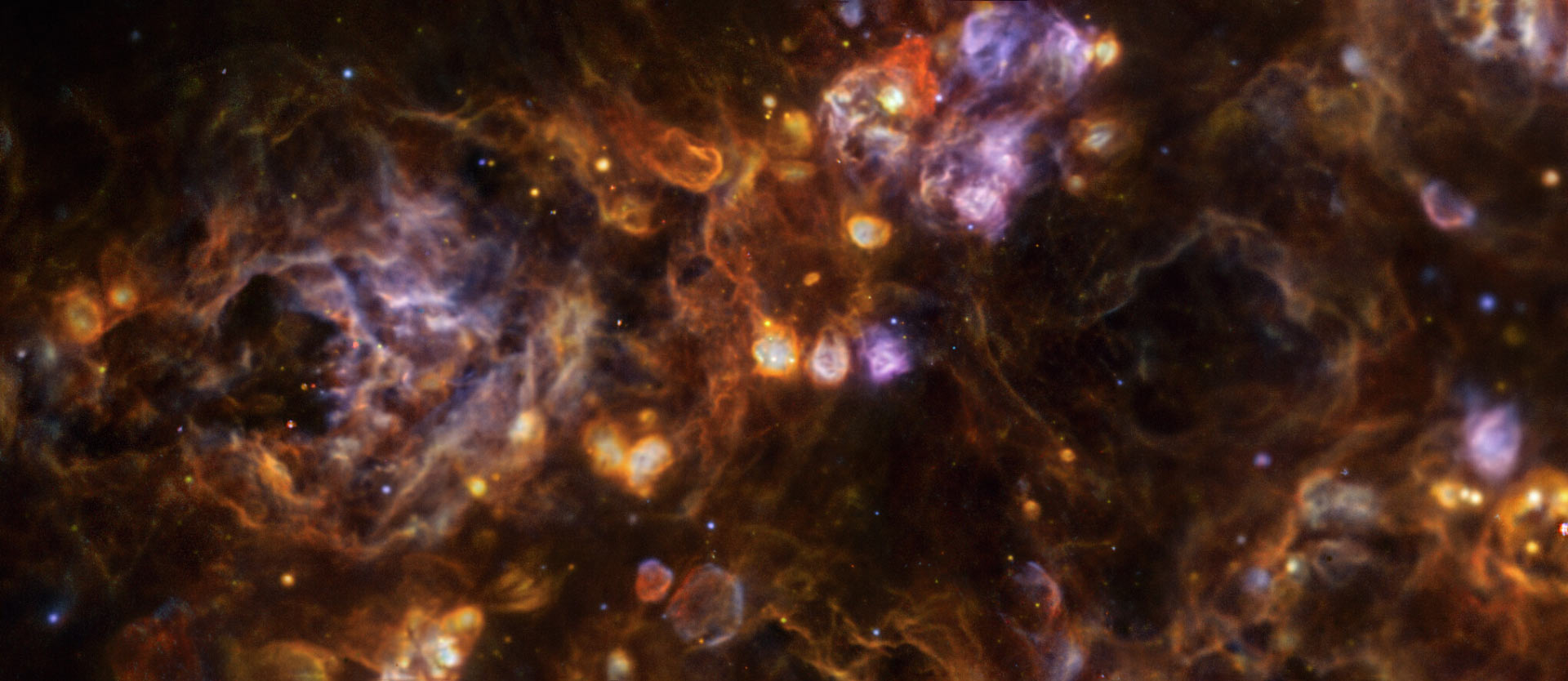
This VLT/MUSE image shows part of the Triangulum galaxy, a spiral galaxy located about 3 million light-years away in the constellation of Triangulum. Image credit: ESO / Feltre et al.
The Triangulum galaxy, also known as Messier 33 or NGC 598, is a spiral galaxy about 3 million light-years from Earth.
Visible under exceptionally dark skies as a faint, hazy patch in the constellation of Triangulum, it has long been a favorite target for astronomers.
The galaxy is one of the most prominent members of the Local Group, a gravitationally bound collection of more than 50 galaxies that includes the Milky Way and the Andromeda galaxy. It ranks as the group’s third-largest galaxy, though it is also the smallest spiral galaxy in the group.
It spans roughly 60,000 light-years, making it far smaller than Andromeda, which stretches about 200,000 light-years across. The Milky Way, by comparison, is about 100,000 light-years in diameter.
“Stars are not, as is often imagined, isolated spheres in the dark, but rather live in rich and complex environments that they actively shape,” said Dr. Anna Feltre from the INAF-Astrophysical Observatory of Arcetri and her colleagues in a statement.
“Studying this cosmic interplay tells us about how stars form, and how their radiation affects the surrounding material, which helps us to understand how galaxies evolve as a whole.”
In their study, the astronomers used data taken with the Multi Unit Spectroscopic Explorer (MUSE) instrument at VLT.
“MUSE’s superpower is its ability to break up the light into the different rainbow colors, allowing us to examine the chemical composition of the interstellar matter at every location across its whole field of view,” they said.
“The different colors of the image represent different elements: blue, green and red indicate the presence of oxygen, hydrogen and sulfur, respectively.”
“MUSE allowed us to map the distribution of many other elements, as well as their motion, key to understanding the link between stars and their surroundings.”
“This cosmic interplay produces a spectacular and dynamic landscape, revealing that the birthplaces of stars are far more beautiful and complex than we ever imagined,” Dr. Feltre concluded.
The team’s paper was published online in the journal Astronomy & Astrophysics.
_____
A. Feltre et al. 2026. M3D: Mosaicking M33 with MUSE datacubes. I. Unveiling the diversity of H II regions in M33 with MUSE. A&A 706, A367; doi: 10.1051/0004-6361/202557122