Observations from the Subaru Telescope on January 7, 2026, revealed a surprisingly low carbon dioxide-to-water ratio, suggesting the composition of the interstellar comet 3I/ATLAS changed as it heated up near the Sun.
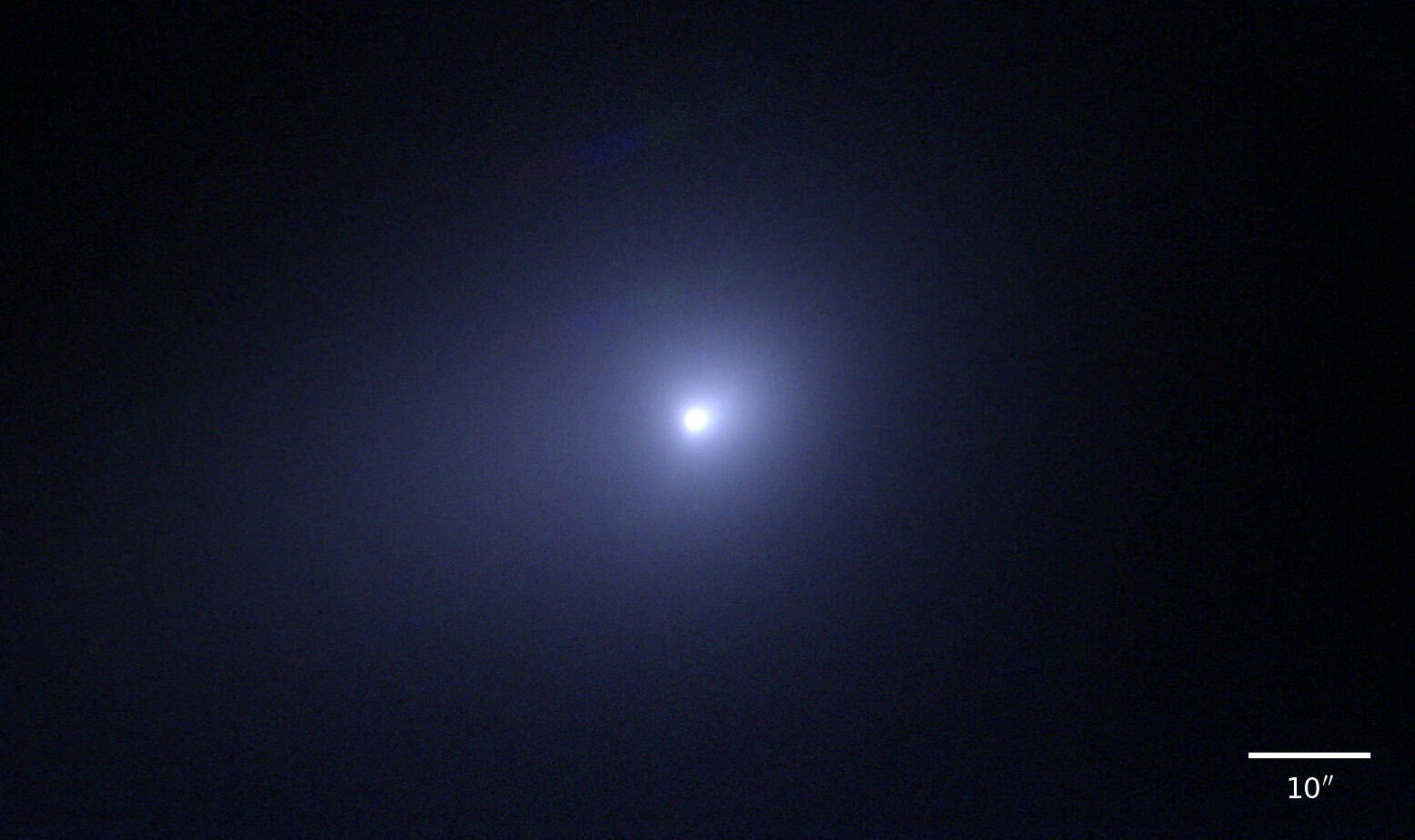
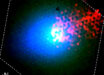
This image from the Subaru Telescope shows the interstellar comet 3I/ATLAS. Image credit: NAOJ.
3I/ATLAS was discovered by the NASA-funded ATLAS survey telescope in Rio Hurtado, Chile, on July 1, 2025.
Also known as C/2025 N1 (ATLAS) and A11pl3Z, the interstellar visitor arrived from the direction of the constellation Sagittarius.
On October 30, 2025, 3I/ATLAS reached perihelion, its closest approach to the Sun.
“Interstellar comet 3I/ATLAS is the third confirmed interstellar object,” said Koyama Space Science Institute astronomer Yoshiharu Shinnaka and colleagues from Japan.
“It provides a rare opportunity to investigate the physical and chemical properties of icy planetesimals that formed in a protoplanetary disk beyond the Solar System.”
“Since its discovery on July 1, 2025 by the Asteroid Terrestrial-impact Last Alert System (ATLAS), follow-up observations have rapidly established the presence of cometary activity and characterized the dust coma, including constraints on the nucleus size and dust distribution.”
Dr. Shinnaka and co-authors observed 3I/ATLAS with the Subaru Telescope on January 7, 2026, more than two months after perihelion.
They then applied analytical methods and expertise developed through studies of solar system comets to the data.
From this analysis, they estimated the ratio of carbon dioxide to water in the coma, the cloud of gas surrounding the comet’s nucleus.
Because the coma’s gas originates from the nucleus, its composition provides clues to the nucleus itself.
Carbon dioxide-to-water ratio calculated from the Subaru Telescope data was lower than the ratio suggested by data from the Webb and SPHEREx space telescopes.
This change is consistent with the idea that the nucleus’s interior composition differs from its exterior, and that as 3I/ATLAS heated up during its passage near the Sun, gas began escaping from different regions of the nucleus.
“With the full-scale operation of survey telescopes in the coming years, many more interstellar objects are expected to be discovered,” Dr. Shinnaka said.
“By applying the observational and analytical techniques we have developed through studies of solar system comets to interstellar objects, we can now directly compare comets hailing from both inside and outside the Solar System and explore differences in their composition and evolution.”
“Through studies of such objects, we hope to gain a deeper understanding of how planetesimals and planets formed in a wide variety of stellar systems, including our own Solar System.”
The team’s paper will be published in the Astronomical Journal.
_____
Yoshiharu Shinnaka et al. 2026. A post-perihelion constraint on the CO2/H2O ratio of interstellar comet 3I/ATLAS from [O I] forbidden lines. AJ, in press; arXiv: 2603.25002