Stellar activity and plasma turbulence could distort narrow radio signals before they leave their home planetary systems, potentially explaining part of the long silence in the search for extraterrestrial intelligence.

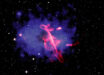
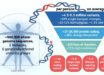
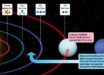
Vishal Gajjar & Grayce C. Brown report one of the first quantitative frameworks for assessing the impact of stellar environments on the detectability of narrowband technosignatures. Image credit: Sci.News.
In most technosignature searches, astronomers account for distortions that happen as radio waves travel across interstellar space.
Plasma density fluctuations in stellar winds, as well as occasional eruptive events such as coronal mass ejections, can distort radio waves near their point of origin, effectively ‘smearing’ the signal’s frequency and reducing the peak strength that search pipelines rely on.
“SETI searches are often optimized for extremely narrow signals,” said Dr. Vishal Gajjar, an astronomer at the SETI Institute.
“If a signal gets broadened by its own star’s environment, it can slip below our detection thresholds, even if it’s there, potentially helping explain some of the radio silence we’ve seen in technosignature searches.”
To quantify the effect, Dr. Vishal Gajjar and his colleague, Dr. Grayce Brown, built on something we can measure directly: radio transmissions from spacecraft in our Solar System.
Using empirical measurements from solar system probes, they calibrated how turbulent plasma broadens narrowband signals and then extrapolated those measurements to a wide range of stellar environments.
The result is a practical framework for estimating how much broadening could occur for different types of stars and observing frequencies — especially in the ‘space weather’ conditions expected around active stars.
The work points to a strong implication for target selection and search design.
M-dwarf stars, which constitute about 75% of stars in the Milky Way, have the highest likelihood that any narrowband signals will get broadened before leaving the system.
The astronomers argue that this motivates search strategies that remain sensitive even when signals are not perfectly razor-thin.
“By quantifying how stellar activity can reshape narrowband signals, we can design searches that are better matched to what actually arrives at Earth, not just what might be transmitted,” Dr. Brown said.
The team’s work was published March 5 in the Astrophysical Journal.
_____
Vishal Gajjar & Grayce C. Brown. 2026. Exo-IPM Scattering as a Hidden Gatekeeper of Narrowband Technosignatures. ApJ 999, 201; doi: 10.3847/1538-4357/ae3d33