Paleontologists have identified a new, giant species of the mosasaur genus Pluridens from the Late Cretaceous phosphate deposits of Morocco. Named Pluridens imelaki, the species belonged to a group of relatively slender-jawed mosasaurs and may have reached more than 9 m (29.5 feet) in length.
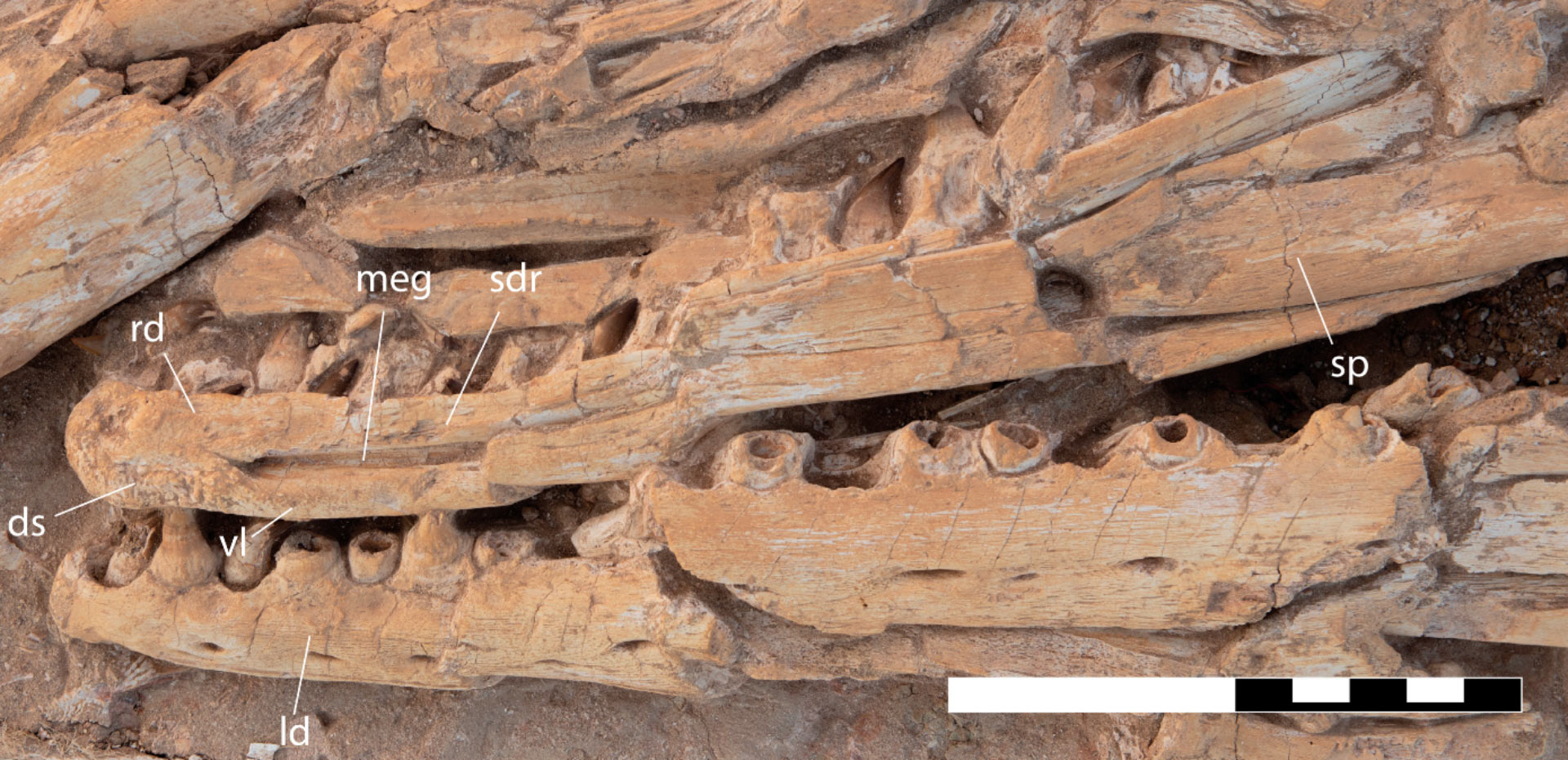
Pluridens imelaki, holotype, close-up of the dentaries. Scale bar – 10 cm. Image credit: Nicholas R. Longrich & Nour-Eddine Jalil, doi: 10.3390/d18030159.
Pluridens imelaki lived in the oceans during the latest Maastrichtian stage of the Cretaceous period, roughly 66-67 million years ago.
The species belonged to the Halisaurinae, a subfamily generally considered smaller than many other mosasaurs.
Earlier members ranged from about 4-5 m (13-16.4 feet) in length in species such as Halisaurus, to roughly 7.5 m (24.6 feet) in the related species Pluridens serpentis.
Pluridens imelaki had a body length exceeding 9 m, making the animal comparable in size to some of the largest predatory mosasaurs known from the region.
“The Late Cretaceous witnessed a major radiation of the Mosasauridae, a specialized clade of large marine squamates, which became the dominant marine predators during the final 25 million years of the period,” said University of Bath’s Dr. Nicholas Longrich and Dr. Nour-Eddine Jalil from the Muséum National d’Histoire Naturelle in Paris, France, and the Muséum d’Histoire Naturelle de Marrakech.
“The most diverse known mosasaurid assemblage, and possibly the most diverse marine reptile fauna in the world, comes from the Late Maastrichtian phosphatic beds of Morocco.”
“Many new species have been described in recent years, and more than 16 species have now been reported.”
“All four major mosasaurid subfamilies are represented in the phosphates: Mosasaurinae, Plioplatecarpini, Tylosaurinae, and Halisaurinae, and the basal mosasauroid Pachyvaranus.”
“Although Mosasaurinae contribute most of the species diversity, Halisaurinae are particularly abundant in the phosphates and were also common across Africa during the Cretaceous.”
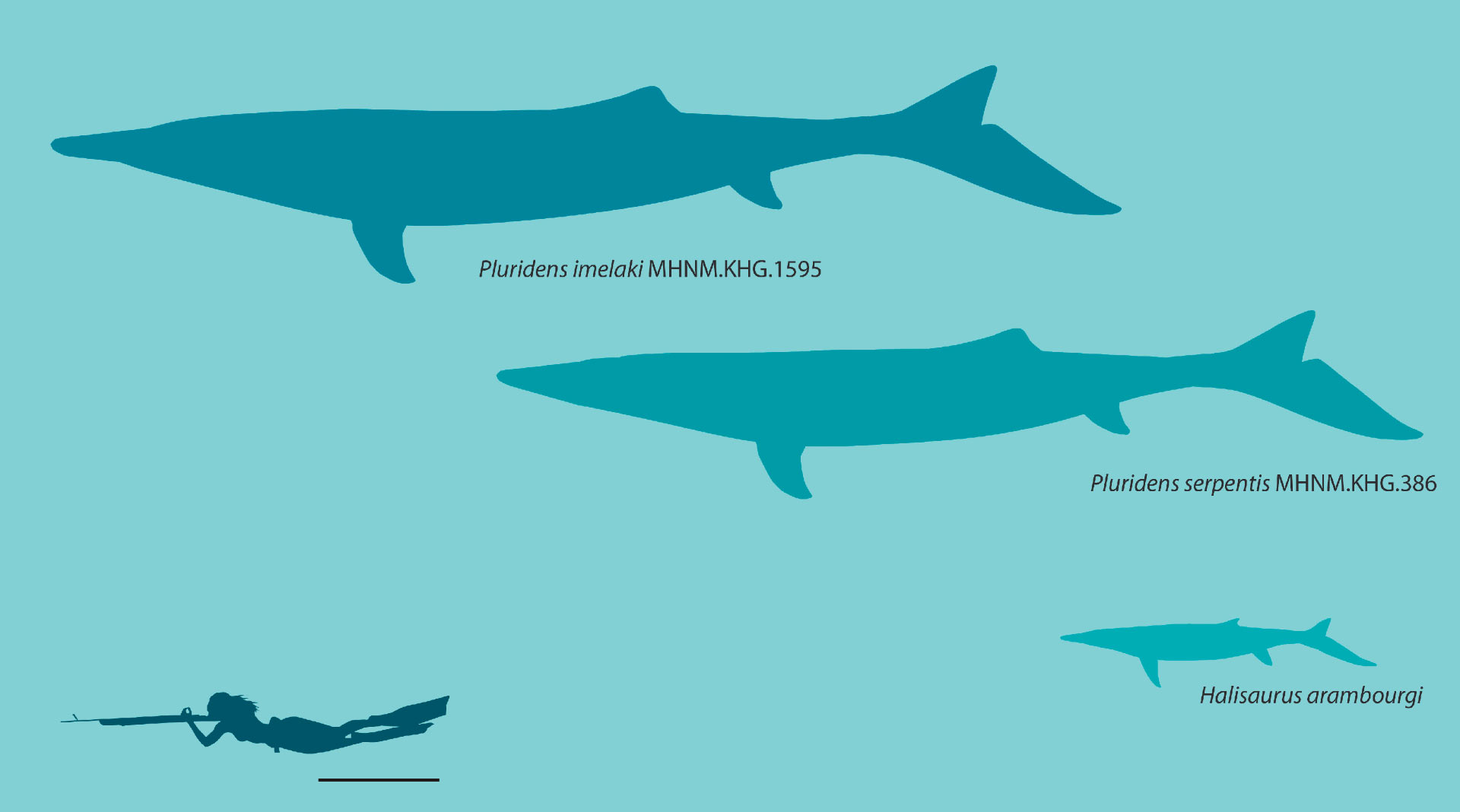
Relative size of Pluridens imelaki, Pluridens serpentis, and Halisaurus arambourgi, all from the latest Maastrichtian-aged phosphates of Morocco. Scale bar – 1 m. Image credit: Nicholas R. Longrich & Nour-Eddine Jalil, doi: 10.3390/d18030159.
The 1.25-m- (4.1-foot-) long skull and associated lower jaws of Pluridens imelaki were found in the phosphate beds of Couche III at Sidi Chennane in Morocco’s Khouribga province.
“The phosphate beds represent a marine upwelling zone, which was laid down in a shallow marine embayment along the eastern margin of the Atlantic between the Late Maastrichtian and the Early Eocene,” the paleontologist said.
“They are part of a large series of phosphate beds that accumulated along the margin of the Tethys and the eastern Atlantic during the Late Cretaceous and Early Paleogene.”
Comparisons with other species suggest that Pluridens imelaki likely had a different feeding strategy than closely related mosasaurs.
Differences in jaw structure, tooth shape, and eye size indicate that the species occupied a distinct ecological niche in the end-Cretaceous marine ecosystem.
“Pluridens imelaki reveals that Halisaurinae were not only more species-rich than previously recognized, but also exhibited greater diversity in tooth morphology, jaw shape, and body size than previously thought,” the researchers concluded.
“Rather than simply being outcompeted by Mosasaurinae, the Halisaurinae staged a minor adaptive radiation in the Late Cretaceous and were important members of the ecosystem in low latitudes.”
The discovery of Pluridens imelaki was described in a paper published this week in the journal Diversity.
_____
Nicholas R. Longrich & Nour-Eddine Jalil. 2026. A Giant Halisaurine from the Late Maastrichtian of Morocco. Diversity 18 (3): 159; doi: 10.3390/d18030159