Astrophysicists from the University of Illinois and the University of Chicago have developed an innovative method to measure the Hubble constant — the rate at which the Universe is expanding — using the subtle background hum of gravitational waves. As gravitational-wave detectors become more sensitive in the coming years, this approach could reshape our understanding of cosmic history and help resolve a central debate in modern astrophysics.
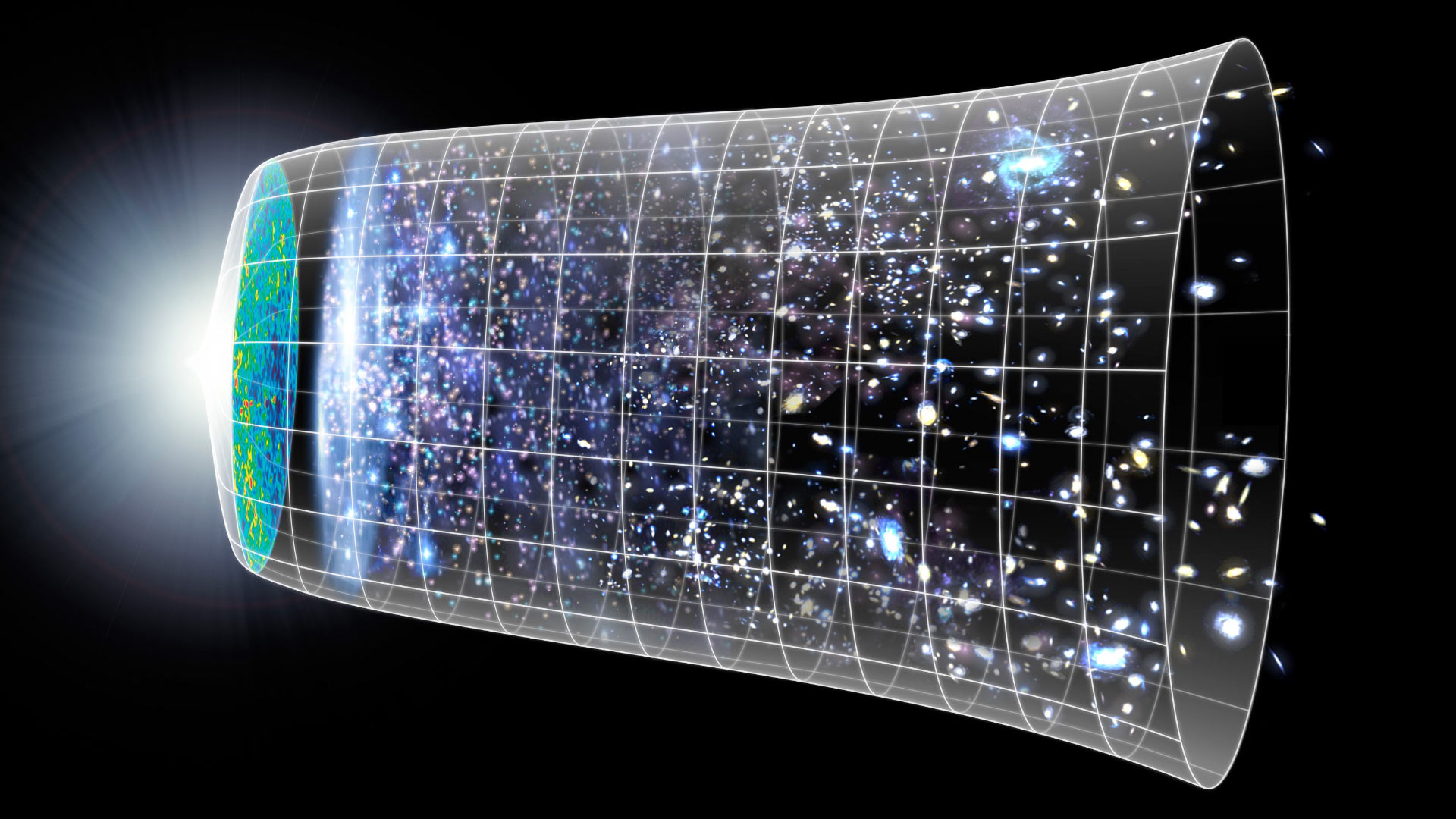
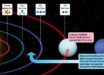
Schematic of the expansion of the Universe from the Big Bang to the present day. Image credit: NASA / EFBrazil.
“This result is very significant — it’s important to obtain an independent measurement of the Hubble constant to resolve the current Hubble tension,” said University of Illinois Professor Nicolás Yunes.
“Our method is an innovative way to enhance the accuracy of Hubble constant inferences using gravitational waves.”
Professor Yunes and his colleagues propose a gravitational-wave-based technique that leverages faint ‘background hum’ from countless distant black hole collisions to refine estimates of the Hubble constant.
Unlike traditional methods, this new approach taps into ripples in spacetime itself — gravitational waves — which carry information about vast distances and the rate at which objects are moving apart.
The astrophysicists refer to this as the ‘stochastic siren’ method.
“Because we are observing individual black hole collisions, we can determine the rates of those collisions happening across the Universe,” said University of Illinois graduate student Bryce Cousins.
“Based on those rates, we expect there to be a lot more events that we can’t observe, which is called the gravitational-wave background.”
“It’s not every day that you come up with an entirely new tool for cosmology,” added University of Chicago Professor Daniel Holz.
“We show that by using the background gravitational-wave hum from merging black holes in distant galaxies, we can learn about the age and composition of the Universe.”
“This is an exciting and completely new direction, and we look forward to applying our methods to future datasets to help constrain the Hubble constant, as well as other key cosmological quantities.”
As gravitational wave detectors become more sensitive in the coming years, the stochastic siren method could become a cornerstone of precision cosmology.
The gravitational-wave background is expected to be detected within the next six years.
Until that point, the method would constrain incrementally higher values of the Hubble constant as the upper limits on the background improve, providing another probe of the Hubble tension even without a full detection.
“This should pave the way for applying this method in the future as we continue to increase the sensitivity, better constrain the gravitational-wave background, and maybe even detect it,” Cousins said.
“By including that information, we expect to get better cosmological results and be closer to resolving the Hubble tension.”
The team’s work will be published in the journal Physical Review Letters.
_____
Bryce Cousins et al. 2026. Stochastic Siren: Astrophysical gravitational-wave background measurements of the Hubble constant. Phys. Rev. Lett, in press; doi: 10.1103/4lzh-bm7y