Using a vast catalog of Sun-like stars built by ESA’s Gaia mission, astronomers have found strong evidence that our home star traveled outward with thousands of stellar counterparts roughly 4 to 6 billion years ago, offering new clues to the formation of the Milky Way’s central bar.
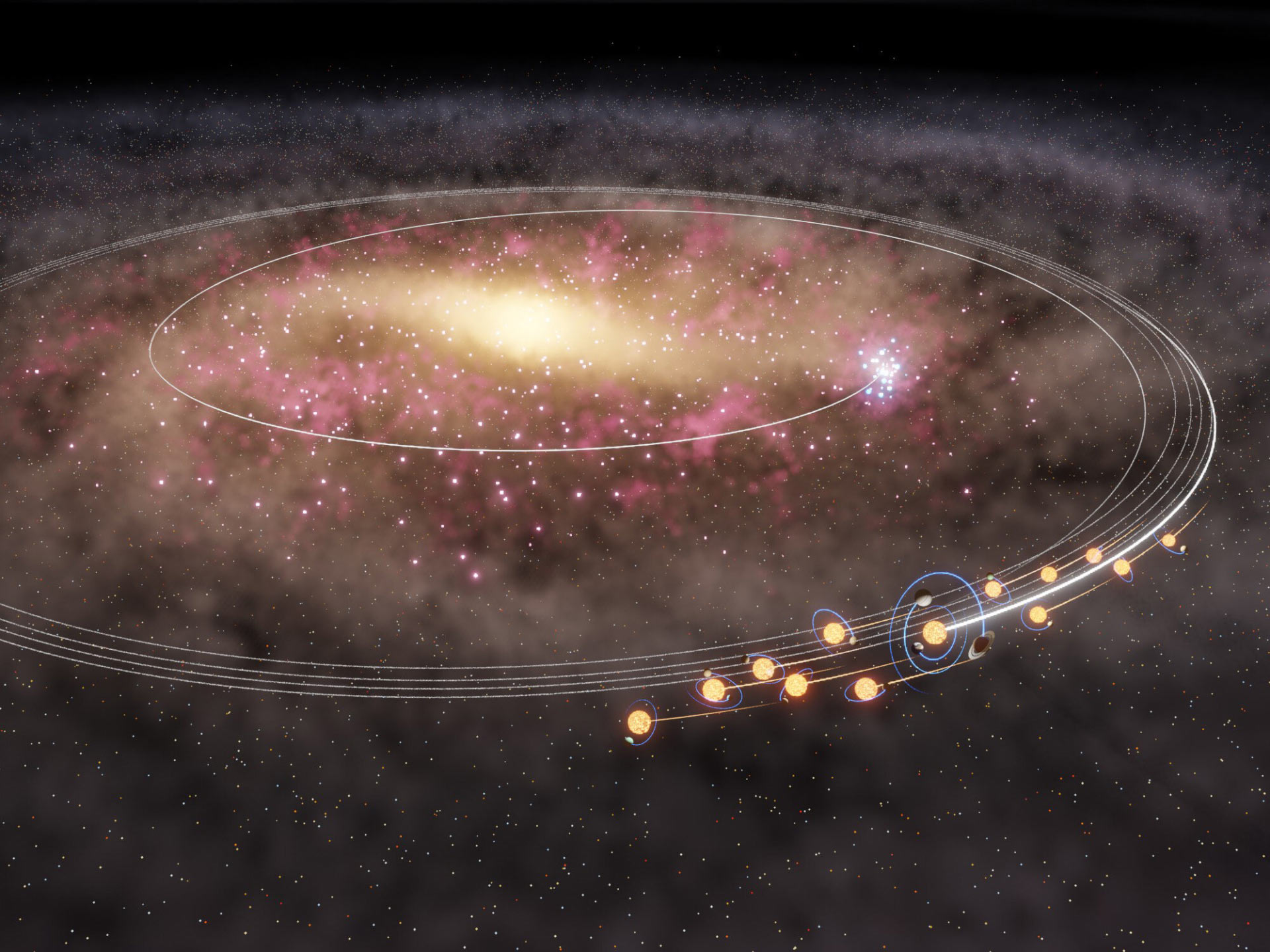
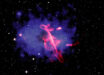
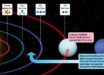
An artist’s impression of a migration of the Sun and its stellar twins from the center of the Milky Way approximately 4 to 6 billion years ago. Image credit: NAOJ.
“While archaeology on Earth studies the human past, galactic archaeology traces the vast journey of stars and galaxies,” said Tokyo Metropolitan University astronomer Daisuke Taniguchi and colleagues.
“For example, we know that our Sun was born around 4.6 billion years ago, more than 10,000 light-years closer to the center of the Milky Way than we are today.”
“While studies of the composition of stars support this theory, this has long proven a conundrum to scientists.”
“Observations reveal an enormous bar-like structure at our Galactic center which creates a corotation barrier, which makes it difficult for stars to escape so far from the center.”
In their research, the authors aimed to build a large catalog of solar twins, stars whose stellar parameters are very close to those of the Sun.
“Solar twins are defined as stars with stellar parameters (i.e., effective temperature, surface gravity, and metallicity) very close to those of the Sun,” they said.
“By performing differential analyses between stars with very similar stellar parameters — solar twins in our case — one can achieve an extremely high accuracy in the measurements of stellar parameters and chemical abundances.”
The astronomers used data gathered by ESA’s Gaia satellite, a daunting trove of observations from two billion stars and other objects.
They created a catalogue of 6,594 solar twins, a collection around 30 times larger than previous surveys.
From this immense list, they were able to obtain the most accurate picture to date of the ages of these stars, carefully correcting for selection bias of stars which are easier to see.
Looking at the distribution of ages, they noticed a broad peak for stars around 4 to 6 billion years old: this includes our Sun, and is evidence for similar stars of similar age, positioned around the same distance from the center of our Galaxy.
This means that our Sun is not at its current position by accident, but as part of a much larger stellar migration.
The discovery sheds light not only on the nature of our Solar System, but the evolution of the Milky Way itself.
“The corotation barrier created by the bar structure at the Galactic center would not allow for such a mass event,” the researchers said.
“However, the story changes if it was still being formed at the time.”
“The ages of our solar twins reveal not only when the mass escape occurred, but the time range over which the bar was formed.”
“The center of the Galaxy is a far less hospitable environment for the evolution of life than outer regions.”
“Our findings thus illuminate a key factor in how our Solar System, and in turn our planet, found itself in a region of the Galaxy where organisms could develop and evolve.”
The results were published March 12, 2026 in the journal Astronomy & Astrophysics.
_____
Daisuke Taniguchi et al. 2026. Solar twins in Gaia DR3 GSP-Spec. I. Building a large catalog of solar twins with ages. A&A 707, A260; doi: 10.1051/0004-6361/202658913