An unusual flickering of a young F-type star called Gaia20ehk and an expanding cloud of dust around it suggest that a catastrophic planetary crash unfolded in real time, offering a rare glimpse of the violent processes that can shape young planetary systems.
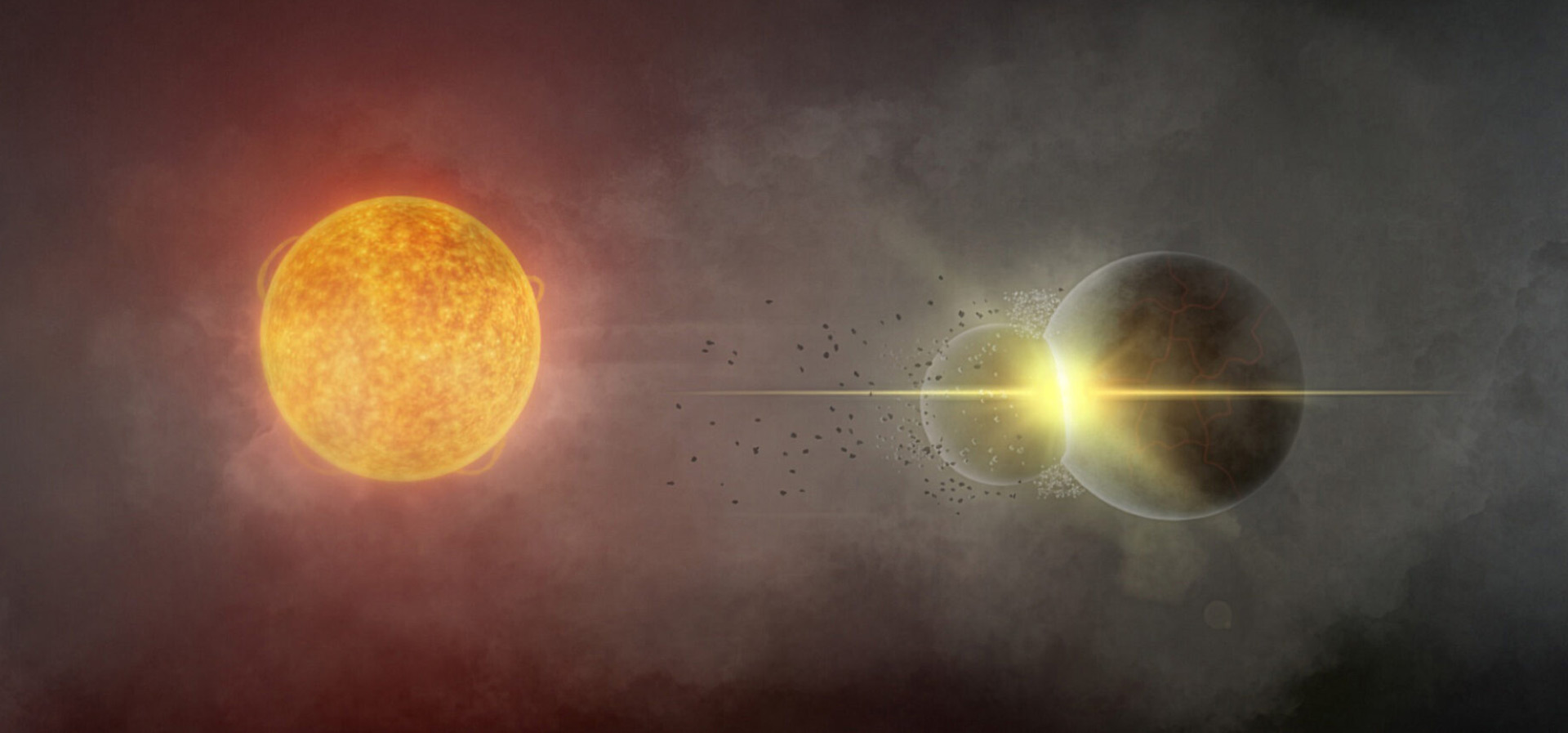
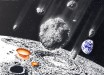
A planetary collision around star Gaia20ehk. Image credit: Andy Tzanidakis.
Gaia20ehk is located approximately 11,000 light-years from Earth in the constellation of Pupis.
It is a stable ‘main sequence’ star, which means that it should emit steady, predictable light. Yet in 2016, this star began to flicker wildly.
“The star’s light output was nice and flat, but starting in 2016 it had these three dips in brightness,” said Anastasios (Andy) Tzanidakis, a doctoral candidate at the University of Washington.
“And then, right around 2021, it went completely bonkers.”
“I can’t emphasize enough that stars like our Sun don’t do that. So when we saw this one, we were like Hello, what’s going on here?”
The cause of Gaia20ehk’s flickering had nothing to do with the star itself: huge quantities of rocks and dust — seemingly from out of nowhere — were passing in front of the distant star as the material orbited the system, patchily dimming the light that reached Earth.
The likely source of all that debris was even more remarkable: a catastrophic collision between two planets.
“It’s incredible that various telescopes caught this impact in real time,” Tzanidakis said.
“There are only a few other planetary collisions of any kind on record, and none that bear so many similarities to the impact that created the Earth and the Moon.”
“If we can observe more moments like this elsewhere in the Galaxy, it will teach us lots about the formation of our world.”
There are also clues that the collision resembles the one that created the Earth and the Moon about 4.5 billion years ago.
The dust cloud is orbiting Gaia20ehk at roughly one astronomical unit, the same distance from the Sun to the Earth.
At that distance, the material could eventually cool down enough to solidify into something similar to our Earth-Moon system.
“How rare is the event that created the Earth and the Moon? That question is fundamental to astrobiology,” said University of Washington’s Professor James Davenport.
“It seems like the Moon is one of the magical ingredients that makes the Earth a good place for life.”
“It can help shield Earth from some asteroids, it produces ocean tides and weather that allow chemistry and biology to mix globally, and it may even play a role in driving tectonic plate activity.”
“Right now, we don’t know how common these dynamics are. But if we catch more of these collisions, we’ll start to figure it out.”
The team’s paper appears today in the Astrophysical Journal Letters.
_____
Anastasios Tzanidakis & James R. A. Davenport. 2026. Gaia-GIC-1: An Evolving Catastrophic Planetesimal Collision Candidate. ApJL 1000, L5; doi: 10.3847/2041-8213/ae3ddc