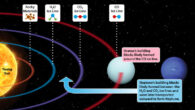
Uranus and Neptune are often described as near-twins, but a new study suggests their chemistry, and possibly their histories, may differ more than expected.
The...
Dr. Stephen Kane from the University of California, Riverside and colleagues offer a tidy explanation for one of the Solar System’s enduring puzzles:...
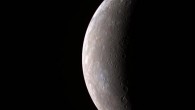
The Solar System’s smallest planet has contracted by nearly 19 km (12 miles) across, as crater debris masked telltale wrinkles on its surface, according...
For the first time, astronomers combined Hubble and Webb space telescopes to hunt down some of the smallest, faintest objects ever spotted in the outer...
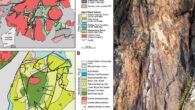
Zircon crystals and impact-altered minerals show that a massive asteroid slammed into what is now the Pilbara region of Western Australia about 3 billion...
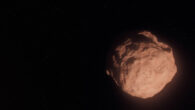
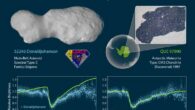
The main-belt asteroid Donaldjohanson, a heavily cratered fragment born from a catastrophic breakup 155 million years ago, appears to wobble through space...
Planetary scientists analyzing a lunar meteorite known as Northwest Africa (NWA) 12593 have uncovered evidence of an asteroid impact that occurred 3.5...
The Northwest Africa (NWA) 12774, an angrite meteorite discovered in the Sahara Desert, likely in Mauritania, appears to be a fragment of a vanished protoplanet,...
The Jovian system has four large moons, including the largest moon in the Solar System, Ganymede, whereas the Saturnian system is dominated by one giant...
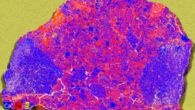
A new nanoscale analysis of the Bennu sample OREX-800066-3 returned by NASA’s OSIRIS-REx mission shows that organic compounds and minerals cluster into...
A new analysis of isotopic signatures across planets and meteorite parent bodies suggests our home world formed entirely from inner solar system material,...
Using a vast catalog of Sun-like stars built by ESA’s Gaia mission, astronomers have found strong evidence that our home star traveled outward with thousands...
The Moon formed from a giant impact of the proto-Earth with the ancient protoplanet Theia. In a new study, a team of scientists from the United States,...
The leading hypotheses for the origin of the Moon call for a giant impact event between proto-Earth and a separate impactor called Theia. The efficiency...
The first bodies to form in the Solar System acquired their materials from stars, the presolar molecular cloud and the protoplanetary disk. Asteroids that...